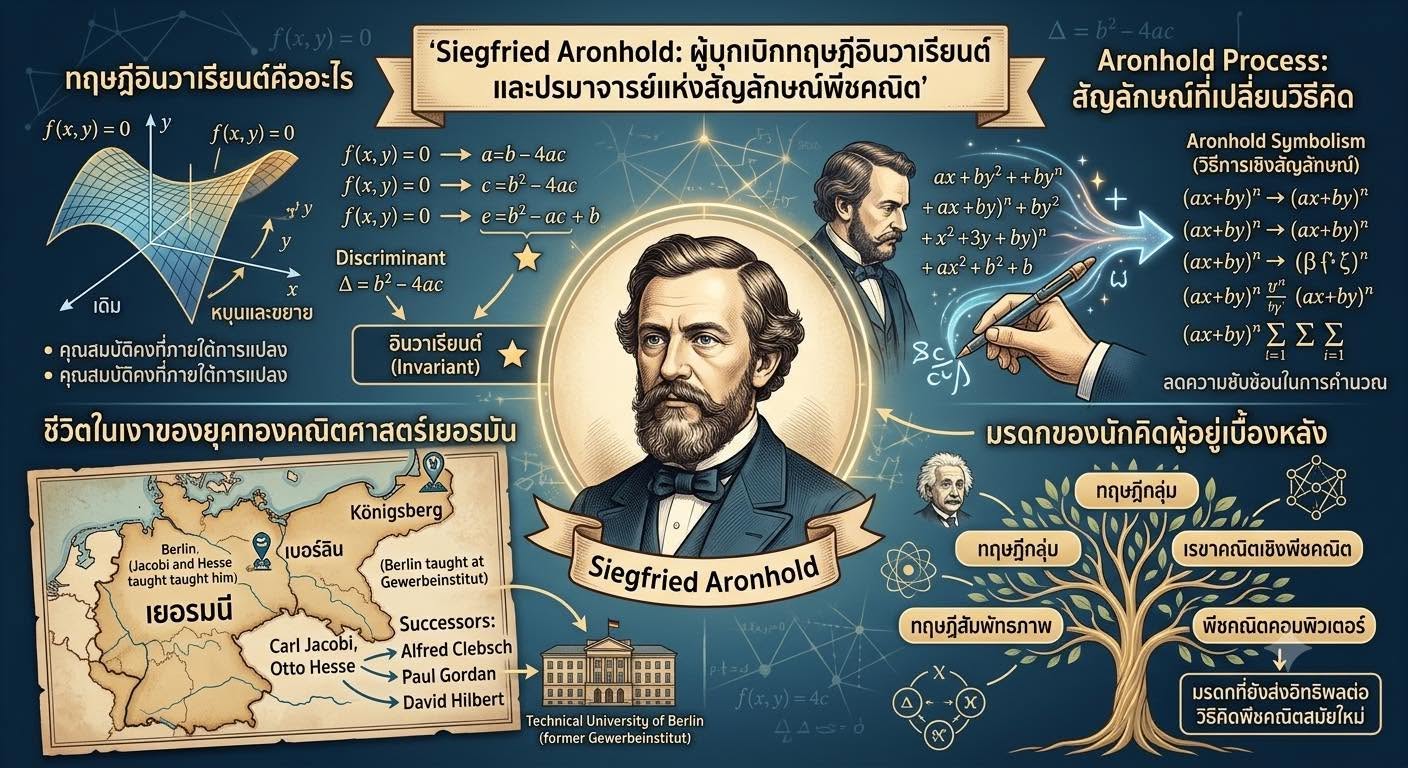
Siegfried Aronhold: Pioneer of invariant theory and master of symbolic algebra.
If Plooker coordinates were a new language for describing straight lines in space, Siegfried Aronhold invented another language to deal with an equally complex problem: the question of which properties of a polynomial remain "unchanged" when transformed. This question is at the heart of Invariant Theory, a field in which Aronhold was one of the most important pioneers in the 19th century.
Life in the Shadow of the Golden Age of German Mathematics
Siegfried Heinrich Aronhold was born in 1819 in Angerburg, Prussia (now in Poland). He studied at the University of Königsberg, which at that time was one of the major centers of mathematics in Europe. There he was influenced by leading mathematicians such as Carl Gustav Jacob Jacobi and Otto Hesse, important figures in algebra and algebraic geometry of their time.
Aronhold spent most of his working life in Berlin, teaching at the Gewerbeinstitut (which later became part of the Technical University of Berlin). Although he did not hold the same prominent academic position as many of his contemporary mathematicians, his intellectual work had a profound influence on the field of algebra.
What is Invariant Theory?
Imagine a polynomial equation, such as the equation of a curve or surface in geometry. If we change the coordinate system that describes that equation (e.g., rotate the axes or scale), the coefficients of the polynomial will change accordingly. However, some fundamental geometric properties of the curve, such as the number of intersection points or singularity, will remain unchanged.
Algebraic quantities that remain "constant" even after being transformed by these coordinate systems are called invariants. The systematic study of how these invariants form, are calculated, and how they are related is the heart of invariant theory, which became a major branch of algebra in the 19th century, developed by legendary mathematicians such as Arthur Cayley and James Joseph Sylvester in England.
Aronhold Process: A Symbol That Changes the Way We Think
The biggest problem with early invariant theory was the computational difficulty. Writing out polynomials with multiple variables and high degrees in full form, and then trying to find the invariant manually, was an incredibly complex and error-prone task.
Aronhold invented a method called Aronhold Symbolism (or Aronhold Process), a symbolic method that uses symbolic techniques to represent high-degree polynomials concisely by writing the polynomial in its power form using repetitive linear expressions and then applying symbolic operations on these auxiliary variables instead of directly calculating all the coefficients.
This method made finding the invariants and covariants of complex polynomials a much more organized and computationally efficient process. Instead of directly dealing with tens or hundreds of coefficients, mathematicians could work through much more concise symbols. This method was widely accepted and further used by great German mathematicians such as... Alfred Clebsch and Paul Gordan This symbol was further developed to become a standard tool in classical Invariant theory.
From classical algebra to modern mathematics and physics.
Although classical invariant theory in the style of Aronhold was gradually replaced by more abstract approaches in the early 20th century, especially after the work of David Hilbert who elegantly proved fundamental theorems about invariants using abstract algebra, the concept of invariant itself never disappeared.
Conversely, the concept of invariance under transformation has become one of the pillars of modern mathematics and physics. Ranging from group theory and algebraic geometry to Einstein's theory of relativity, it relies at its core on the notion of quantities that remain constant under coordinate transformations. Furthermore, the symbolic techniques pioneered by Aronhold are reflected in the methodology of modern computer algebra, which must handle complex algebraic expressions using highly structured symbolic systems.
The legacy of the thinkers behind it.
Siegfried Aronhold died in 1884, and while his name may not be as widely known as that of legendary contemporary mathematicians like Cayley or Sylvester, the symbolic techniques he laid the foundation for became crucial tools in the rapid growth of invariant theory in the latter half of the 19th century and continue to influence symbolic thinking in modern algebra to this day.
Aronhold's story reminds us that sometimes the greatest mathematical advances don't come solely from the discovery of new theorems, but from the invention of new "language" or "symbols" that allow us to see and manipulate complexities that once seemed impossible.