Remembering Giuseppe Veronese: The Pioneer of Geometry in Higher-Dimensional Spaces
Giuseppe Veronese was an Italian mathematician who pioneered projective geometry in n-dimensional spaces and introduced the concept of non-Archimedean continua, an idea far ahead of his time. On this occasion, we look back on the life of a thinker who rose from poverty in a small fishing village to become one of the key figures who helped lay the foundations of modern geometry.
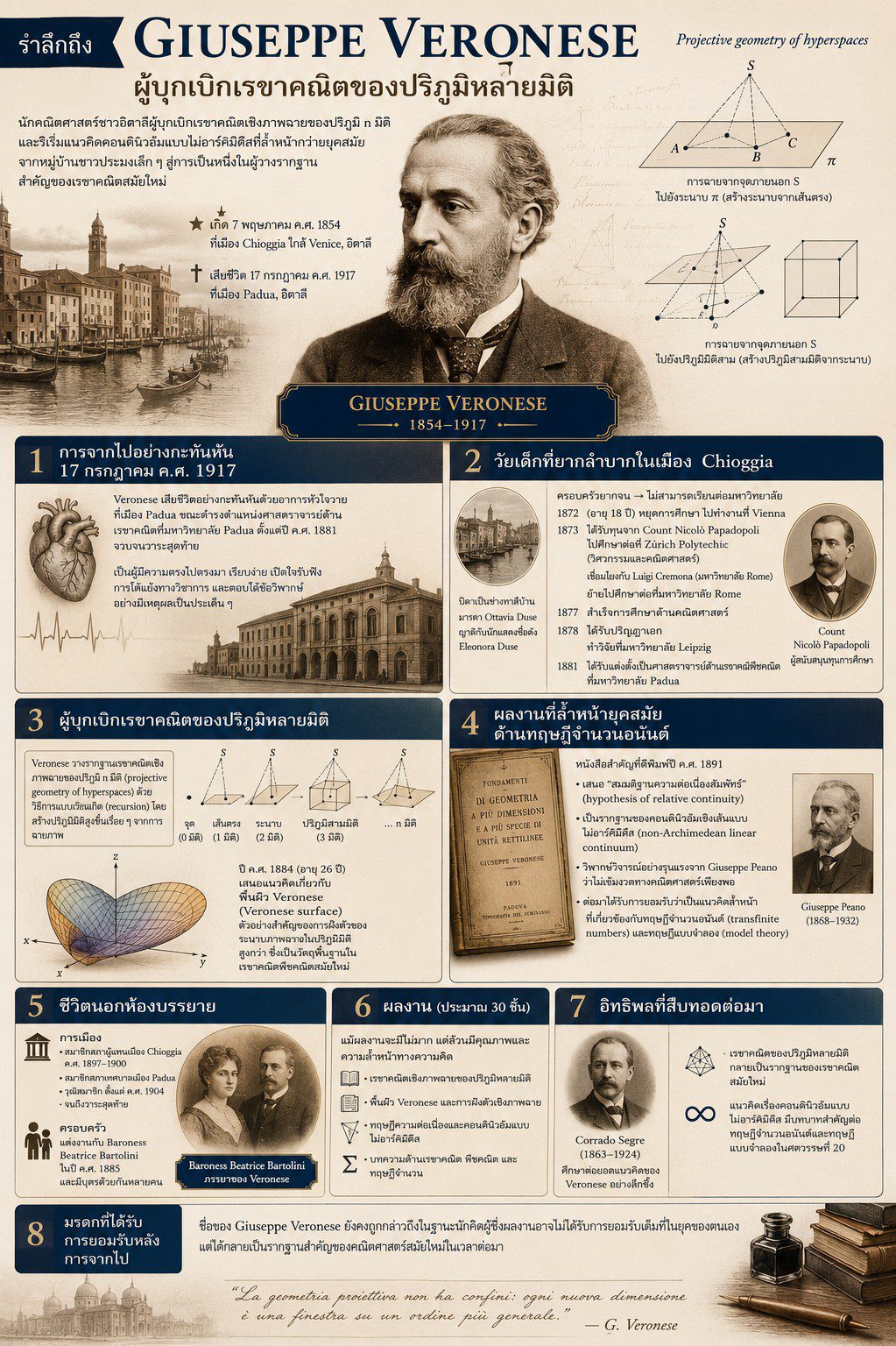
His Sudden Passing: July 17, 1917
Giuseppe Veronese died suddenly of a heart attack in Padua on July 17, 1917, while he was still serving as a professor of geometry at the University of Padua, a position he had held since 1881 until the final days of his life. Those who knew him described him as a straightforward and humble person, always open to listening to academic debates and willing to respond to criticism point by point with careful reasoning and logic.
His passing marked the end of the life of a scholar who, despite facing intense academic controversies throughout his career, saw his work become increasingly recognized and appreciated in the years that followed.
A Difficult Childhood in the City of Chioggia
Giuseppe Veronese was born on May 7, 1854, in the town of Chioggia, a small fishing village near Venice. His father was a house painter, while his mother, Ottavia Duse, was a relative of Eleonora Duse, a famous Italian actress. His family was poor and could not afford to support his university education. In 1872, at the age of only 18, Veronese was forced to leave his studies and went to work in Vienna.
Fortunately, in the following year, he received support from Count Nicolò Papadopoli, a patron who provided him with a scholarship that allowed him to resume his studies at Zürich Polytechnic in a program combining engineering and mathematics. During this period, he began corresponding with the renowned mathematician Luigi Cremona of the University of Rome on mathematical topics. He later transferred to the University of Rome, where he completed his studies in mathematics in 1877 and earned his doctoral degree the following year. Afterwards, he conducted further research at the University of Leipzig before being appointed professor of algebraic geometry at the University of Padua in 1881.
The Pioneer of Geometry in Higher-Dimensional Spaces
The Pioneer of Geometry in Higher-Dimensional Spaces Veronese’s most important contribution was laying the foundations of projective geometry of n-dimensional spaces. Before his work, the concept of higher-dimensional spaces was often presented mainly through linear algebraic formulations described only in geometric language. Veronese was among the first to make higher-dimensional spaces into a truly geometric subject, using a recursive method that constructed spaces of increasingly higher dimensions through projection. This was analogous to how a plane can be constructed by projecting points on a line from an external point, or how three-dimensional space can be constructed by projecting points on a plane from an external point.
In 1884, at the age of only 26, he introduced the concept of what is now known as the Veronese surface, an important example of embedding a projective plane into a higher-dimensional space. It later became a fundamental object in modern algebraic geometry and remains important to this day.
His Ahead-of-His-Time Work on the Theory of Infinite Numbers
In addition to his work on higher-dimensional geometry, Veronese’s most famous contribution was his book Fondamenti di geometria a più dimensioni e a più specie di unità rettilinee, published in 1891. In this work, he proposed the concept of the “hypothesis of relative continuity”, which became a foundation for what later came to be known as the non-Archimedean linear continuum. This idea was far ahead of its time and represented a bold attempt to expand the traditional foundations of geometry and the concept of continuous quantities.
This idea was strongly criticized by the renowned mathematician Giuseppe Peano, who argued that it lacked sufficient mathematical rigor. However, as time passed, the mathematical community came to recognize that Veronese’s work was far more significant than initially believed. Today, he is regarded as a pioneer of several ideas that later became important parts of the theory of transfinite numbers and model theory.
Life Beyond the Lecture Hall
Veronese did not limit his role solely to the academic world. He was also actively involved in politics, serving as a member of parliament representing the city of Chioggia from 1897 to 1900. He later became a member of the Padua municipal council and eventually was appointed as a senator in 1904, a position he held until the end of his life. In his personal life, he married Baroness Beatrice Bartolini in 1885, and they had several children together.
A Legacy Recognized After His Passing
Although Veronese published only around 30 works throughout his career, a relatively small number compared with other mathematicians of his era, the quality and originality of his ideas had a lasting influence long after his death. Both his geometry of higher-dimensional spaces and his concept of the non-Archimedean continuum continued to be studied and developed by later mathematicians, including Corrado Segre, well into the 20th century.
On the anniversary of his passing each year, the name of Giuseppe Veronese continues to be remembered as that of a thinker whose work may not have received full recognition during his own lifetime, but later became an important foundation of modern mathematics.