Amédée Mannheim: The Artillery Officer Who Created the Slide Rule Used by the World for More Than a Century
Before the advent of electronic calculators, engineers, scientists, and students around the world relied on the slide rule as an essential calculation tool. They carried it with them to perform multiplication, division, exponentiation, and trigonometric calculations. Although it appeared to be a simple instrument, behind its worldwide success was one man who transformed it into the global standard for more than a century: Victor Mayer Amédée Mannheim.
Who Was Amédée Mannheim?
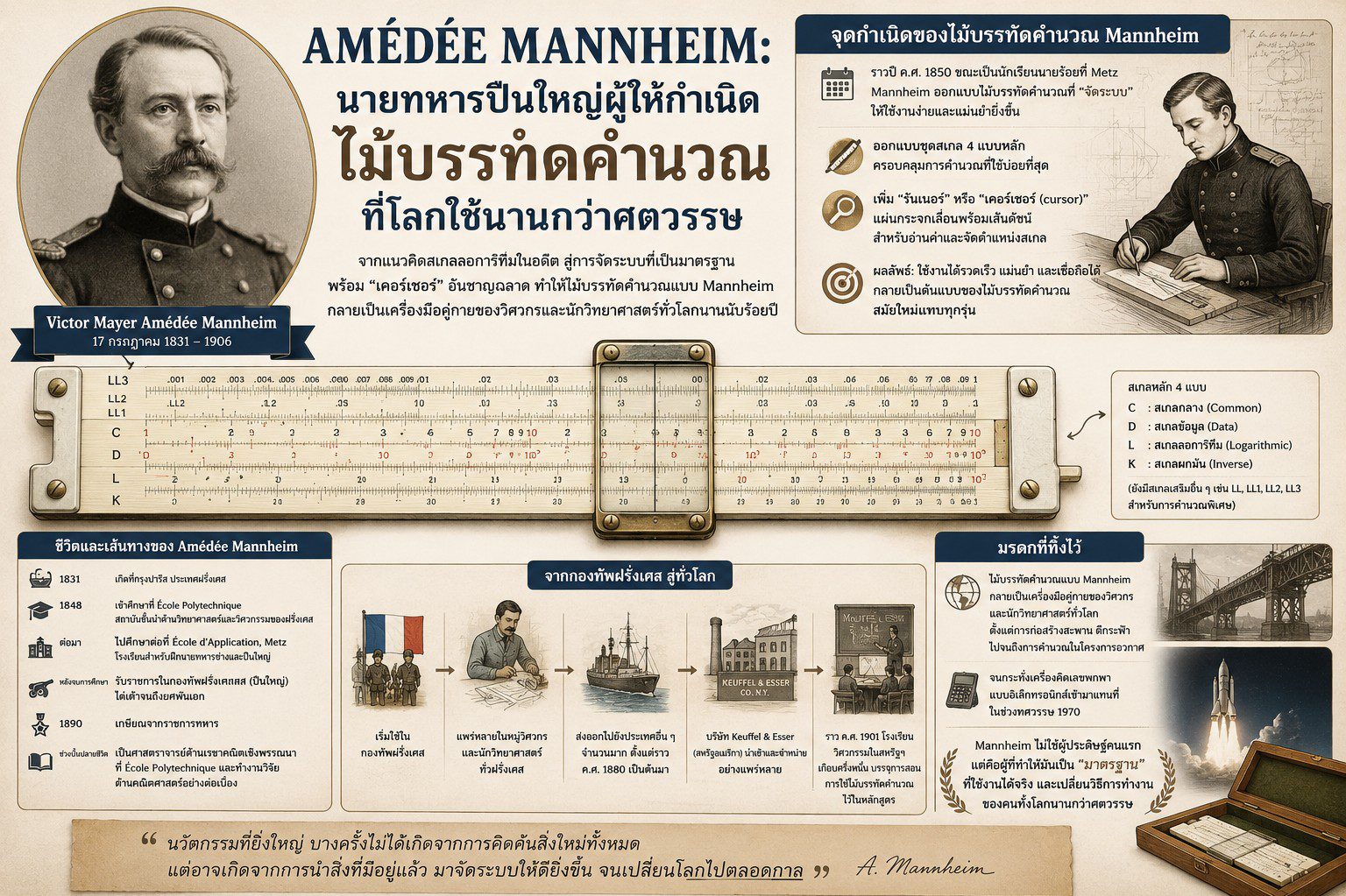
Amédée Mannheim was born in Paris, France, on July 17, 1831, and died in 1906. He demonstrated exceptional talent in mathematics from an early age, earning admission to École Polytechnique, France’s premier institution for science and engineering, in 1848. He later continued his studies at the École d’Application in Metz, a military academy dedicated to training engineering and artillery officers.
After graduating, Mannheim embarked on a career as an artillery officer in the French Army, eventually rising to the rank of Colonel before retiring from military service in 1890. Alongside his military career, he pursued mathematical research, focusing particularly on descriptive geometry and polar reciprocal transformation. He later became a professor of descriptive geometry at École Polytechnique, the institution with which he remained closely associated throughout his professional life.
The Origin of the Mannheim Slide Rule
The slide rule was not a new invention in Mannheim’s time. The concept of using logarithmic scales for calculation dated back to the early seventeenth century, stemming from the work of William Oughtred and Edmund Gunter, who adapted John Napier’s logarithmic scales for practical computation. However, these early designs were neither convenient to use nor standardized.
What Mannheim did was to standardize the slide rule into a more systematic and practical form. This concept emerged around 1850, while he was still a cadet at Metz. He designed a set of four scales that covered the most commonly used calculations. More importantly, he introduced the “runner,” now known as the cursor—a sliding transparent glass plate with an index line that allowed users to read values and align different scales with greater precision.
It was the addition of the cursor that transformed the slide rule from a difficult-to-use instrument into a tool that was much faster and more accurate for calculations. This innovation made the Mannheim slide rule the foundation for nearly all modern slide rule designs that followed.
From the French Army to the World
The Mannheim slide rule was first adopted by the French Army before spreading among engineers and scientists throughout France. It was later exported widely to other countries beginning around 1880. The renowned American calculating instrument company Keuffel & Esser imported and extensively marketed Mannheim-style slide rules in the United States. By around 1901, nearly half of engineering schools in the U.S. had incorporated slide rule instruction into their curricula.
From that point onward, the Mannheim slide rule became an essential tool for engineers and scientists around the world. It was used in everything from the construction of bridges and skyscrapers to calculations for space exploration projects. However, with the arrival of portable electronic calculators in the 1970s, slide rules gradually disappeared from everyday use. Despite this, they remain cherished by collectors and enthusiasts of the history of calculating instruments to this day.
The Legacy He Left Behind
Although Mannheim was not the first person to invent the slide rule, he was the one who transformed it into a practical standard that was widely adopted around the world for more than a century. His work is a powerful example of how innovation does not always come from creating something entirely new, but can also arise from organizing existing ideas and improving them to make them more effective—ultimately changing the way people around the world worked.