Terence Tao: The “Mozart of Mathematics” Who Solves Problems Across Almost Every Field
If there is one living mathematician who is often regarded as “the greatest mathematician of his generation,” Terence Tao is consistently among the first names mentioned. His research spans nearly every branch of mathematics, from partial differential equations to number theory. He is widely known as the “Mozart of Mathematics,” a title given by fellow mathematicians in recognition of his extraordinary abilities.
A Young Prodigy from the City of Adelaide
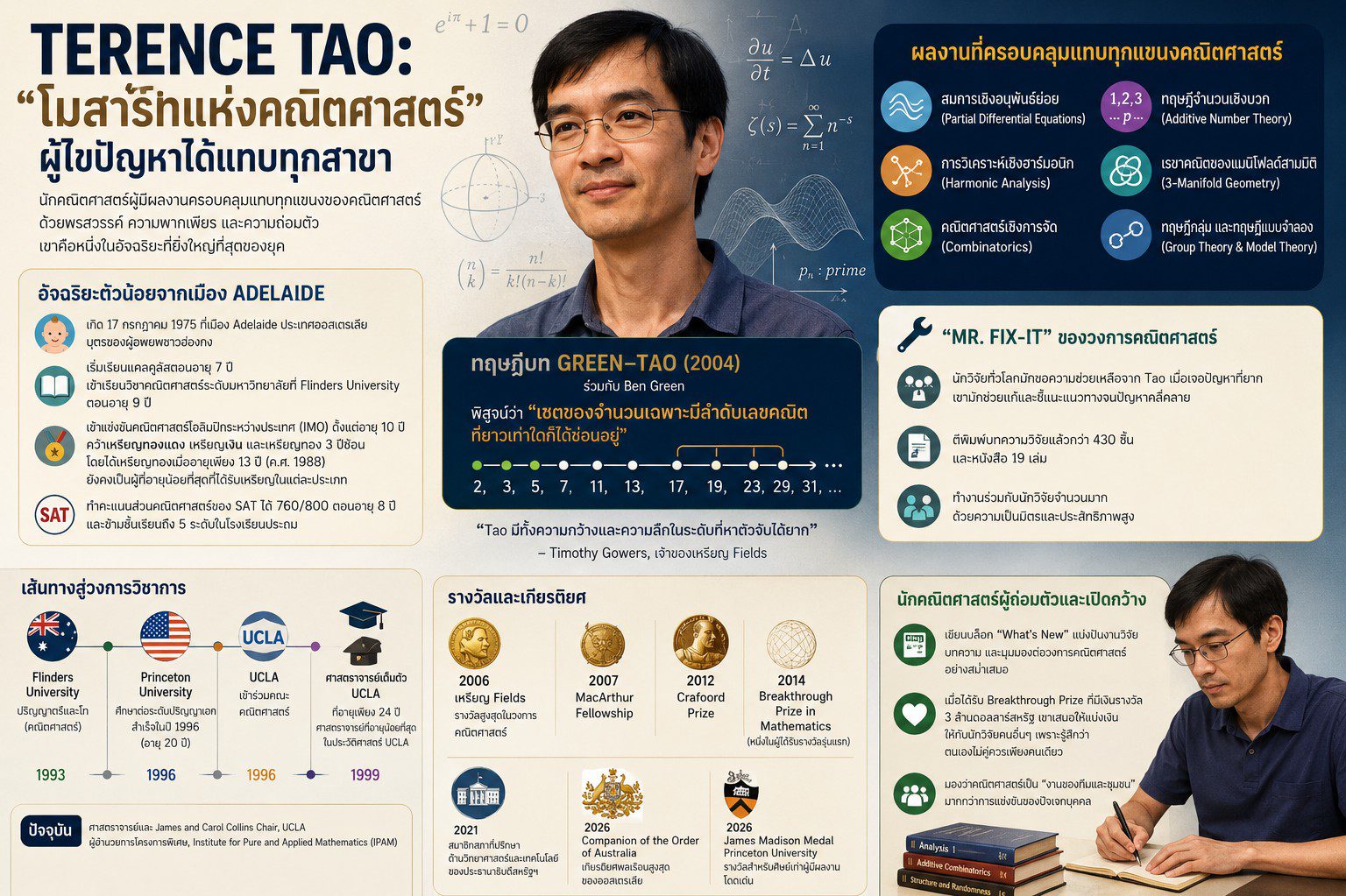
Terence Chi-Shen Tao was born on July 17, 1975, in Adelaide, Australia, to parents who were immigrants from Hong Kong. He demonstrated remarkable mathematical talent from an early age, beginning to study calculus at just 7 years old. By the age of 9, he was already taking university-level mathematics courses at Flinders University in Adelaide. He also scored 760 out of 800 on the mathematics section of the SAT at the age of 8 and skipped ahead by five grade levels during primary school.
Tao’s extraordinary abilities became even more evident when he participated in the International Mathematical Olympiad (IMO) at the age of 10, making him the youngest contestant in the history of the competition at that time. He won a bronze medal, silver medal, and gold medal in three consecutive years, earning the gold medal at just 13 years old in 1988. He remains the record holder as the youngest recipient of medals in each category of the competition to this day.
The Path to the Academic World
Tao continued his studies and earned both his bachelor’s degree and master’s degree from Flinders University before moving to the United States at the age of 16 to pursue a Ph.D. at Princeton University. He completed his doctorate in 1996 at the age of just 20. Afterward, he joined the faculty at the University of California, Los Angeles (UCLA) and became a full professor at only 24 years old, making him the youngest full professor in UCLA’s history. He currently remains a professor at UCLA, holding the James and Carol Collins Chair, and serves as the director of special projects at the university’s Institute for Pure and Applied Mathematics (IPAM).
Research Spanning Nearly Every Branch of Mathematics
What sets Tao apart from most mathematicians is the extraordinary breadth of his research, spanning an exceptionally wide range of fields. His work covers partial differential equations, harmonic analysis, combinatorics, additive number theory, as well as the geometry of three-dimensional manifolds, group theory, and model theory. Contemporary mathematician Timothy Gowers, another recipient of the Fields Medal, has described Tao’s knowledge as possessing a rare combination of both breadth and depth that is exceptionally difficult to match.
One of Tao’s most famous achievements is the Green–Tao theorem, which he proved jointly with British mathematician Ben Green in 2004. The theorem showed that the set of prime numbers contains arithmetic progressions of arbitrarily long length, a result that generated major excitement in the field of number theory. He has also made important contributions to the study of wave equations connected to gravitational waves in Einstein’s general relativity, as well as research on the Kakeya conjecture in harmonic analysis.
Another remarkable aspect of Tao is his exceptional ability to collaborate effectively with other researchers. He has earned the nickname “Mr. Fix-it” in the mathematical community because many researchers facing difficult problems often seek his insight and assistance in finding solutions. To date, he has published more than 430 research papers and 19 books.
Awards and Honors
In 2006, Tao received the Fields Medal, widely regarded as the highest honor in mathematics and often compared to a Nobel Prize in significance. He was recognized for his contributions to partial differential equations, combinatorics, harmonic analysis, and additive number theory. He became the first Australian and the first UCLA faculty member to receive this prestigious award. He has also received numerous other major honors, including the MacArthur Fellowship in 2007, the Crafoord Prize in 2012, and the Breakthrough Prize in Mathematics in 2014, where he was among the inaugural recipients of the award.
Most recently, Tao has continued to receive widespread recognition. In 2026, he was appointed a Companion of the Order of Australia, one of the highest civilian honors in Australia. He also received the James Madison Medal from Princeton University, which recognizes alumni who have achieved outstanding accomplishments in their professional careers and fields of education. He was also selected to serve as a member of the President’s Council of Advisors on Science and Technology (PCAST) of the United States in 2021.
A Humble and Open-Minded Mathematician
Despite his fame and extraordinary achievements, Tao remains widely recognized for his humility and his willingness to collaborate with others. He continues to write his personal blog, “What’s New,” one of the most influential mathematics blogs in the field, where he regularly shares research updates, interesting articles, and his perspectives on the mathematical community. When he received the Breakthrough Prize, which came with a prize of 3 million US dollars, he even attempted to suggest that the prize money be shared with other researchers, expressing that he felt the recognition should not belong solely to him.
Terence Tao is therefore not only a mathematician of extraordinary achievement, but also a role model for scholars who view mathematics as a collective endeavor built through teamwork and community, rather than merely a competition among individuals.