Remembering Robert Fricke, the Pioneer of Automorphic Functions and Elliptic Modular Functions Theory
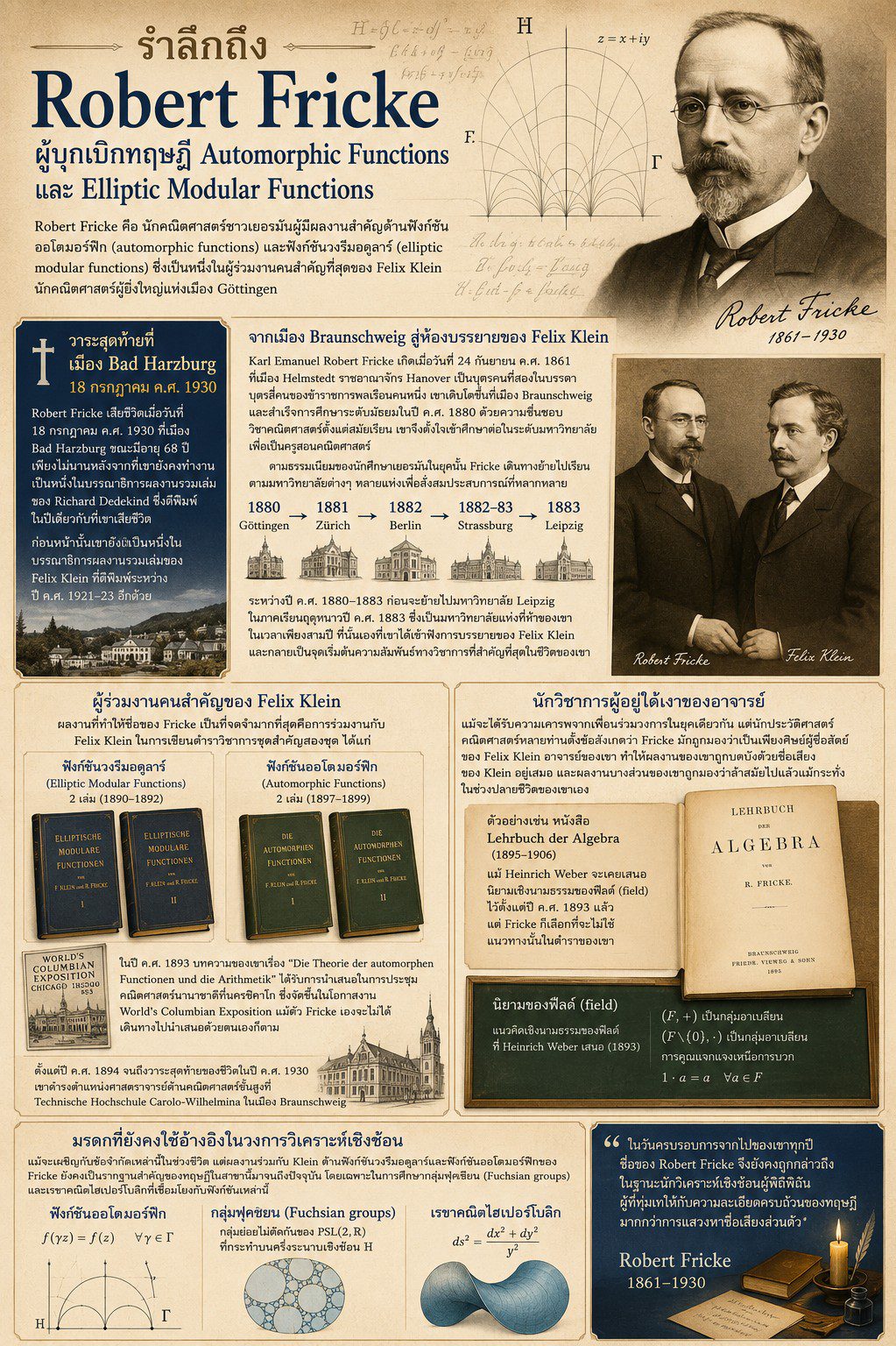
Robert Fricke was a German mathematician whose major contributions were in automorphic functions and elliptic modular functions. He was one of the most important collaborators of Felix Klein, the great mathematician of Göttingen. On this occasion, we look back on the life of a mathematician who devoted himself to one of the deepest and most complex fields of complex analysis of his era.
The Final Chapter in Bad Harzburg, July 18, 1930
Robert Fricke died on July 18, 1930, in Bad Harzburg at the age of 68, shortly after continuing his work as one of the editors of the collected works of Richard Dedekind, which were published in the same year as his death. Before that, he had also served as one of the editors of Felix Klein’s collected works, published between 1921 and 1923, demonstrating that he continued his scholarly work throughout the later years of his life.
From the City of Braunschweig to Felix Klein’s Lecture Hall
Karl Emanuel Robert Fricke was born on September 24, 1861, in Helmstedt, Kingdom of Hanover, as the second of four children of a civil servant. He grew up in the city of Braunschweig and completed his secondary education in 1880. With a strong interest in mathematics since his school years, he decided to pursue university studies with the goal of becoming a mathematics teacher.
Following the tradition of German students of that era, Fricke traveled between several universities to gain a wide range of academic experiences. He studied at the universities of Göttingen, Zürich, Berlin, and Strassburg between 1880 and 1883, before moving to the University of Leipzig in the winter semester of 1883, which was his fifth university in just three years. It was there that he attended Felix Klein’s lectures, marking the beginning of the most important academic relationship of his life.
A Key Collaborator of Felix Klein
Fricke’s most memorable contributions came from his collaboration with Felix Klein in writing two major sets of academic texts: two volumes on elliptic modular functions and another two volumes on automorphic functions. These works became classic reference texts in the field of complex analysis and continue to be cited by later generations of mathematicians to this day.
In 1893, his paper titled “Die Theorie der automorphen Functionen und die Arithmetik” was presented at the International Mathematical Congress in Chicago, held as part of the World’s Columbian Exposition, although Fricke himself did not travel to deliver the presentation. From 1894 until the end of his life in 1930, he served as a professor of higher mathematics at the Technische Hochschule Carolo-Wilhelmina in Braunschweig.
A Scholar Who Worked in the Shadow of His Mentor
Although he was respected by his contemporaries, many historians of mathematics have noted that Fricke was often viewed merely as Felix Klein’s loyal student, causing his own contributions to be overshadowed by Klein’s reputation. Some of his works were even considered outdated by the later years of his life. One example is his book Lehrbuch der Algebra, in which he chose not to adopt the abstract definition of a field, despite Heinrich Weber having already proposed such a definition in 1893.
A Legacy Still Referenced in the Field of Complex Analysis
Despite these limitations during his lifetime, Fricke’s collaborative work with Klein on elliptic modular functions and automorphic functions remains a fundamental foundation of the field to this day, particularly in the study of Fuchsian groups and hyperbolic geometry connected to these functions. On each anniversary of his passing, Robert Fricke’s name continues to be remembered as a meticulous complex analyst who devoted himself to the completeness and rigor of mathematical theory rather than the pursuit of personal fame.