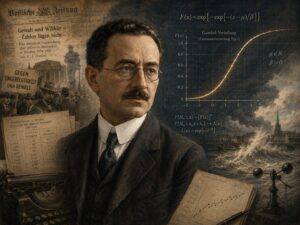
Emil Julius Gumbel: The Statistician Who Fought for Peace and the Father of Extreme Value Theory
Sometimes the scientists who leave behind the greatest academic legacies are also the same people who must struggle intensely for truth and justice in their own societies. The story of Emil Julius Gumbel, a German statistician, is a clear reflection of the life of a scholar whose deep research work was inseparably intertwined with political courage.
The Statistician Who Opposed Political Violence
Emil Julius Gumbel was born on July 18, 1891, in Munich, Germany, into a Jewish family whose father was the manager of a private bank. He studied mathematics, economics, statistics, and physics at the universities of Munich and Berlin before completing his doctoral dissertation in population statistics at the University of Heidelberg in 1914, shortly before the outbreak of World War I.
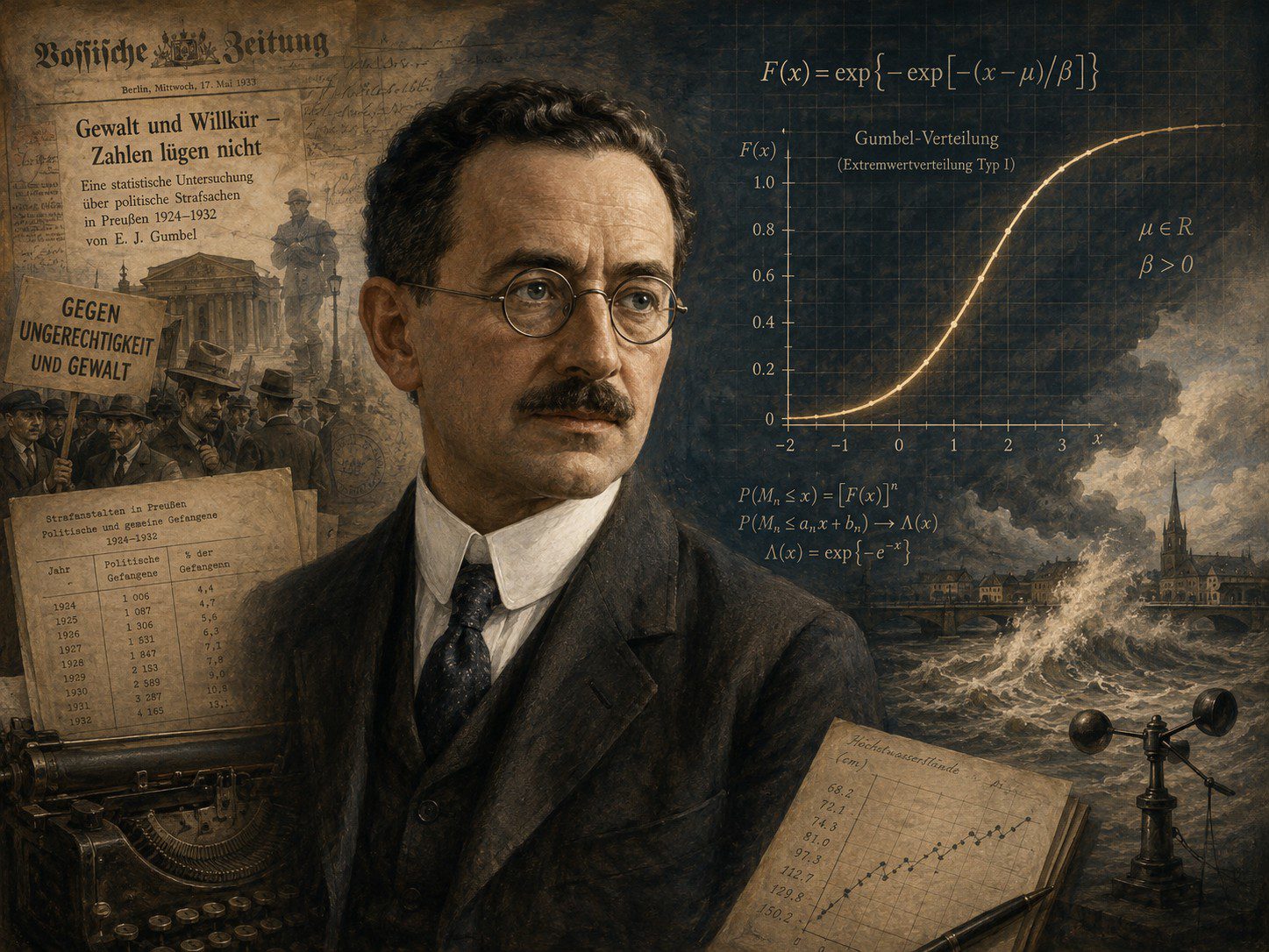
Although he initially served as a soldier during the war, his experiences on the battlefield turned Gumbel into a passionate pacifist. He was discharged from military service on medical grounds in 1915. Afterwards, he joined several left-wing political and pacifist groups and used his statistical expertise to expose political violence, particularly by collecting and analyzing data on political murders during the Weimar Republic. His research showed that most political murders were committed by far-right groups, yet these crimes received significantly lighter punishments compared to those committed by left-wing groups. This work made him a target of far-right organizations and led to his dismissal from the University of Heidelberg in 1932. He was then forced into exile in France and eventually emigrated to the United States in 1940.
The Father of Extreme Value Theory
Despite facing political difficulties throughout his life, Gumbel remained a dedicated researcher who continued to work in the field of statistics. The achievement that made his name remembered in mathematics and statistics to this day was his pioneering work in extreme value theory, a branch of statistics that studies the behavior of the most extreme or rare values in a dataset, such as the largest flood in a hundred years or the maximum potential damage that could occur.
Gumbel developed the concept now known as the Gumbel distribution, which is one of the three fundamental probability distributions used to describe the maximum or minimum values of random variables. This distribution is highly useful for modeling rare but high-impact extreme events. His major works that compiled these ideas were the books Statistical Theory of Extreme Values and Some Practical Applications in 1954 and Statistics of Extremes in 1958, which he wrote after settling in the United States.
A Legacy with Wide Applications in the Modern World
The Gumbel distribution has become an important tool in many professional fields that deal with risks from extreme events, including hydraulic engineering, which uses it to predict maximum flood levels; structural engineering, which applies it to account for the strongest wind forces or earthquakes that buildings may have to withstand; the financial sector, which uses it to assess risks from maximum potential losses; as well as the study of various natural disasters.
Gumbel lived in the United States, teaching at various institutions in New York City, before becoming a professor at Columbia University in 1953. He continued his academic and political activities until the later years of his life, including participating in opposition to the Vietnam War. He died of cancer in 1966, leaving behind both a statistical legacy that remains widely used and an example of a scholar who never separated scientific knowledge from social responsibility.