Marjorie Senechal: The Mathematician Who Connected Crystallography with the Geometry of Tiling
When discussing the connection between mathematics and the natural world, one of the most beautiful examples is the study of crystal structures. Marjorie Senechal, an American mathematician and historian of science, devoted her academic life to uncovering the geometric secrets hidden within the nature of these solid structures.
From a Hospitalized Child Addicted to Reading to the World of Mathematics
Marjorie Lee Senechal, born with the surname Wikler, was born on July 18, 1939, in Saint Louis, Missouri, United States. She was the eldest of four children of Abraham Wikler, a physician with the U.S. Public Health Service. The family later moved to Lexington, Kentucky, where she grew up on the grounds of the Lexington Narcotic Hospital, a medical facility for drug addiction treatment where her father served as deputy director.
She received her early education at the Training School of the University of Kentucky, a small school with only one classroom per grade level, before continuing her studies and graduating from the University of Chicago and the Illinois Institute of Technology. She pursued her doctoral studies under the supervision of Abe Sklar, a mathematician renowned for his work in probability theory.
An Expert in Mathematical Crystallography
Senechal is known in the mathematical community for her research on tessellations and quasicrystals, which are solid structures that possess order but do not repeat periodically like conventional crystals. She is an expert in mathematical crystallography, studying the arrangement of atoms in solids through the perspectives of geometry and symmetry theory.
During the 1974–75 academic year, she conducted research at the University of Groningen in the Netherlands, where she experienced working in a crystallography department for the first time, allowing her to gain a much broader understanding of the field. Later, during the 1979–80 academic year, she also served as an exchange scientist at the Institute of Crystallography of the Academy of Sciences of the Soviet Union in Moscow. There, she collaborated with Boris Delone, a leading researcher in crystallography, as well as the network of mathematicians and crystallographers associated with him, which later became an important academic connection in her career.
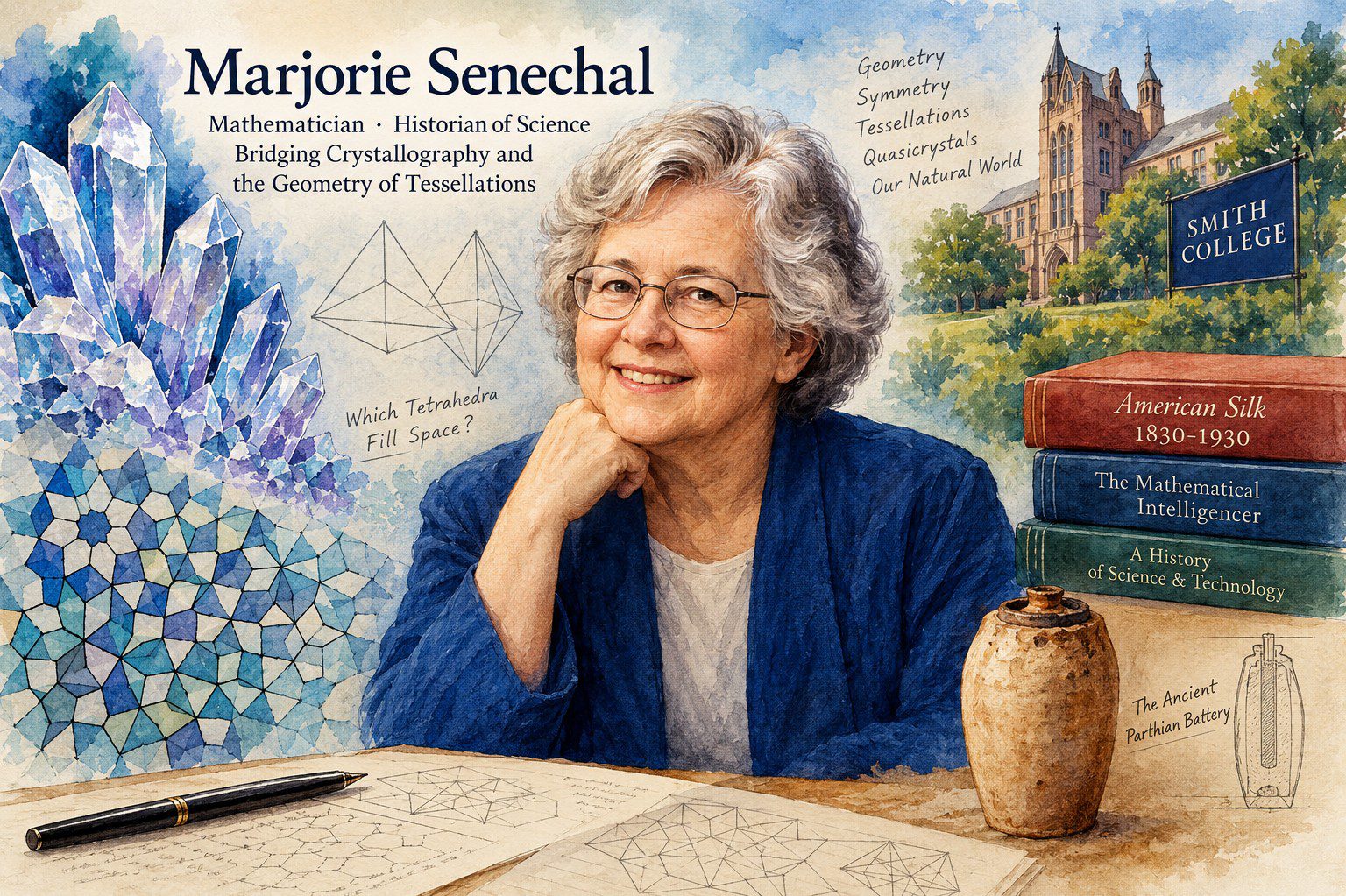
One of her acclaimed works is the article “Which Tetrahedra Fill Space?”, which earned her the Carl B. Allendoerfer Award from the Mathematical Association of America for excellence in mathematical exposition in the journal Mathematics Magazine.
A Scholar Working Across Disciplines
In addition to her work in crystallography and the theory of tiling, Senechal has a broad interest in the history of science and technology. She has studied the ancient electric battery of the Parthian Empire and has also published several books on the history of silk. Her book American Silk 1830–1930 received the Millia Davenport Publication Award from the Costume Society of America.
Throughout her career, she served as the Louise Wolff Kahn Professor Emerita of Mathematics and History of Science and Technology at Smith College. She also served as the editor-in-chief of The Mathematical Intelligencer, a journal that presents articles on mathematics, mathematicians, and the cultural history of mathematics.
A Legacy That Connects Multiple Fields of Knowledge Together
Marjorie Senechal is a clear example of a mathematician who sees the beauty of mathematics through its connections with the real world, whether in the structures of natural crystals, geometric patterns in tessellations, or even the history of ancient technologies. Her research in mathematical crystallography and quasicrystals continues to serve as an important foundation that materials scientists and mathematicians of later generations use for further development to this day.