Pierre Alphonse Laurent: The Military Engineer Who Discovered the Series That Extended the Scope of the Taylor Series
In complex analysis, one of the key tools that extends the scope of the Taylor series to include functions with singularities is the Laurent series, named after Pierre Alphonse Laurent, a French military engineer who discovered it while working far from the mainstream academic community.
From Military Cadet to Colonial Engineer
Pierre Alphonse Laurent was born on July 18, 1813, in Paris, France. He entered the École Polytechnique in 1830 and graduated in 1832 as one of the top students of his class. He was then commissioned as a second lieutenant in the French Army Corps of Engineers and continued his studies at the École d’Application in Metz before being assigned to Algeria.
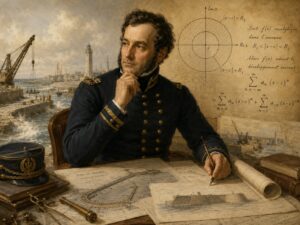
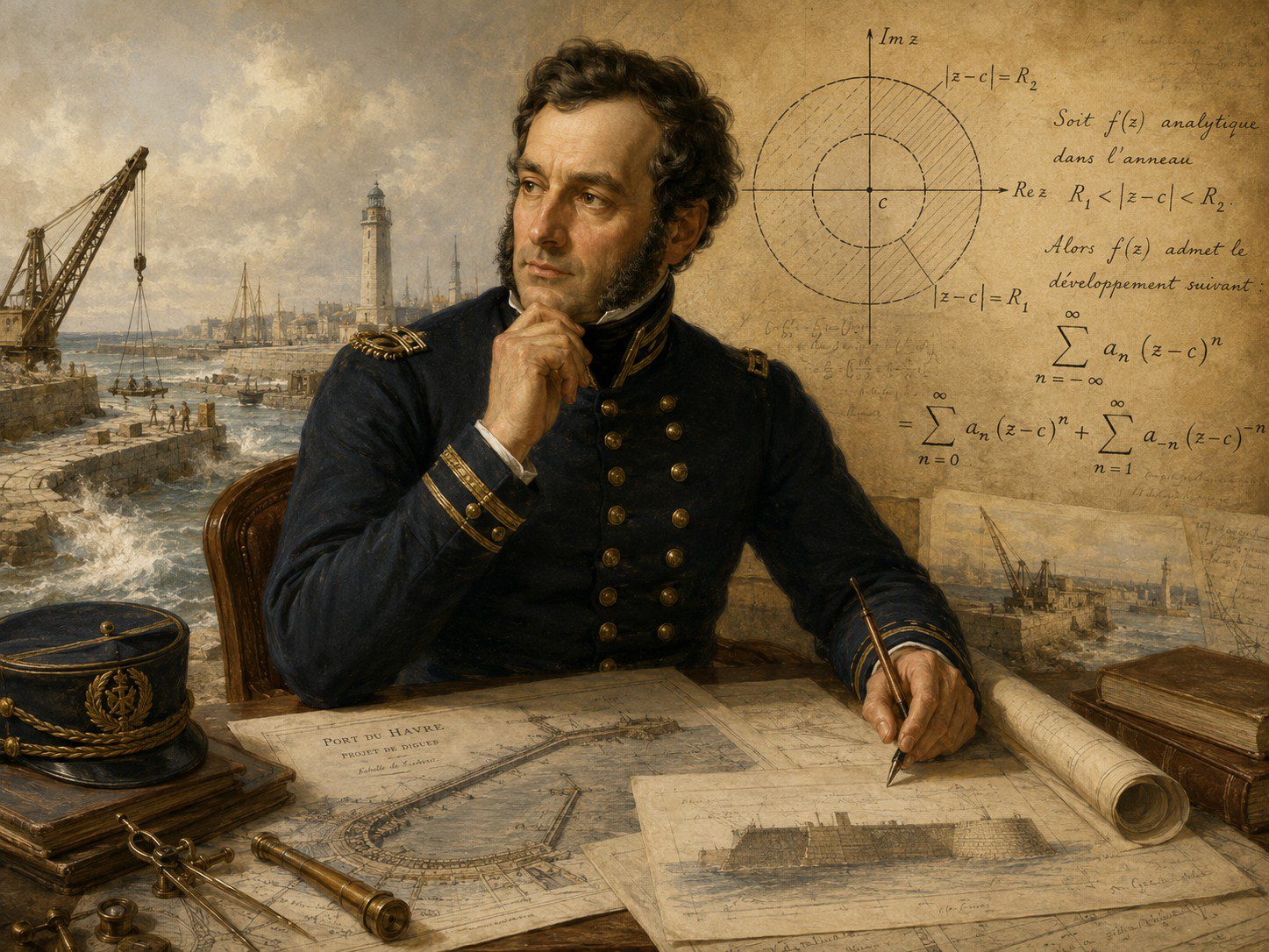
After returning from Algeria around 1840, Laurent spent about six years overseeing the expansion of the Port of Le Havre on the English Channel. This hydraulic engineering project later enabled the city to replace Rouen as France's principal seaport.
A Discovery Made Outside the Academic Mainstream
The most remarkable episode in Laurent's life was that the series bearing his name was discovered in 1843 while he was still working as an engineer in Le Havre, rather than as a university academic. He submitted a paper presenting the idea for a major prize competition organized by the Académie des Sciences, but unfortunately missed the submission deadline. As a result, the paper was neither published nor considered for the award.
The Laurent series represents a complex function as a power series that includes not only positive powers, as in the Taylor series, but also negative powers. This enables it to describe the behavior of functions around singularities, something the Taylor series cannot do. The mathematician Augustin Louis Cauchy recognized the significance of this work and repeatedly advocated for its publication, but it never materialized during Laurent's lifetime. His work was ultimately published only after his death.
Interestingly, there is evidence suggesting that Karl Weierstrass may have discovered a very similar concept as early as 1841. However, he did not publish his work at the time either, which is why the series has continued to bear Laurent's name to this day.
A Legacy Still Used in Mathematics and Physics
Pierre Alphonse Laurent died in Paris in 1854 at the age of only 41, leaving behind only a few published works. However, the Laurent series became an indispensable fundamental tool in complex analysis and has played an important role in modern theoretical physics, including quantum field theory and scattering theory, which constantly rely on the expansion of functions around singularities. Laurent's story is therefore a memorable example of a thinker who discovered something important while working far from academic centers, yet whose work has continued to influence science for more than a century and a half.