

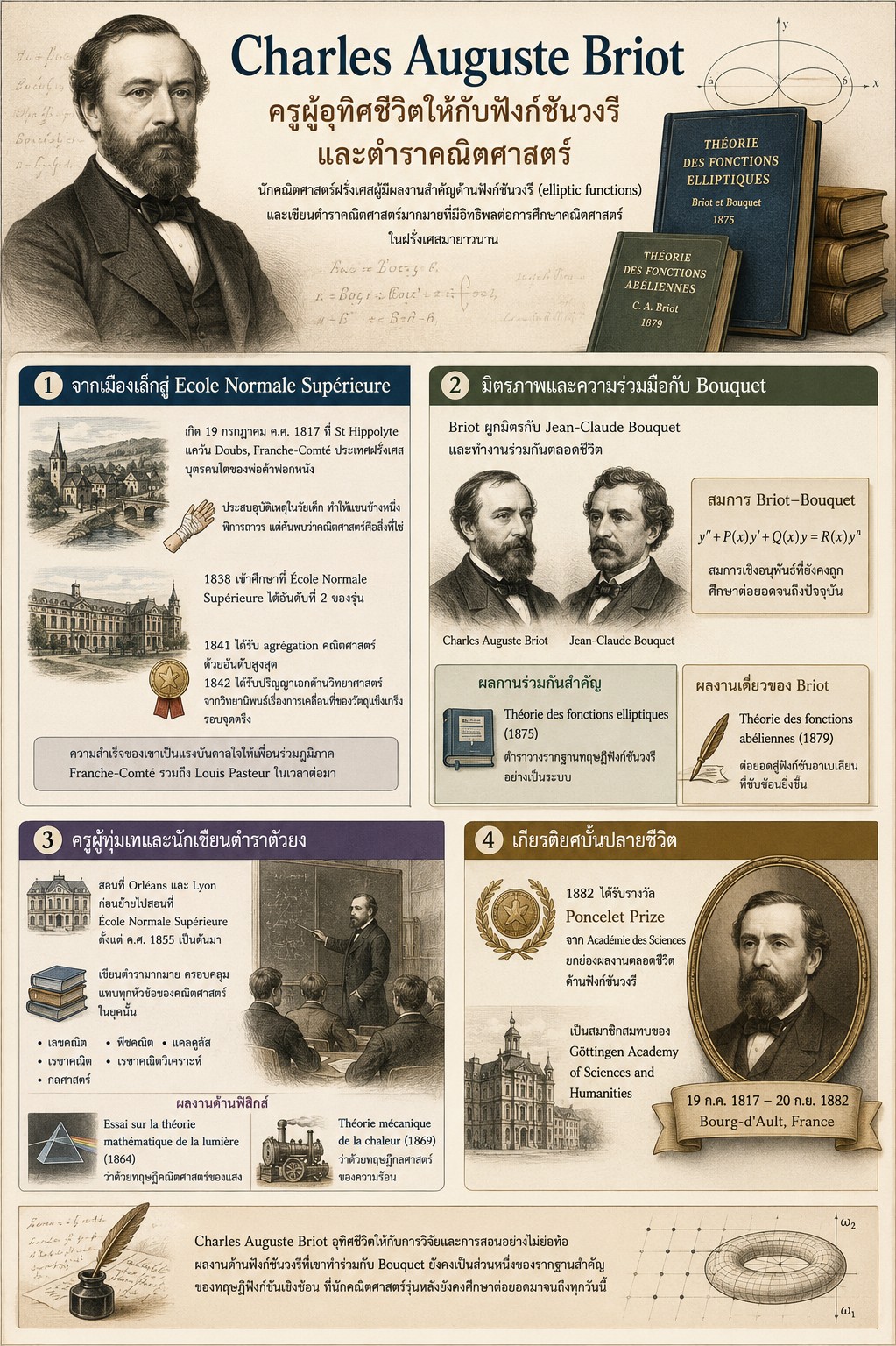
Charles Auguste Briot: A teacher who dedicated his life to elliptic functions and mathematics textbooks.
Among 19th-century French mathematicians, Charles Auguste Briot may not be the most famous name, yet his work on elliptic functions and the mathematics textbooks he authored have had a lasting influence on mathematical education in France.
From a Small Town to the École Normale Supérieure
Charles Auguste Albert Briot was born on July 19, 1817, in Saint-Hippolyte, in the Doubs department of the Franche-Comté region, France. He was the eldest child in the large family of Auguste Briot, a prominent local tanner. During his childhood, Briot suffered an accident that left one of his arms permanently disabled, forcing him to choose a career path that did not require physical labor; he ultimately discovered that mathematics was his true calling.
He was sent to Paris for further studies, and within just five years, he rose to academic distinction. Upon entering the École Normale Supérieure in 1838, he ranked second in his class; three years later, he graduated with the highest honors in the *agrégation* in mathematics, subsequently obtaining his doctorate in science in March 1842.Stemming from his thesis on the motion of a rigid body around a fixed point, this outstanding achievement inspired others from the Franche-Comté region to follow in his footsteps—among them Louis Pasteur, who would later become a renowned scientist.
Friendship and cooperation with Bouquet
During his studies, Briot befriended a fellow student who shared his passion for mathematics, Jean-Claude Bouquet; the two became lifelong academic collaborators. Together, they published several significant works, including what is now known as the Briot–Bouquet equation—a type of differential equation that continues to be the subject of further study in the mathematical community to this day.
Their most significant joint work is the book *Théorie des fonctions elliptiques*, published in 1875, which systematically laid the foundations of the theory of elliptic functions. Additionally, Briot published a solo work, *Théorie des fonctions abéliennes*, in 1879, extending the study from elliptic functions to the more complex Abelian functions.
A dedicated teacher and prolific textbook author.
Briot spent the majority of his career teaching mathematics in Orléans and Lyon before moving to the École Normale Supérieure in 1855. His dedication as an educator is reflected in the numerous textbooks he authored, covering virtually every topic in the mathematics curriculum of the era—including arithmetic, algebra, calculus, geometry, analytic geometry, and mechanics—consistent with the common practice among French mathematicians of that time to write their own teaching materials.
In addition to his work on elliptic functions, he published works in physics—such as *Essai sur la théorie mathématique de la lumière* (on the mathematical theory of light) in 1864 and *Théorie mécanique de la chaleur* (on the mechanical theory of heat) in 1869—demonstrating broad interests that extended beyond pure mathematics alone.
Honors in the twilight of life
In 1882—the same year he passed away—Briot was awarded the Poncelet Prize by the Académie des Sciences in recognition of his lifelong work on elliptic functions. He was also an associate member of the Göttingen Academy of Sciences and Humanities, demonstrating that his work had gained international recognition.
Charles Auguste Briot passed away on September 20, 1882, in Bourg-d’Ault, France. His life exemplifies that of a mathematician dedicated to both research and teaching. His work on elliptic functions, conducted in collaboration with Bouquet, remains a cornerstone of complex function theory—a field that mathematicians continue to study and build upon to this day.
 ‘
‘