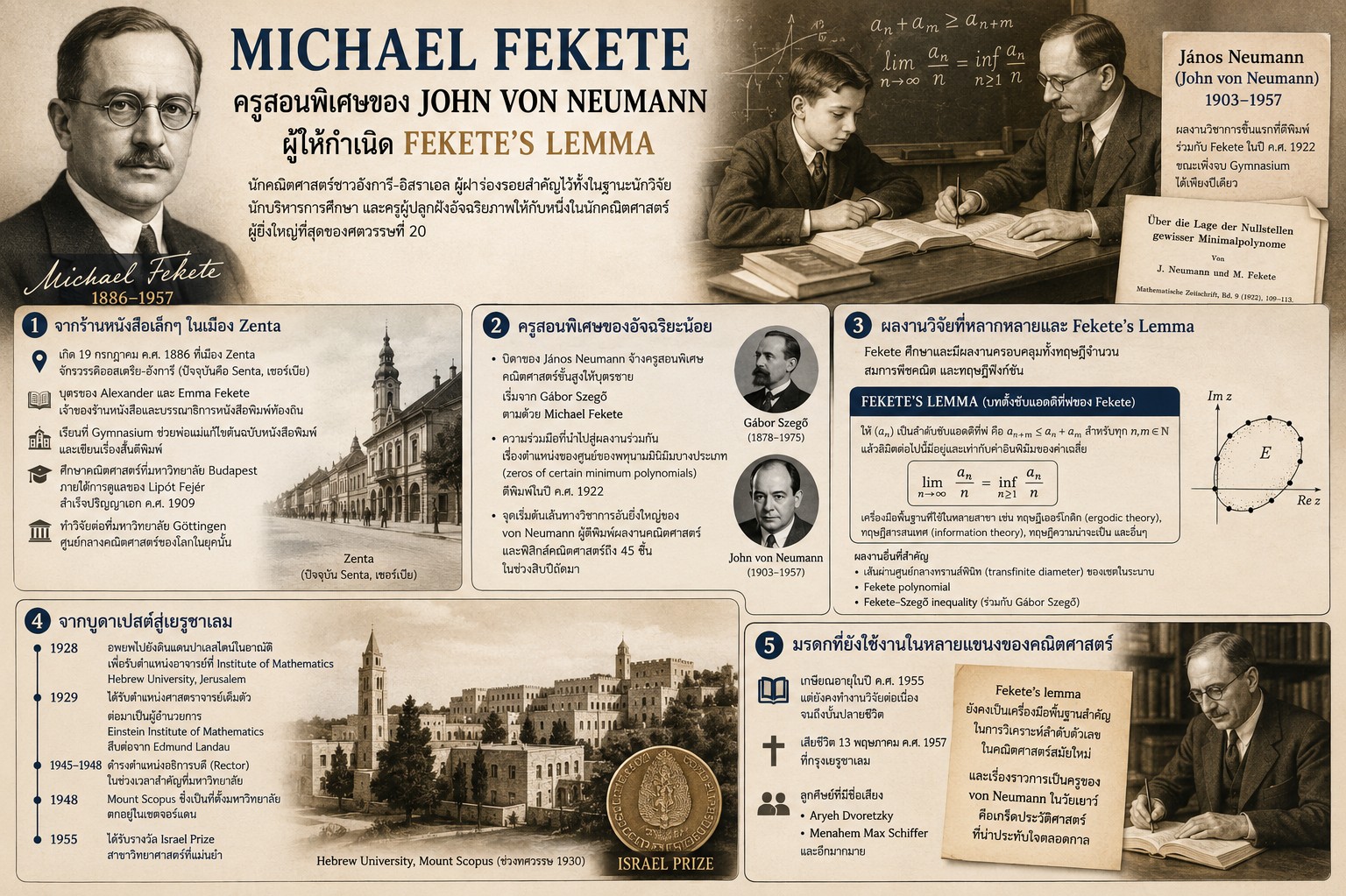
Michael Fekete: John von Neumann’s tutor and the originator of Fekete’s Lemma.
Before John von Neumann became one of the greatest mathematicians and computer scientists of the 20th century, he had a tutor who instilled in him a foundation of advanced mathematics from a young age. That tutor was Michael Fekete, a Hungarian-Israeli mathematician who later developed a mathematical tool still used by analysts worldwide to this day.
From a small bookstore in the town of Zenta
Mihály Fekete—later known as Michael Fekete—was born on July 19, 1886, in Zenta, a town then part of the Austro-Hungarian Empire (now Senta, Serbia). He was one of four children born to Alexander and Emma Fekete, who owned a bookstore and edited the local newspaper. During his time at the *Gymnasium*, he assisted his parents in editing newspaper manuscripts and also wrote short stories that were published in the paper.
After completing his studies at the Gymnasium, Fekete pursued mathematics at the University of Budapest under the supervision of Lipót Fejér—a renowned mathematician of the Hungarian school—and earned his doctorate in 1909. He subsequently traveled to conduct further research at the University of Göttingen, one of the world's most important mathematical centers at the time.
The little genius's private tutor
Beyond his own research, Fekete became widely known for his role as a private tutor to the young János Neumann—who would later become the great mathematician John von Neumann. Neumann’s father hired tutors to teach his son advanced mathematics from an early age; Gábor Szegő was the first, followed subsequently by Fekete.
This collaboration between teacher and student led to a joint publication in 1922 concerning the zeros of certain minimum polynomials—von Neumann's first academic paper, published just one year after he had graduated from the Gymnasium. It marked the beginning of von Neumann's illustrious academic career, during which he published 45 works in mathematics and mathematical physics over the following decade.
Diverse research findings and Fekete’s Lemma
Throughout his career, Fekete produced research spanning number theory, algebraic equations, and function theory; he was known as an analyst of the Fejér school who favored solving challenging, specific problems. His most renowned contribution is Fekete’s lemma (or Fekete’s subadditive lemma), a crucial tool for analyzing the behavior of subadditive sequences.It states that the limit of the sequence's averages as the index approaches infinity equals the minimum of those averages. This tool has become a fundamental element in various fields of mathematics, including ergodic theory, information theory, and probability theory.
In addition, he made significant contributions regarding the transfinite diameter of sets in the plane—a concept he studied throughout his career—as well as work on the Fekete polynomial and the Fekete–Szegő inequality, conducted in collaboration with Gábor Szegő.
From Budapest to Jerusalem
In 1928, Fekete emigrated to Mandate Palestine to accept a teaching position at the Institute of Mathematics of the Hebrew University of Jerusalem, an institution that had been founded just three years earlier. He was appointed full professor the following year and later became the director of the university's Einstein Institute of Mathematics, succeeding the renowned mathematician Edmund Landau.
Fekete played a pivotal role in the university's administration, serving as Dean of the Faculty of Science and as Rector between 1945 and 1948—a critical period for the institution, as Jerusalem was partitioned into Israeli and Jordanian sectors in 1948, leaving the Mount Scopus campus within the Jordanian zone. In 1955, he was awarded the Israel Prize in Exact Sciences, one of the country's highest honors.
A legacy that remains in use across various branches of mathematics.
Fekete retired in 1955 but continued his research until the end of his life. He passed away on May 13, 1957, in Jerusalem, leaving behind renowned students—such as Aryeh Dvoretzky and Menahem Max Schiffer—and a mathematical legacy that remains widely used; notably, Fekete’s lemma continues to be a fundamental tool for analyzing sequences of numbers across various fields of modern mathematics.And the story of serving as a tutor to the young von Neumann remains a fascinating historical anecdote in the world of mathematics to this day.