Remembering Bruno de Finetti, a pioneer of subjective Bayesian probability.
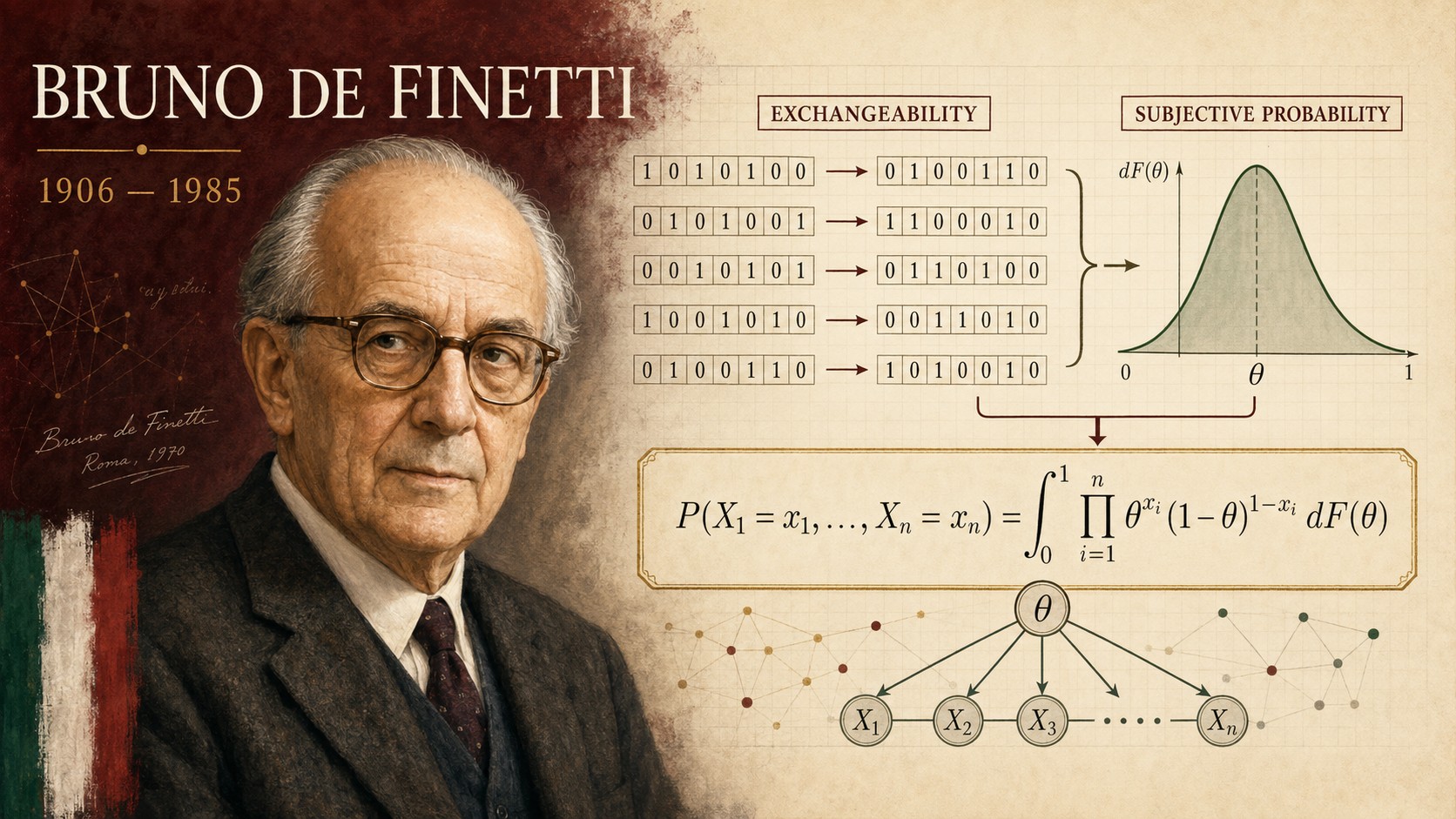
Bruno de Finetti was an Italian mathematician who pioneered the concept of Bayesian probability from a subjective perspective and is the originator of de Finetti's theorem, a key theorem that links exchangeability to the deep structure of probability. On this occasion, we look back at the life of a thinker who constantly challenged conventional ideas about probability.
His final moments in Rome, July 20, 1985.
Bruno de Finetti died on July 20, 1985, in Rome, Italy, at the age of 79, nine years after retiring from his professorship at Sapienza University in Rome in 1976. Throughout his life, he reflected the spirit of a thinker who never ceased to challenge conventional thinking, despite facing opposition from mainstream academia for decades.
A boy with a disability who never stopped learning.
Bruno de Finetti was born on June 13, 1906, in Innsbruck, Austria. When his father died when he was only 6 years old, he moved to live with his mother in Trento. At the age of 13, he suffered from a severe case of osteomyelitis in his left leg, requiring surgery that left him permanently disabled.
In 1923, he entered the Politecnico di Milano to study engineering, following in the footsteps of his father and grandfather, before transferring to the University of Milan to study applied mathematics in his third year, graduating in 1927 with an award-winning dissertation. Even while still an undergraduate student, he published Mendel's first article on population genetics, developing the first mathematical model of populations with overlapping generations.
Pioneer of subjective probability.
After graduating, de Finetti worked at the Italian Central Statistics Office (Istituto Centrale di Statistica) in Rome until 1931, a period during which he produced a large body of research. It is reported that in 1930 alone, he published 17 articles. He then moved to work for the insurance company Assicurazioni Generali in Trieste, while also teaching probability calculus at the University of Trieste.
De Finetti's most significant contribution is the concept of subjective probability, which views probability not as an objective property inherent in nature, but as a personal degree of belief that must be consistent according to the principle of coherence. He explained this concept through a thought experiment on betting odds, which became the foundation of the 'Dutch book' theorem—used to prove that logically inconsistent beliefs will inevitably lead to unavoidable losses. The classic work compiling this concept is the article 'La prévision: ses lois logiques, ses sources subjectives,' published in 1937.
De Finetti's Theorem: A bridge between two perspectives on probability.
De Finetti's most famous work is his named theorem, which states that a sequence of exchangeable random variables can be viewed as arising from a randomization process with success parameters in Bernoulli trials. This theorem is extremely important because it provides a beautiful bridge between subjective Bayesian probability views and classical frequency probability views, and has been further expanded upon by later mathematicians.
Although de Finetti's ideas were not initially widely accepted due to non-academic reasons, preventing him from receiving a full professorship at the University of Trieste until 1950, the later contributions of the American statistician Leonard J. Savage, who embraced independent subjectivity, helped to popularize de Finetti's work in the English-speaking world. The British statistician Dennis Lindley was another key supporter of his work.
A legacy that remains controversial and in use.
After moving to teach at the Faculty of Economics at the University of Rome in 1954 and then to the Faculty of Science in 1961, de Finetti continued his research in probability, genetics, and financial economics. His subjective probability concept remains one of the two main schools of thought in modern probability theory and has had a profound influence on Bayesian statistics, which are widely used in artificial intelligence, machine learning, and data science today.
Each year on the anniversary of his passing, Bruno de Finetti's name continues to be remembered as that of a thinker who dared to challenge mainstream thinking and profoundly changed humanity's perspective on the uncertain nature of things.