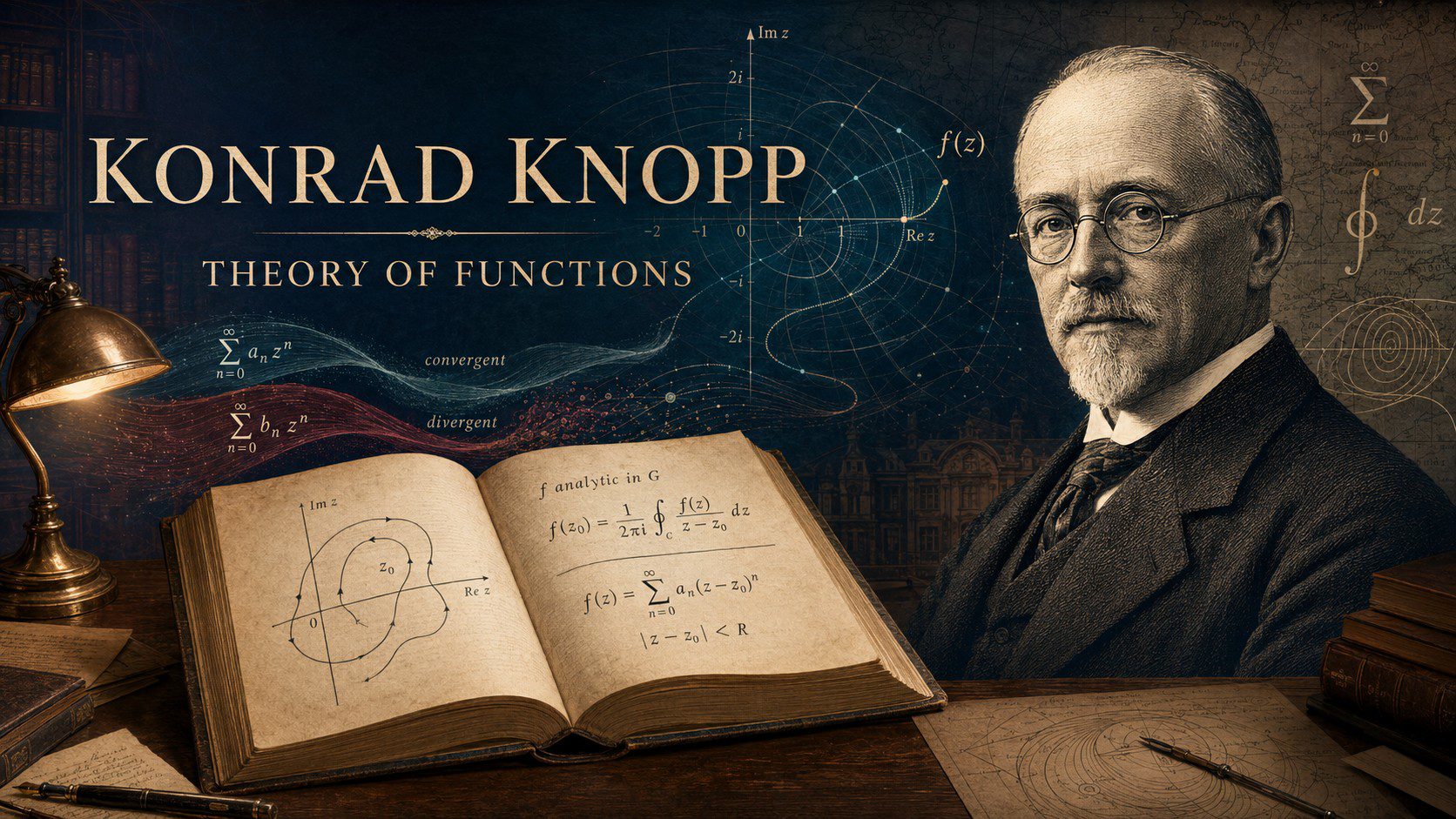
Konrad Knopp: The author of the textbook Theory of Functions that mathematicians around the world have been studying for generations.
If anyone has ever taken a complex analysis course at the university level, there's a good chance they've heard of this textbook. Theory of Functions Which is a classic work by Konrad Knopp, a German mathematician who specialized in complex analysis functions and general limit theory.
A traveler starting a career abroad
Konrad Hermann Theodor Knopp was born on July 22, 1882, in Berlin, Germany. He was the son of Paul Knopp, a businessman in manufacturing, and Helene, whose maiden name was Ostertun. He received his early education in Berlin before studying for a semester at the University of Lausanne in 1901, then returned to continue his studies at the University of Berlin under the guidance of several famous mathematicians, including Hermann Schwarz, Ferdinand Georg Frobenius, Friedrich Schottky, Edmund Landau, and Issai Schur.
He received his teaching certificate in 1906 and his doctorate in 1907 from a thesis supervised by Schottky and Frobenius. Interestingly, Knopp's early life path was not limited to Germany. In 1908, he traveled to teach at the Commercial Academy in Nagasaki, Japan, and also traveled around China and India before returning to Germany in 1910 and marrying Gertrud Kressner, a female painter. Then the couple moved to Tsingtao in eastern China, where he taught at the German-Chinese Academy for about a year.
A solid academic path in Germany
After returning to Germany in 1911, Knopp taught at the Military Technical Academy and the Military Academy. In 1914, he was injured while on duty during World War I, and he went back to teaching at the University of Berlin in 1915. He got a special professorship at the University of Königsberg in 1915 and became a full professor in 1919.
In 1926, he became the head of the mathematics department at the University of Tübingen, a position he held until he retired in 1950. Besides teaching, in 1918 he was also one of the co-founders of the journal Mathematische Zeitschrift, a famous mathematics journal, and he served as its editor from 1934 to 1952.
Research on the general implications of limit theory
Knopp's main research focused on what is called 'generalized limits' or summability theory, which studies ways to assign meaningful sums to series that do not converge in the usual sense. He published a lot in the journal Mathematische Zeitschrift, which he co-founded, such as his 1923 paper on Euler summation methods and research on Abel's theorem connected to the Laplace transform and Jovan Karamata's Tauberian theorem, even after he retired in 1952.
He also made important contributions with functions that are continuous but nowhere differentiable, which is a topic that challenges the basic understanding of continuity and smoothness of functions.
A classic recipe that's used for learning all over the world
What made Knopp's name widely known among math students around the world is the textbooks he wrote, especially Theory of Functions Which is divided into two volumes that cover complex variable function theory in a detailed and easy-to-understand way, becoming a reference textbook that generations of mathematicians have used to study complex analysis for decades. He also wrote a companion textbook. Infinite Sequences and Series and Theory and Application of Infinite Series It covers sequences and infinite series in great detail, including a book of problem sets that helps learners practice real problem-solving skills.
These textbooks stand out for their clear explanations and well-organized content, making them accessible to both beginners and those looking for in-depth study. Dover Publications continues to publish these books to this day, showing their timeless value.
The legacy that still remains in classrooms around the world
Konrad Knopp passed away on April 20, 1957, in Annecy, France, leaving behind both in-depth research in series theory and classic textbooks that continue to influence the study of mathematics today. His life story, which took him all over the world—from Japan, China, and India to the battlefields of the World Wars—before returning to establish himself in the German academic scene, is an interesting reflection of a mathematician dedicated both to research and to passing on knowledge to the next generation.