Remembering W. W. Rogosinski, co-author of the Fourier series textbook with G. H. Hardy
Werner Wolfgang Rogosinski, whom his colleagues affectionately called 'Rogo,' was a German-English mathematician known for his significant work on Fourier series and for co-authoring an important textbook with G. H. Hardy, the great British mathematician. On this occasion, we look back on the life of a mathematician who had to overcome many challenges from the political dangers of his time, yet still maintained an undiminished love for mathematics.
Final agenda in the city of Aarhus, July 23, 1964
Rogosinski passed away on July 23, 1964, in Aarhus, Denmark, at the age of 69, just five years after he moved to take a position at Aarhus University in 1959. His passing marked the end of the life of a mathematician who had faced hardships throughout the first half of his life—from being dismissed from his professorship because of his Jewish background during the Nazi era to having to restart his career abroad in a position far below his abilities. Yet, he never lost his passion for mathematics.
A boy who loves music from the city of Breslau
Werner Wolfgang Rogosinski was born on September 24, 1894, in the city of Breslau, which at that time was part of the German Empire (now Wrocław, Poland), into a Jewish family of Polish descent. His father was a city lawyer. His family loved music, and Rogosinski himself learned piano and violin from a young age. His younger brother Kurt later became a professional pianist.
He attended the Gymnasium at St. Maria Magdalena School in Breslau from 1900 to 1913, focusing mainly on Latin and Greek, before going on to study mathematics at the universities of Breslau, Freiburg, and Göttingen under Edmund Landau. However, his studies were interrupted when World War I broke out, and he had to serve as a sergeant in a military medical unit.
The academic path in the city of Königsberg
After the war, Rogosinski went back to his studies and earned his PhD in 1922 with a dissertation on the application of Pfeiffer's method to Dirichlet's divisor problem, which caused quite a stir in the field. In 1923, he traveled to Königsberg and started as a lecturer before being promoted to associate professor in 1928. There, he worked with several famous mathematicians like Richard Brauer, Gábor Szegő, and Kurt Reidemeister for five years, and the Rogosinski and Szegő families became close friends.
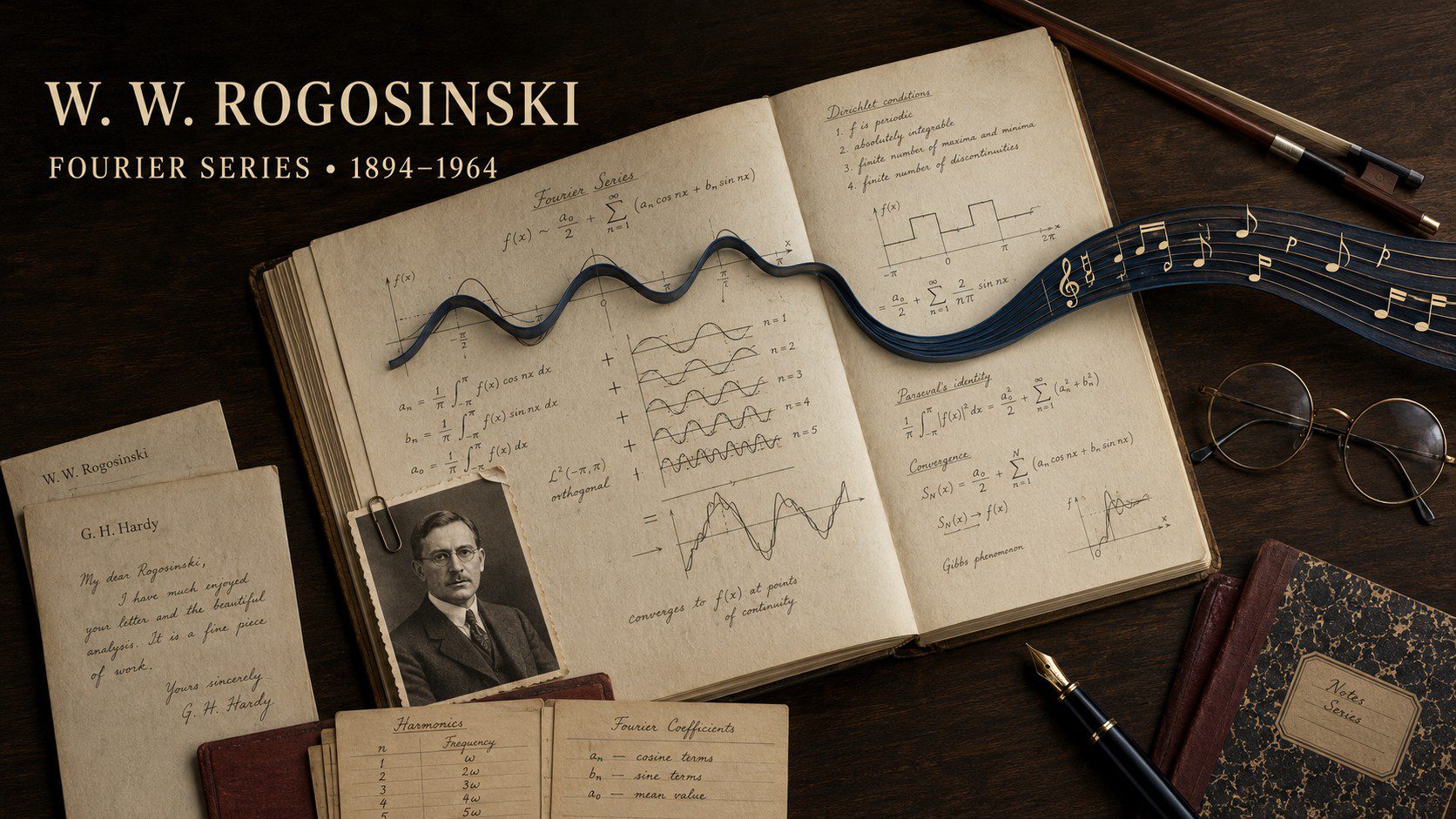
His first major work was the book 'Fouriersche Reihen,' published in 1930. It’s a textbook introducing Fourier series for students and was translated into English in 1950. People still refer to it even today.
Collaboration with G. H. Hardy amid a political crisis
Rogosinski's situation started to get tough when the Nazis came to power in Germany, and in 1936 he was dismissed from his professorship because of his Jewish background. But it was this very misfortune that led to the most important academic collaboration of his life, when he worked with G. H. Hardy, the great British mathematician, on Fourier series research. This became a period of high-quality work and full of joy in collaboration, even though it happened amid increasingly bad political circumstances.
In 1941, Aberdeen University in Scotland, which was short on staff because of the war, appointed Rogosinski as an assistant professor. Even though this position was far below the capabilities of a top mathematician like him, and the pay wasn’t great, it was still an important step that made him feel lucky to still have a place in academia.
Legacy of Fourier series that’s still in use
Throughout his career, Rogosinski published work covering Fourier series, complex analysis, and integrals. His collaborations with Hardy and the Fourier Series textbook he wrote are still referenced in the field of Fourier analysis today. He was elected a Fellow of the Royal Society in 1954, which is one of the highest honors in the British scientific community, before moving to his final position at Aarhus University in 1959.
Every year on the anniversary of his passing, the name Werner Wolfgang Rogosinski still reflects a mathematician who wouldn't let political difficulties stop his academic dedication, and serves as an example of beautiful intellectual collaboration across borders in a world full of divisions.