Remembering Hans Hahn, the creator of the Hahn–Banach Theorem and co-founder of the Vienna Circle
Hans Hahn was an Austrian mathematician and philosopher who was a key figure in functional analysis, best known for his work on the Hahn–Banach theorem. At the same time, he was also one of the founders of the Vienna Circle, a group of thinkers who laid the groundwork for logical positivism. On this occasion, we’d like to take a moment to look back on the life of a thinker who stood at the crossroads of mathematics and philosophy in a profound way.
Final agenda in Vienna, July 24, 1934
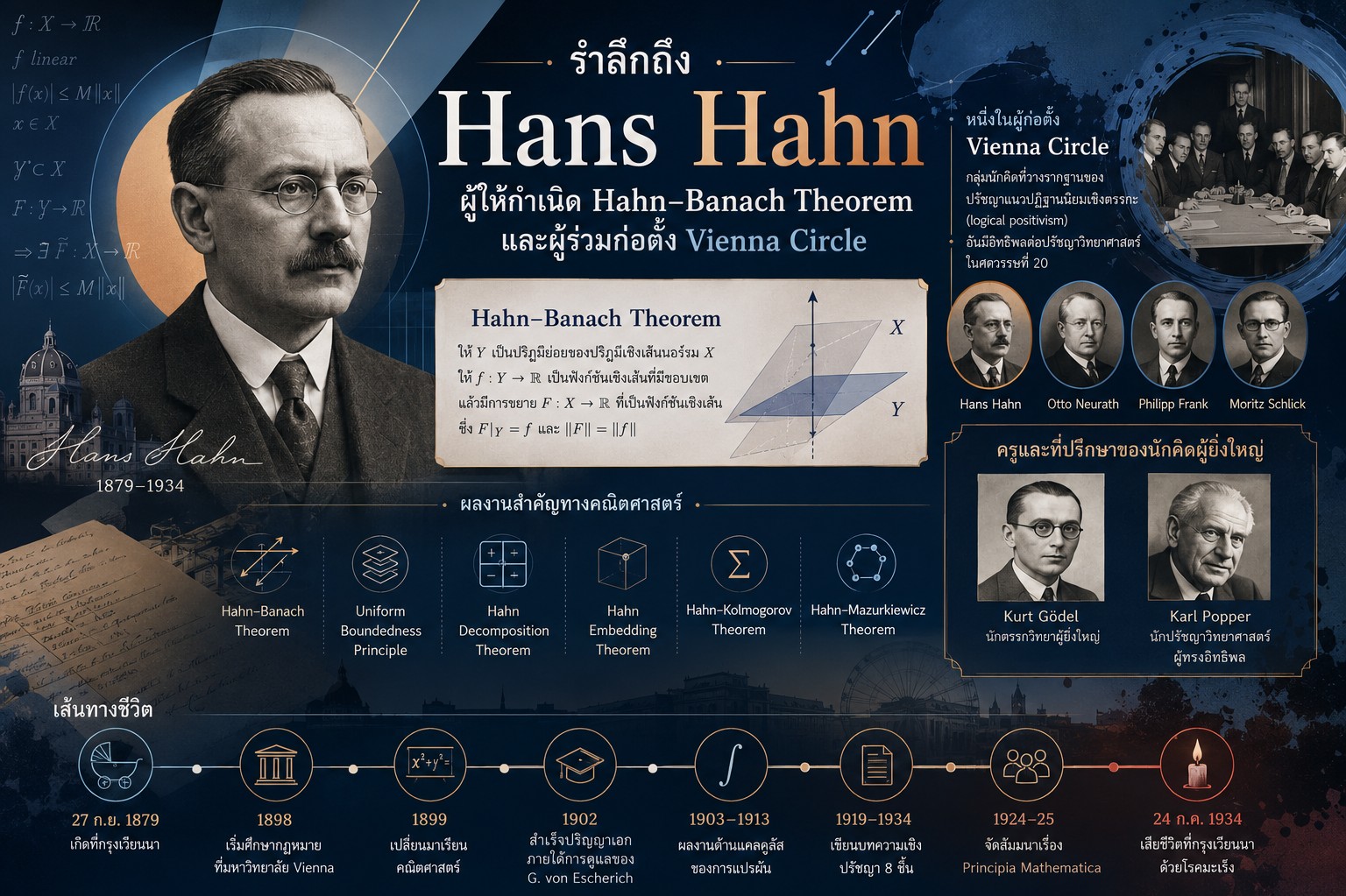
Hans Hahn passed away on July 24, 1934, in Vienna, Austria, at the age of 54, after being diagnosed with cancer and undergoing surgery. His sudden passing was a huge loss for both the mathematics and philosophy communities in Vienna, as he was still playing a key role in the Vienna Circle that he helped found.
Even though he has passed away, his work continues to be published. The book Set Functions, which he co-wrote with Arthur Rosenthal, was published in 1948, a full 14 years after his death.
Four thinkers who are inseparable
Hans Hahn was born on September 27, 1879, in Vienna, the son of Ludwig Benedikt Hahn, a high-ranking civil servant, and Emma Blümel. He started studying law at the University of Vienna in 1898 but switched to mathematics the following year. He went on to study at the universities of Strasbourg, Munich, and Göttingen before returning to Vienna to complete his doctoral dissertation under the supervision of Gustav Ritter von Escherich, finishing in 1902.
While studying in Vienna, he formed a close friendship with three other mathematics students: Paul Ehrenfest, Heinrich Tietze, and Gustav Herglotz, eventually becoming known as the 'inseparable four,' who had a huge influence on the development of his thinking.
From calculus of variations to functional analysis
Early in his career, between 1903 and 1913, Hahn made significant contributions to the calculus of variations, building on Karl Weierstrass's ideas. Later, he turned his attention to real functions and set functions, especially regarding integrals. He studied the construction of the Lebesgue integral as a limit of Riemann sums, an idea that Émile Borel had suggested earlier.
The work that made him most well-known is the Hahn–Banach theorem, which is one of the most fundamental theorems in functional analysis. It deals with extending a linear function with bounds from a subspace to the entire space while preserving the bounds. He also independently discovered the uniform boundedness principle along with Stefan Banach and Hugo Steinhaus around the same time. Other works that bear his name include the Hahn decomposition theorem, Hahn embedding theorem, Hahn-Kolmogorov theorem, and Hahn-Mazurkiewicz theorem, all of which are essential tools in various fields of analysis and topology.
The founder of the Vienna Circle and the teacher of Gödel and Popper
Besides his pure mathematics work, Hahn also played a very important role as one of the founders of the Vienna Circle, along with Otto Neurath, Philipp Frank, and Moritz Schlick. This was a group of thinkers who laid the foundational groundwork for logical positivist philosophy, which had a deep influence on 20th-century philosophy of science. Between 1924 and 1925, he held seminars on Whitehead and Russell's Principia Mathematica, which were attended by many people and had a huge impact on the discussion approaches of the Vienna Circle later on.
Hahn was also a mentor to several world-famous thinkers, including Kurt Gödel, the great logician, and Karl Popper, the influential philosopher of science, both of whom were influenced by him to some extent. He also wrote eight philosophical essays between 1919 and 1934 on empiricism, logic, and mathematics, which were later translated into English and published as a book in 1980.
A legacy that connects mathematics with philosophy
Hans Hahn is a rare example of a thinker who achieved great success both as a mathematician pioneering functional analysis and topology, and as a philosopher playing a key role in laying the foundations of new logical thinking. The Hahn-Banach theorem he discovered remains one of the cornerstones of modern functional analysis, widely used by mathematicians around the world. Every year on the anniversary of his passing, Hans Hahn's name continues to remind us of the power of crossing boundaries between disciplines, creating valuable contributions to both fields at the same time.