Charles-Émile Picard: Legendary analyst who gave birth to Picard's theorem
Among French mathematicians from the late 19th to early 20th century, Charles-Émile Picard is considered one of the greatest analysts, comparable to his contemporary Henri Poincaré. His work spans complex analysis, differential equations, and algebraic geometry, especially Picard’s theorems, which remain a fundamental part of function theory to this day.
A childhood faced with war
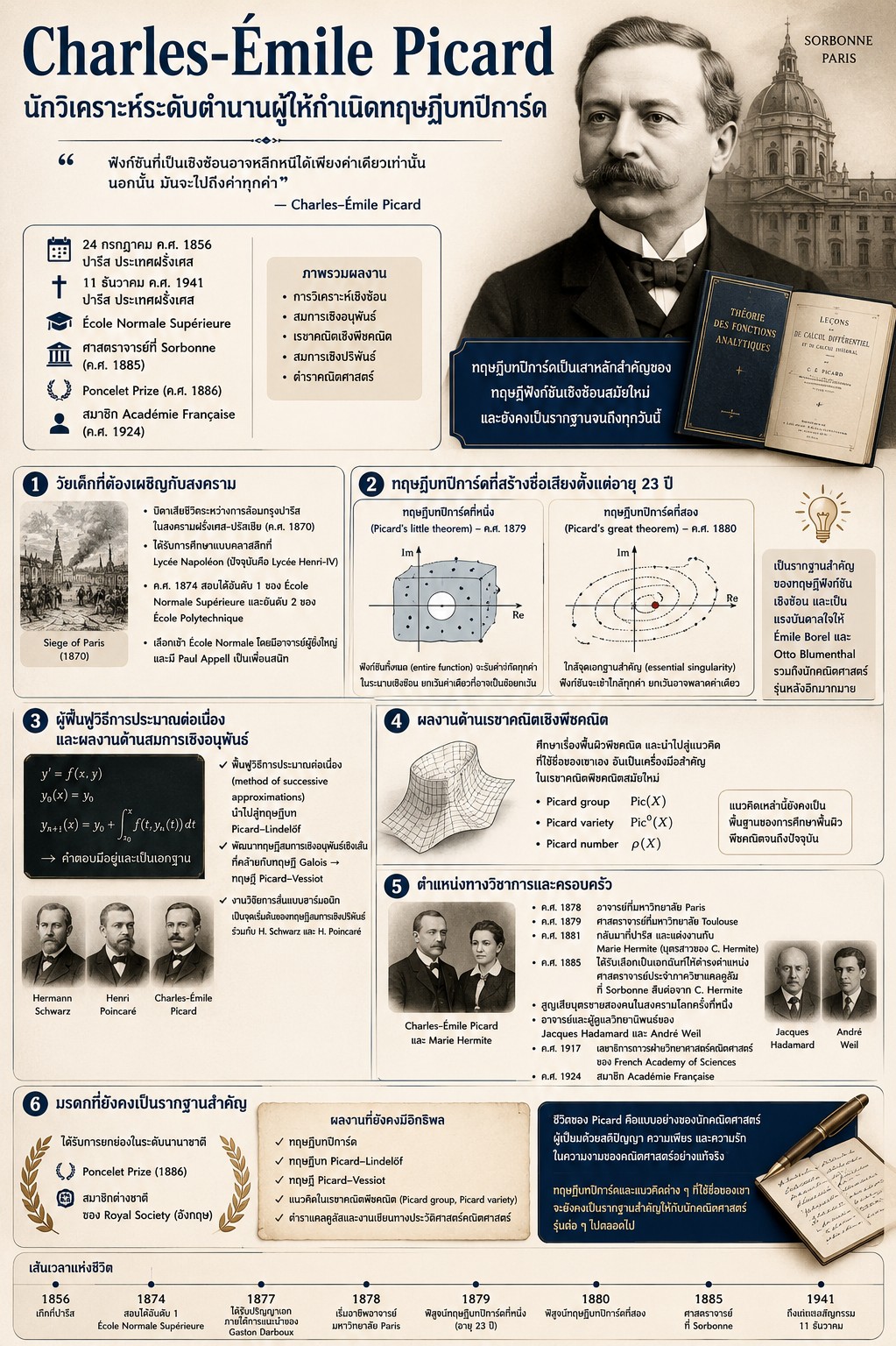
Charles Émile Picard was born on July 24, 1856, in Paris, France. His father was a manager of a silk factory who died during the Siege of Paris in the Franco-Prussian War in 1870, leaving his mother a widow to raise two sons on her own. Despite facing these hardships, Picard still received a classical education at Lycée Napoléon (later Lycée Henri-IV) in Paris, where he excelled in both languages and literature.
In 1874, after just one year of preparation, he was selected as the top student at École Normale Supérieure and second at École Polytechnique. He chose to study at École Normale, which had several famous professors, including Charles Auguste Briot, Jean-Claude Bouquet, and Gaston Darboux, who was his PhD advisor when he completed his doctorate in 1877. He also had Paul Appell as a close classmate.
Pythagoras' theorem that made him famous since the age of 23
The work that made Picard's name known throughout the mathematics community happened in 1879, when he was only 23 years old. He proved an amazing result about entire functions, which are functions that are defined and differentiable at every point in the complex plane, showing that such functions take on all possible values except possibly one. This result is known as Picard’s little theorem. Later, in 1880, he extended the result to Picard’s great theorem, which deals with the behavior of functions near essential singularities.
These two theorems became a crucial foundation for modern complex function theory and inspired later mathematicians like Émile Borel and Otto Blumenthal to further develop work in the same direction extensively.
A restorer of continuous approximation methods and work on differential equations
Picard also made significant contributions to reviving the method of successive approximations to prove the existence of solutions to differential equations, which is now known as the Picard–Lindelöf theorem. He also developed the theory of linear differential equations in a way that resembles Galois theory for algebraic equations, later known as Picard–Vessiot theory. His research on harmonic oscillations, together with the work of Hermann Schwarz from Germany and his contemporary Henri Poincaré, is also considered the starting point of the theory of integral equations.
In algebraic geometry, he made important contributions to algebraic surfaces, which led to concepts named after him, like the Picard group and Picard variety, which are still basic tools in modern algebraic geometry.
Academic positions and family
Picard started his career as a lecturer at the University of Paris in 1878 and became a professor at the University of Toulouse the following year. He returned to Paris in 1881, and in 1885 he was unanimously chosen to hold the position of professor of differential and integral calculus at the Sorbonne, succeeding Charles Hermite, at the young age of 29. In 1881, he also married Marie Hermite, the daughter of Charles Hermite, another great mathematician, which connected him closely with the leading French mathematician network. However, his family lost two sons in World War I, which brought him deep sorrow for the rest of his life.
Picard also supervised the theses of several famous mathematicians, including Jacques Hadamard and André Weil. In 1917, he was elected as the permanent secretary for mathematical sciences of the French Academy of Sciences, and in 1924, he was elected as a member of the prestigious Académie Française.
A Legacy That Remains a Fundamental Foundation
Charles-Émile Picard passed away on December 11, 1941, in Paris. Throughout his career, he received the Poncelet Prize in 1886 and was elected as a foreign member of the Royal Society of England. He is also known for writing classic calculus textbooks and biographies of several French mathematicians, including his father-in-law Charles Hermite. Picard's theorem and other concepts bearing his name are still fundamental material that math students around the world study in complex analysis today, cementing his status as one of France's greatest analysts.