Dunham Jackson: The founder of approximation theory and an outstanding textbook author
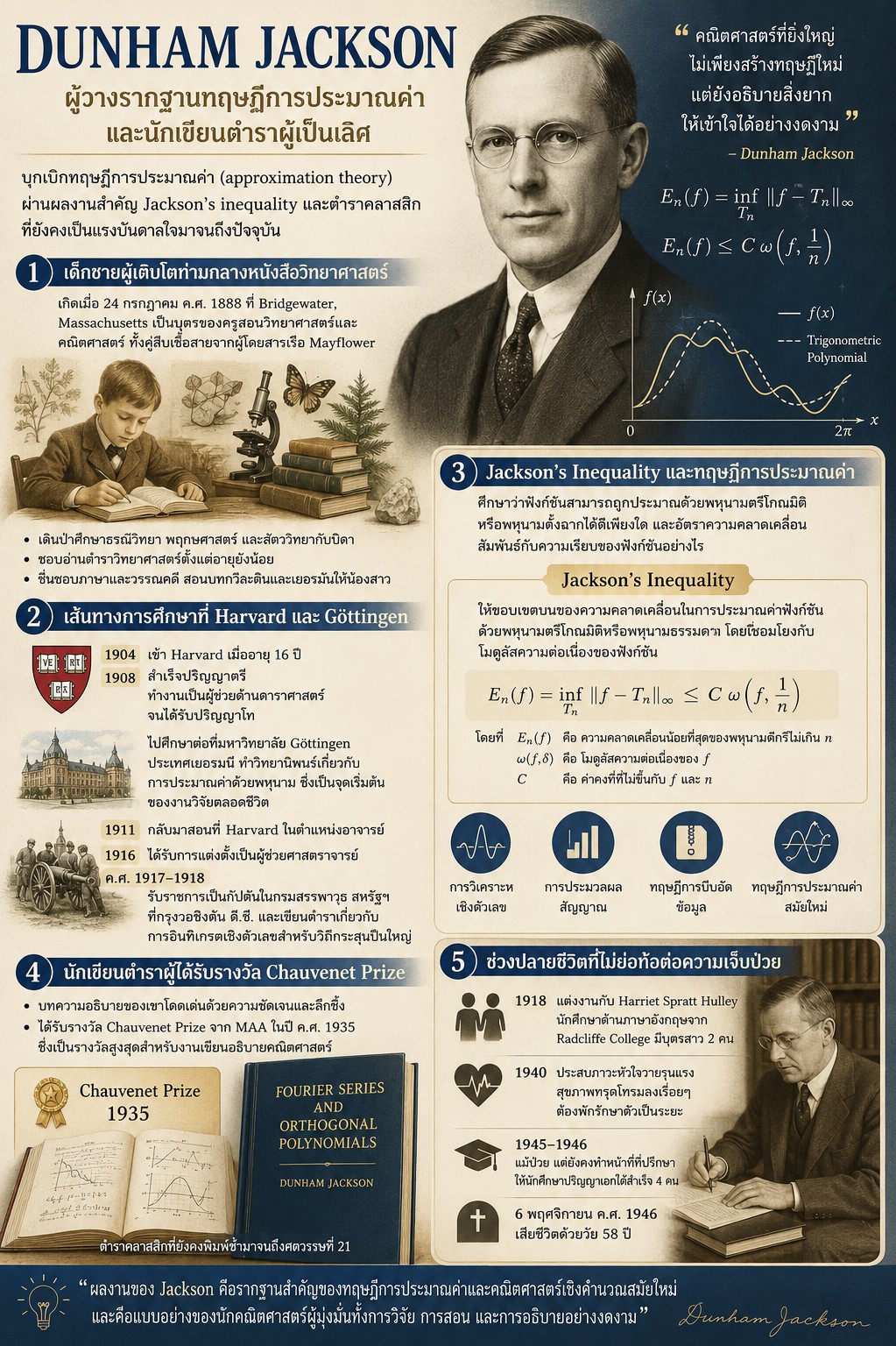
Among American mathematicians of the early 20th century, Dunham Jackson was a pioneer in approximation theory, which studies how well complex functions can be approximated by simpler ones, like polynomials. His work is still a key foundation of the field today, especially through what’s known as Jackson’s inequality.
A boy who grew up surrounded by science books
Dunham Jackson was born on July 24, 1888, in Bridgewater, Massachusetts, USA. He was the son of William Dunham Jackson, a science and math teacher at the town's Normal School, and Mary Vose Jackson. Both of his parents graduated from the same school and were descendants of Mayflower passengers.
Since he could walk, Jackson often followed his father on hikes to study geology, botany, and zoology, which helped him build a broad knowledge base and a love for observing things from a young age. He also enjoyed reading science books in the family library when he was still little. Even in high school, he especially liked language and literature subjects, to the point of teaching Latin and German poetry to his younger sister.
My study path at Harvard and Göttingen
Jackson started studying at Harvard University when he was just 16 years old and earned his bachelor's degree in 1908 before working as an assistant in astronomy until he got his master's degree. He then went to study at the University of Göttingen in Germany, which was one of the most important mathematical centers in the world at that time. His doctoral thesis answered a prize question that the Göttingen faculty had posed earlier, about the possibility of improving results in polynomial approximation, which became the starting point of his lifelong research.
After graduating, Jackson returned to teach at Harvard as an instructor starting in 1911 and became an assistant professor in 1916. During World War I, he served as a captain in the Ordnance Department of the U.S. Army in Washington, D.C., and wrote a textbook on numerical integration for artillery trajectories, which was an application of mathematics to directly support the war effort.
Jackson’s Inequality and Estimation Theory
In 1919, Jackson moved to be a professor at the University of Minnesota, a position he held until the end of his life. His main research focused on the theory of approximation using trigonometric polynomials and orthogonal polynomials, studying how well a function can be approximated by polynomials of a limited degree and how the error in that approximation relates to the smoothness of the function.
The work that made his name known throughout the field is Jackson’s inequality, which gives an upper bound on the error when approximating a function using trigonometric or ordinary polynomials. It connects with the modulus of continuity of that function. This inequality has become a fundamental tool in modern approximation theory and plays an important role in numerical analysis, signal processing, and data compression theory.
A textbook author who won the Chauvenet Prize
Besides his research, Jackson was also widely known as an excellent math explainer, whether in academic publications, lectures, or teaching at all levels. His explanatory articles on orthogonal polynomial series, orthogonal trigonometric sums, and the convergence of Fourier series were so clear and outstanding that he won the Chauvenet Prize from the Mathematical Association of America in 1935, which is the highest award for mathematical exposition. His most famous textbook is "Fourier Series and Orthogonal Polynomials," published in 1941, which keeps getting reprinted even into the 21st century.
The later stage of life where I don't give up despite illness
Jackson married Harriet Spratt Hulley in 1918, who was a graduate student in English at Radcliffe College. They had two daughters. In 1940, he suffered a severe heart attack, and his health steadily declined from then on, requiring him to take breaks for treatment both at home and in the hospital. Despite this, he still managed to advise four PhD students to completion in the final year of his life.
Dunham Jackson passed away on November 6, 1946, at the age of 58, leaving behind research in approximation theory that remains a key foundation of modern computational mathematics, as well as classic textbooks that continue to inspire later generations of mathematicians to appreciate the value of explaining complex ideas clearly and beautifully.