Remembering Henri Lebesgue, the revolutionary of integration theory
Henri Lebesgue was a legendary French mathematician who developed the theory of Lebesgue integration, building on the work of Camille Jordan and Émile Borel, which successfully solved the limitations of the Riemann integral. His work became a crucial foundation supporting all of modern mathematical analysis. On this occasion, let's take a moment to look back on the life of the thinker who forever changed our basic understanding of area and integrals.
Final agenda in Paris, July 26, 1941
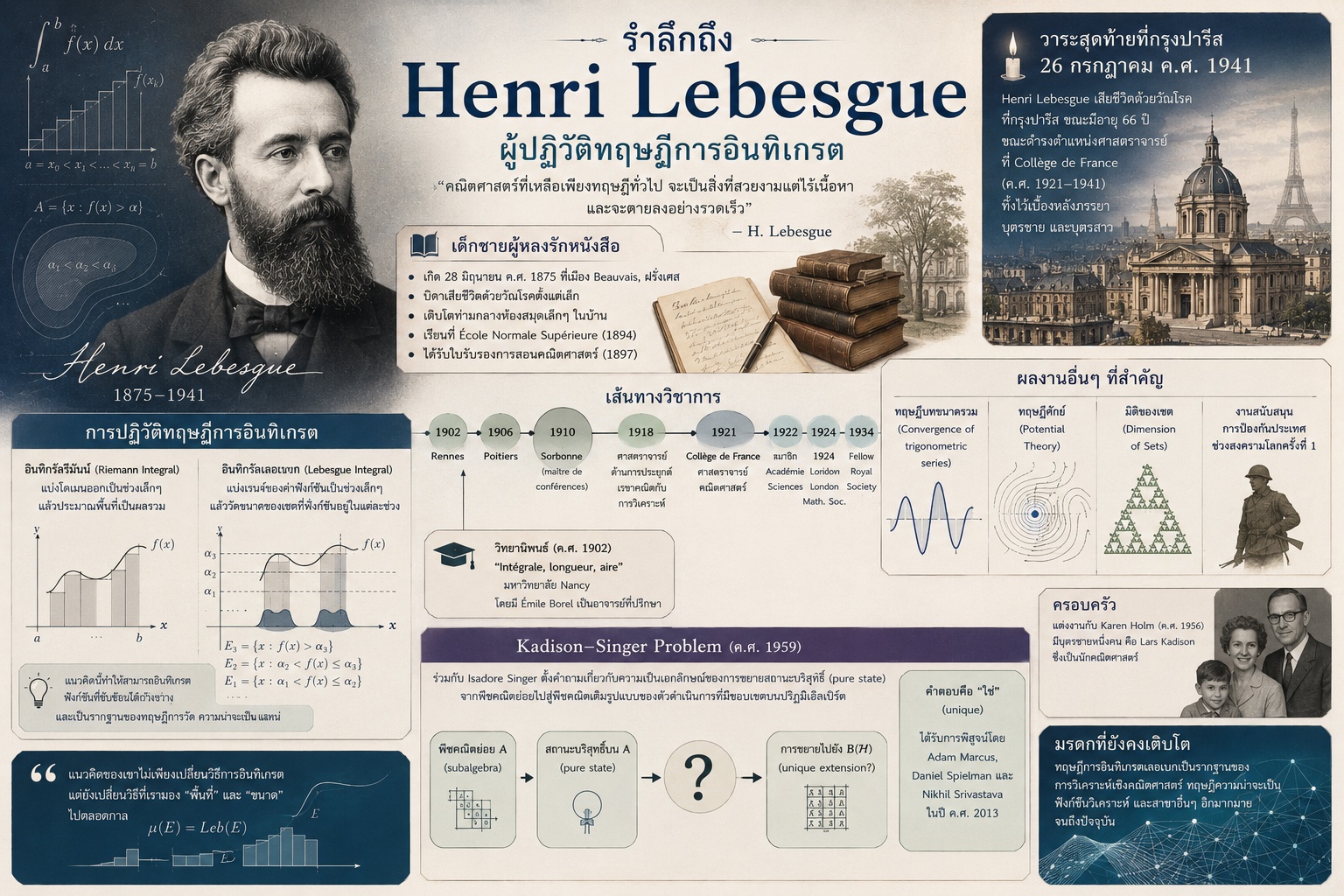
Henri Lebesgue passed away on July 26, 1941, in Paris at the age of 66. He had been suffering from tuberculosis since childhood, the same disease that had claimed his father's life earlier, and this illness was a major factor in his death. At the time, he was still serving as a professor at the Collège de France, a position he had held since 1921, right up until the end. He left behind his wife, a son, and a daughter.
A boy who lost his father but grew up surrounded by books
Henri Léon Lebesgue was born on June 28, 1875, in the town of Beauvais, Oise, France. His father was a typesetter who died of tuberculosis when Lebesgue was still a little boy. So his mother had to raise him on her own. But the family had set up a small library space in their home, which young Lebesgue spent a lot of time with, reading constantly.
He started studying at Collège de Beauvais before moving to Paris to continue his studies at Lycée Saint Louis and Lycée Louis-le-Grand. Then he entered the École Normale Supérieure in 1894 and got his teaching certificate in mathematics in 1897. After that, he spent another two years studying in the institute's library, during which he read René-Louis Baire's work on discontinuous functions and realized that there was still a lot to explore in this field.
The revolution of integrative theory
The revolutionary work that made Lebesgue famous started in 1901 when he developed measure theory, and the following year he proposed the definition of the Lebesgue integral in his doctoral thesis, “Intégrale, longueur, aire,” at the University of Nancy under the supervision of Émile Borel.
The traditional Riemann integral that's been used since the 17th century has a major limitation: it doesn't work well with functions that have complicated discontinuities. Lebesgue solved this problem with a completely different approach. Instead of dividing the function's domain into small intervals like Riemann's method, he divided the range of the function's values into small intervals and measured the size of the set where the function takes values in each interval. This method makes it possible to integrate much more complex functions and opened the door to the development of modern measure theory and probability theory later on.
A stable academic path
After graduating, Lebesgue taught at the University of Rennes from 1902 to 1906 before moving to Poitiers, and in 1910 he moved to the Sorbonne in Paris as a maître de conférences in mathematical analysis. He was promoted to professor of the application of geometry to analysis in 1918 before moving to become a mathematics professor at the Collège de France in 1921, which was his final position in his career. He was also elected a member of the Académie des Sciences in 1922, an honorary member of the London Mathematical Society in 1924, and a foreign member of the Royal Society in 1934.
Other works apart from Lebesgue integrals
Although Lebesgue is most remembered for his integral theory, interestingly, he didn’t devote his entire research life to the field he pioneered. This was because he was too cautious about general theories, once writing that if mathematics were reduced to just general theory, it would become a beautiful but contentless structure, and would quickly die out. So, he turned to research in other areas as well, including trigonometric series, potential theory, and set dimensions. During World War I, he also worked to support French national defense, a period during which he conflicted with Borel, his advisor, who was involved in similar work.
The legacy that is the foundation of all modern mathematics
Lebesgue's integration theory wasn't immediately accepted when it was first published, but over time, his ideas became widely recognized in France, Poland, and the United States, eventually becoming an indispensable tool in mathematical analysis, probability theory, and many other fields of modern mathematics. Every year on the anniversary of his passing, Henri Lebesgue's name still serves as a reminder of the power of looking at old problems from a completely new perspective, which can profoundly change the foundations of an entire field.