George Abram Miller: From a Poor Farm to a Pioneer of Early American Group Theory
The story of George Abram Miller, an American mathematician and one of the early pioneers of group theory, is a classic example of determination that took a young boy from a poor farm in Pennsylvania to becoming one of the most published mathematicians in American history.
A young boy who has to teach to raise money for further studies
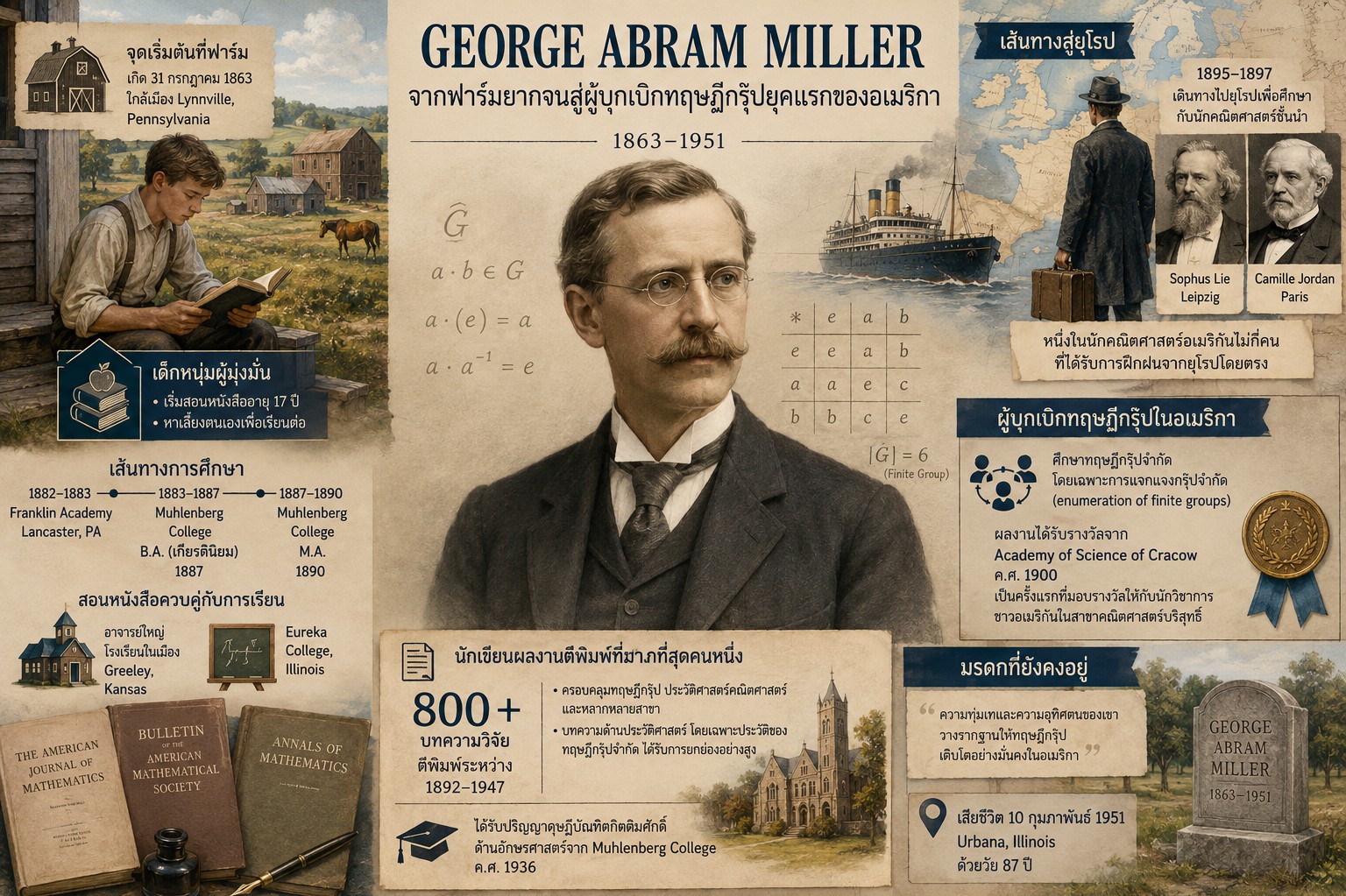
George Abram Miller was born on July 31, 1863, on a farm near the town of Lynnville, Pennsylvania, as the son of Nathan Miller and Mary Sittler. His family descended from Christian Miller, an immigrant from Switzerland to the United States around 1720. The family was poor and could not afford to send him to further education, so Miller had to start teaching at the age of just 17 to earn money to support his own studies.
Between 1882 and 1883, he attended Franklin Academy in Lancaster before transferring to study at Muhlenberg College in Allentown, where he received an honors bachelor's degree in 1887 and a master's degree in 1890. During that time, he had to work as a principal of a school in Greeley, Kansas, and as a mathematics professor at Eureka College in Illinois simultaneously to support himself while continuing his studies.
An extraordinary educational path
Miller's path to obtaining a doctorate is quite interesting, as Cumberland University in Lebanon, Tennessee, offered a correspondence doctoral program that did not require an original dissertation but used advanced subject exams instead. Miller chose this route to earn his doctorate. Even more interesting is that later he offered the same type of program to his own students at Eureka College.
Between 1893 and 1895, he worked as a lecturer at the University of Michigan before traveling to Europe from 1895 to 1897 to attend lectures by Sophus Lie in Leipzig and Camille Jordan in Paris, both legendary mathematicians in the field of group theory. This experience made Miller one of the few American mathematicians of that era who was trained directly in Europe.
Pioneer of early American group theory
Miller devoted most of his career to the study of finite group theory, particularly the enumeration of finite groups, which is the study of methods to classify and count mathematical groups with various structures systematically. His work in this field made him one of the key pioneers of group theory in America at a time when this field was still very new to the American mathematical community.
In 1900, his work in group theory was awarded by the Academy of Science of Cracow, a prize that had not been given to anyone for 14 years, and it was the first time this institution awarded a prize to an American scholar in the field of pure mathematics. Although later historians of mathematics assessed that his work might not be especially significant by current standards, his contemporaries held him in high regard, so much so that he was ranked as the 10th American mathematician in J. M. Cattell's American Men of Science.
One of the most prolific published authors
Miller is known as a mathematician with an astonishingly large number of published works. Throughout his career, he published more than 800 research articles, covering the period from 1892 to 1947, which is a very high number even by today's standards. Besides group theory, he also had a deep interest in the history of mathematics, particularly the history of finite group theory itself, which was only slightly secondary to the theory itself. His historical articles were recognized as being of special value and significance.
He spent most of his working life at the University of Illinois, an institution he had long been affiliated with, and received an honorary Doctor of Letters degree from Muhlenberg College, the institution he had attended in 1936.
The legacy that laid the foundation for the American mathematics community
George Abram Miller passed away on February 10, 1951, in Urbana, Illinois, at the age of 87. His life was a reflection of an American scholar in a transitional era, struggling to establish his academic standing from scratch before traveling to Europe for training to bring new knowledge back to the growing American mathematics community. Although his work may not be remembered on the same level as other legendary mathematicians, his dedication to laying the foundations of group theory for American mathematics in its pioneering days was an important contribution that helped the field grow steadily in the years that followed.