Oskar Anderson: The stateless statistician who laid the foundation for early econometrics
The story of Oskar Anderson, a mathematician and statistician who was called Russian, Bulgarian, and German throughout his life, is a clear reflection of scholars in an era when political borders were extremely volatile. He was one of the pioneers in applying statistics to economics in its early days, particularly in economic statistics and time series analysis.
A German-Baltic boy from the city of Minsk
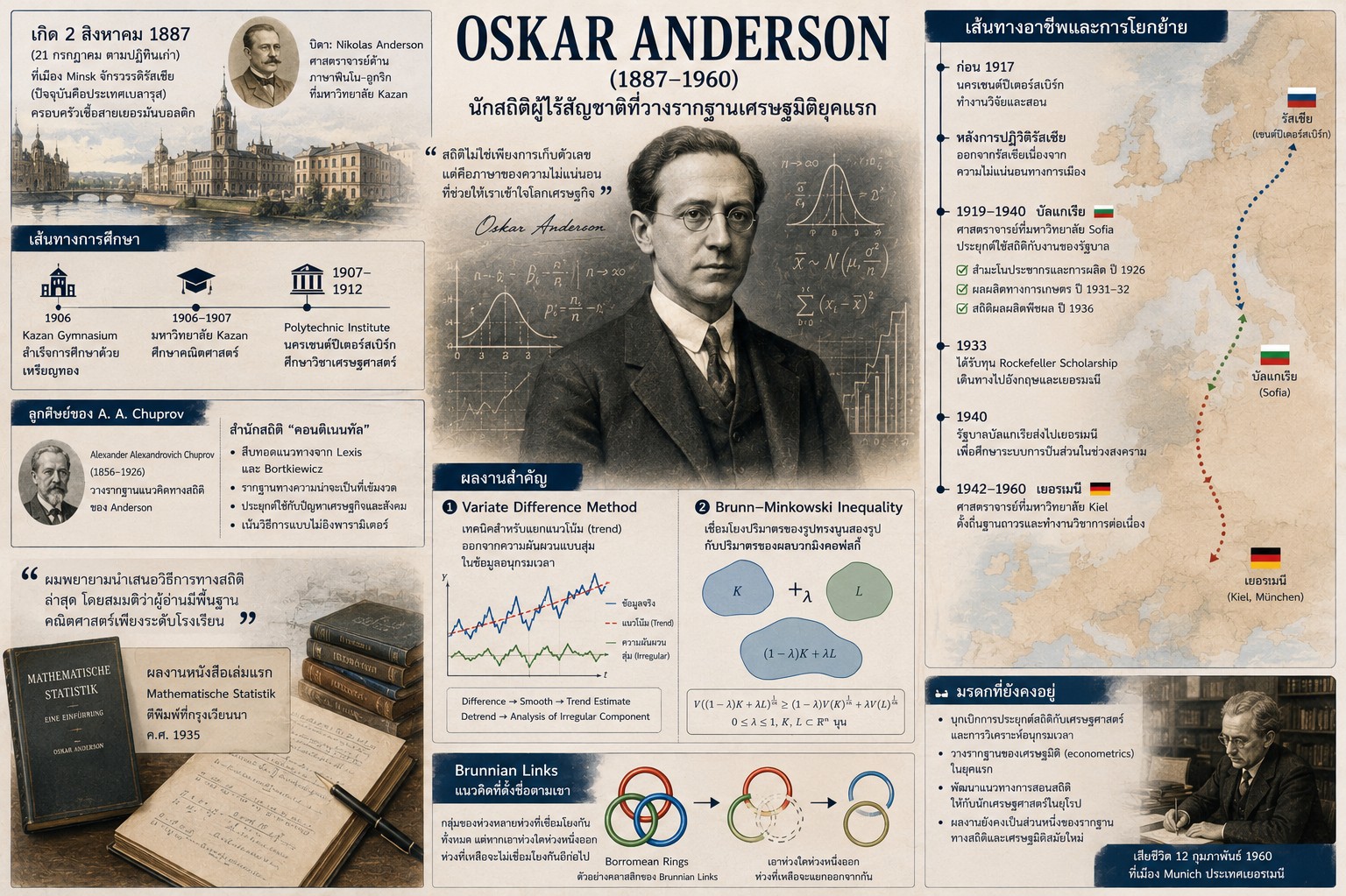
Oskar Johann Viktor Anderson was born on August 2, 1887 (according to the new calendar, or July 21 according to the old calendar) in Minsk, Russian Empire (now Belarus), into a Baltic German family. His father, Nikolas Anderson, was a professor of Finno-Ugric languages at Kazan University, which led the family to move to Kazan while Oskar was still a child.
He attended Kazan Gymnasium, the same school where Nikolai Lobachevsky, the pioneering mathematician of non-Euclidean geometry, had studied nearly a hundred years earlier, and graduated with a gold medal in 1906. After that, he studied mathematics at Kazan University for one year before transferring to study economics at the Polytechnic Institute in Saint Petersburg.
A disciple of Chuprov and the 'Continental' school of statistics
In St. Petersburg, Anderson became a student of Alexander Alexandrovich Chuprov, a renowned Russian statistician who laid important intellectual foundations for him. Anderson developed himself to become a key representative of what is called the 'continental school of statistics,' which inherited approaches from famous statisticians such as Wilhelm Lexis and Ladislaus Bortkiewicz, characterized by a strict emphasis on probabilistic foundations combined with practical applications in economic and social problems.
A key highlight of Anderson is the application of mathematical statistics to economics using nonparametric methods, which is an approach that is ahead of its time in many aspects.
A life that has to move according to political fluctuations
After the Russian Revolution, Anderson faced severe political uncertainty because he disagreed with the new government's approach of transitioning too quickly to a socialist economy without sufficient economic experts. Eventually, he emigrated from Russia and settled in Bulgaria, where he obtained Bulgarian nationality and held a professorship at Sofia University.
While in Bulgaria, Anderson played an important role in applying mathematical statistics to several government projects, including the use of sampling techniques in the 1926 population and production census, the study of agricultural output in Bulgaria during 1931-32, and crop yield statistics in 1936. In 1933, he received a Rockefeller Scholarship, which gave him the opportunity to travel to England and Germany. During that time, he wrote his first book on mathematical statistics, published in Vienna in 1935, which attempted to present the latest statistical methods on the assumption that the readers had only a high school level of mathematical knowledge.
Variate Difference Method and Work on Time Series
One of Anderson's most outstanding works is the development of the Variate Difference Method, a statistical technique used to separate trends from random fluctuations in time series data. This method is extremely important in analyzing economic data that contain both long-term trends and seasonal or cyclical fluctuations. His work in this area is considered a pioneering contribution to what is now called econometrics, a field that combines economics, economic theory, and statistical methods.
Last year in Germany
In 1940, the Bulgarian government sent Anderson to Germany to study the allocation system during the war, and in 1942 he obtained a professorship at the University of Kiel, which marked the beginning of his permanent settlement in Germany. He continued his academic work until his death, and in his later years, he was highly recognized in the German statistics community to the extent that contemporary scholars described him as 'the most famous statistician in Central Europe' and an expert in improving the training of statistics for economists at many German universities.
The legacy of a statistician who crossed the borders of many countries
Oskar Anderson passed away on February 12, 1960, in Munich, Germany. His life reflected the turbulent era of 20th-century Europe, where scholars had to adapt and move according to major political changes. Yet, amidst such uncertainties, he continued to produce valuable research. His work in time series analysis and the application of statistics to economics remains a foundational part that modern econometrics has built upon to this day.