Aleksandr Danilovich Aleksandrov: A mountaineer who revolutionized the geometry of convex surfaces.
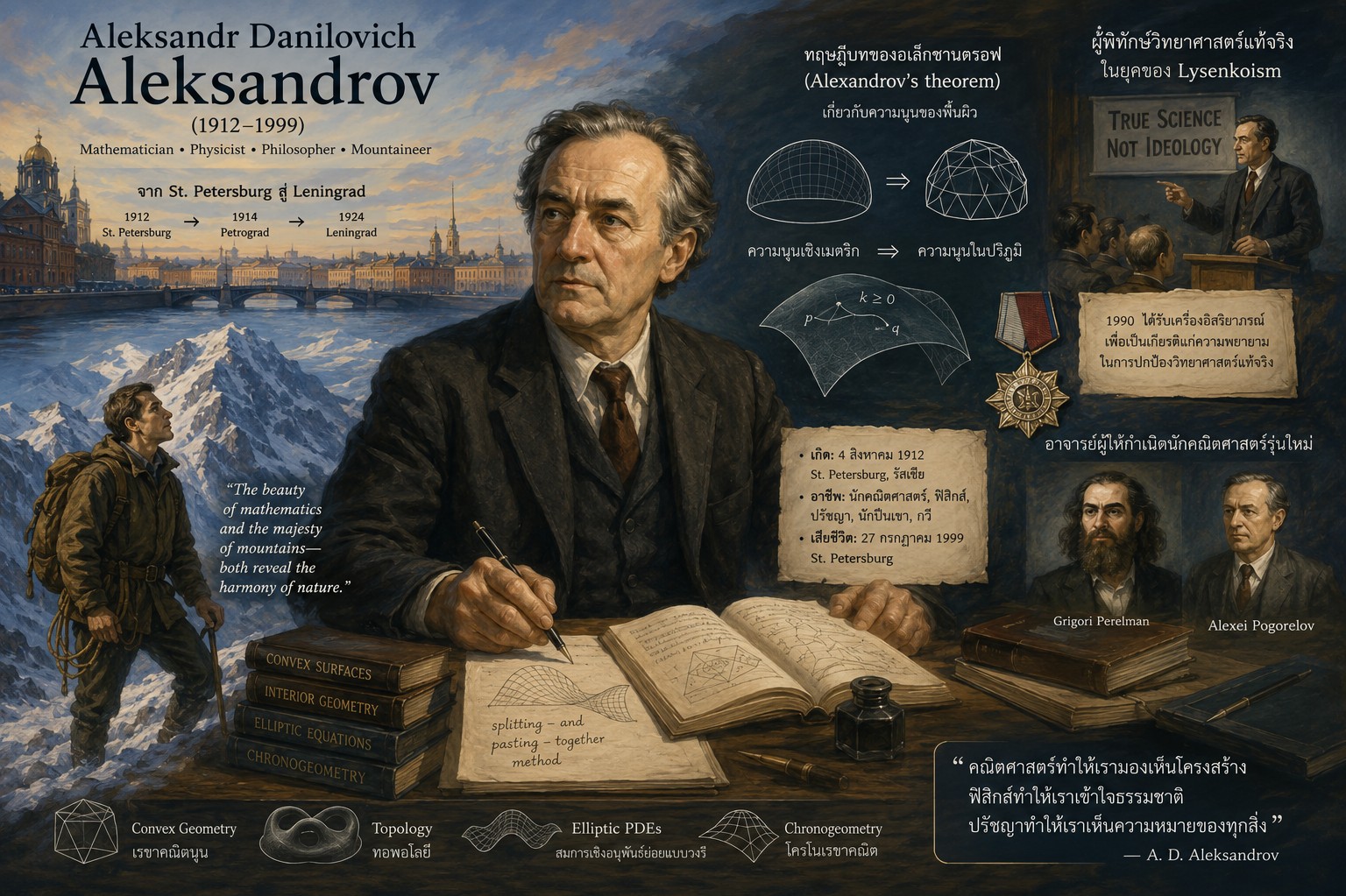
Aleksandr Danilovich Aleksandrov was a Russian mathematician who made significant contributions to convex geometry and topology. He is the originator of Alexandrov's theorem concerning the convexity of a surface. Beyond his role as a mathematician, he was also a physicist, philosopher, and avid mountaineer, leading a life as diverse as his academic achievements.
From the village of Volyn to the metropolis of St. Petersburg.
Aleksandr Danilovich Aleksandrov was born on August 4, 1912, in the village of Volyn, Ryazan Oblast, Russian Empire. His father, Danil Alexandrovich Alexandrov, was the headmaster of a secondary school in St. Petersburg, and his mother, Elizaveta Iosifovna Bartoshevich, was a teacher at the same school. Both came from old noble families, so Aleksandrov grew up mostly in St. Petersburg, despite being born in a small village.
Interestingly, during his childhood, the name of the city where he lived changed twice due to political events. At the age of just two, St. Petersburg was renamed Petrograd, and when he graduated from high school in 1928, the city was renamed Leningrad, reflecting the great political turmoil in Russia at that time.
From art to physics and mathematics.
Interestingly, after graduating from high school, Aleksandrov did not initially intend to study mathematics. Instead, he spent a year at an art school before entering Leningrad State University in 1929, initially focusing primarily on physics. He graduated in 1933 from the physics department under the tutelage of the renowned physicist Vladimir Fock and the mathematician Boris Delaunay. Having these two mentors shaped him into an academic proficient in both physics and mathematics.
He began working as a researcher at the Vavilov State Optical Institute in 1930, and in 1933 he began lecturing on mathematics and mechanics at the university. He received a doctorate in philosophy in 1935 and a doctorate in science in 1937.
Geometry of convex surfaces and Alexandrov's theorem
Aleksandrov's most famous work is the development of the theory of two-dimensional manifolds of bounded curvature, also known as interior geometry, of irregular surfaces. This extended classical differential geometry to cover surfaces that do not necessarily have to be perfectly smooth.
He developed a method called the splitting-and-pasting-together method, which is extremely effective in the bending of convex surfaces. Alexandrov's theorem on the convexity of surfaces is a key result showing the deep link between metric geometry and shape convexity in space, becoming a basic tool in modern convex geometry.
The true defenders of science in the era of Lysenkoism.
Aleksandrov played a crucial role not only in the academic community but also as a defender of scientific integrity during an era of intense political interference. Specifically, during the height of Lysenkoism—a state-supported pseudoscientific genetic theory under Stalin and Khrushchev—he was among those who fought to protect genuine genetics from attacks by this pseudoscientific movement. This was a highly courageous stance that carried immense risks at the time, and in 1990, he was awarded an order of honor in recognition of these efforts.
A mountaineer and poet who loves to travel.
Beyond his academic work, Aleksandrov was also an avid mountaineer and had a passion for poetry, both writing and translating it. He traveled to many countries around the world, including India, the United States, and various European nations. In 1937, he married Marianna Leonidovna Georg and they had two children, Daria and Daniil.
He was also a mentor to several renowned mathematicians, including Grigori Perelman, who later successfully proved the Poincaré conjecture, and Alexei Pogorelov, both of whom continued and expanded upon his mentor's research in geometry.
A Legacy That Remains a Fundamental Foundation
Aleksandr Danilovich Aleksandrov died on July 27, 1999, in St. Petersburg. Throughout his life, he reflected a polymath who seamlessly combined mathematical rigor with a passion for physics, philosophy, and art. His works on the geometry of convex surfaces and topology continue to form a foundation for mathematicians worldwide to this day.