John Venn: A pastor and mathematician who created a set theory teaching tool used worldwide.
When it comes to the simplest tool in the world for describing the relationships between sets, the Venn diagram is often the first name that comes to mind. Behind this powerful yet simple tool is John Venn, an English mathematician and logician whose life story is as fascinating as his work.
The son of a priest from the Clapham Sect.
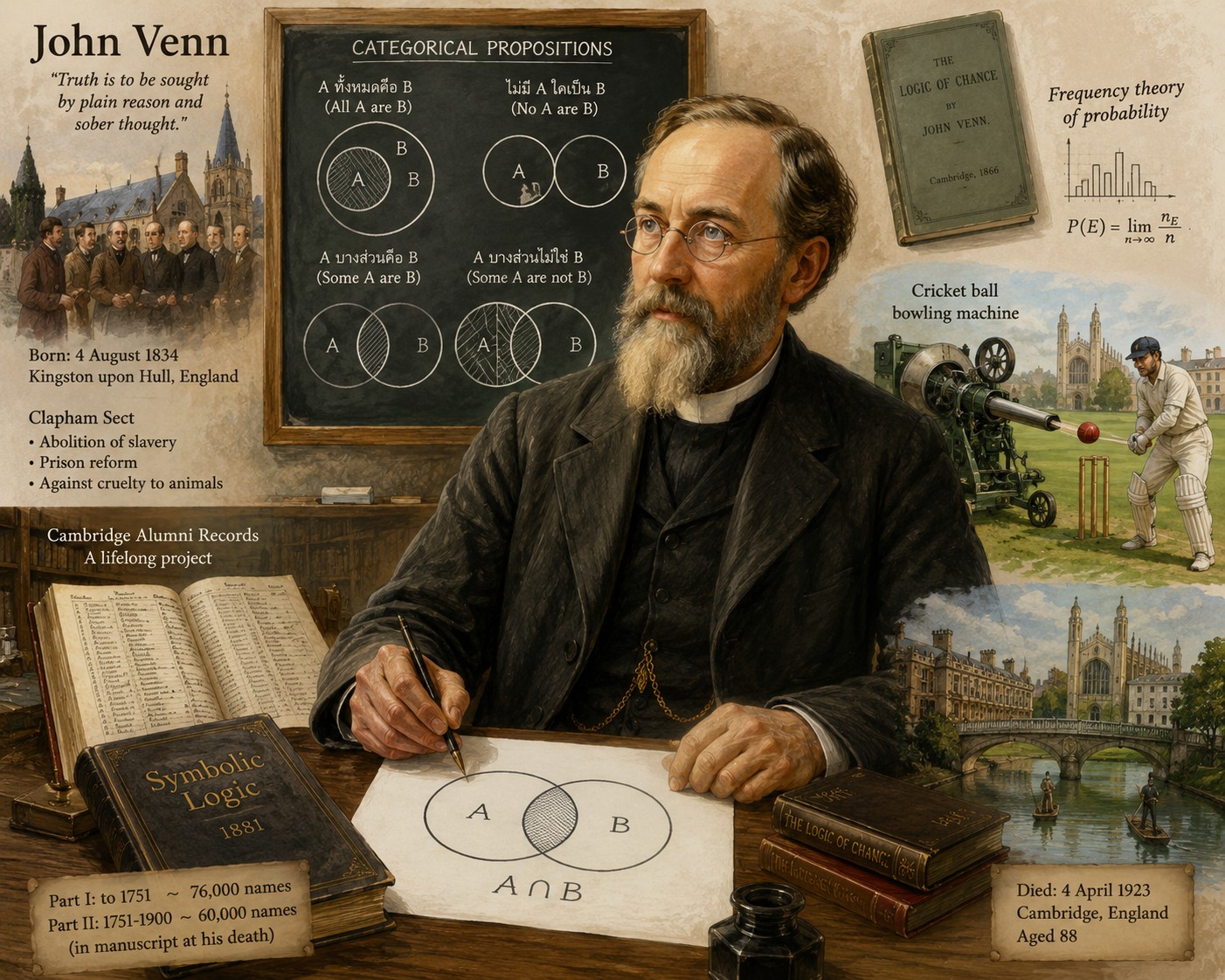
John Venn was born on August 4, 1834, in Kingston upon Hull, Yorkshire, England. His father, the Reverend Henry Venn, was the rector of the parish of Drypool near Hull at the time of John's birth. His family was prominent and had a long history in the ministry. His grandfather, the Reverend John Venn, was the former rector of the parish of Clapham in south London, who became the leader of the Clapham Sect, an evangelical Christian group that played a significant role in campaigning for the abolition of the slave trade, prison reform, and the opposition to cruel sports.
Venn's mother, Martha Sykes, died when he was a young child, so he grew up primarily under his father's care. He received his early education from tutors and schools in the Highgate and Islington areas before entering Gonville and Caius College, University of Cambridge, in 1853, and graduating with a degree in mathematics in 1857. With outstanding academic performance, he was awarded a College Fellowship, a position he held for life.
A path that blends religion with logic.
Following family tradition, Venn was ordained an Anglican priest and worked as a clergyman for a period of his life before returning to Cambridge to teach logic and probability theory, fields in which he made significant contributions. He was elected a Fellow of the Royal Society in 1883 in recognition of his outstanding academic work.
One of Venn's early and most important works was a book. The Logic of Chance Published in 1866, his work introduced the frequency theory of probability, proposing that probability should be determined by the actual frequency with which an event occurs over a long period, rather than by subjective assumptions or "studied" estimations. This idea had a profound influence on the subsequent development of frequency theory of probability.
The origin of Venn diagrams.
The work that made Venn's name known worldwide today is his introduction of Venn diagrams in his work Symbolic Logic, published in 1881. Building upon the ideas of George Boole, a pioneering mathematician of symbolic logic, Venn developed a method for representing relationships between sets using overlapping circles. These circles clearly and easily illustrated categorical propositions such as "All A are B," "No A is B," "Some A are B," and "Some A are not B."
Although the concept of using circles to represent set relationships predates Venn, particularly through the work of Leonhard Euler, Venn developed this system further, making it more complete and systematic. It became capable of representing more complex relationships and is now a widely used standard tool in teaching logic, set theory, probability, statistics, and computer science.
Inventor, expert in machinery
Beyond his work in logic and mathematics, Venn possessed an exceptional skill in machine building. He invented a highly efficient cricket ball bowling machine, so efficient that when the Australian cricket team visited Cambridge in 1909, Venn's machine managed to bowl four of their famous cricketers, demonstrating his remarkable versatility beyond his academic pursuits.
In addition, Venn devoted considerable time to working with his father to compiling the Cambridge student historical records, a project of immense value to later historians and genealogists. The first part covered over 76,000 names up to 1751, and by the time he died, a second part, covering the period from 1751 to 1900, contained another 60,000 names in original handwritten form.
A legacy that continues to be taught around the world.
John Venn passed away on April 4, 1923, in Cambridge at the age of 88. His entire life was a beautiful reflection of a scholar who perfectly blended religious devotion with logical rigor. Although the Venn diagram appears simple with just a few overlapping circles, the clarity and explanatory power it provides have made it one of the most influential educational tools of all time, which continues to be taught to students worldwide from primary school to university to this day.