William Rowan Hamilton: The Irish genius who discovered the Quaternion on Broom Bridge.
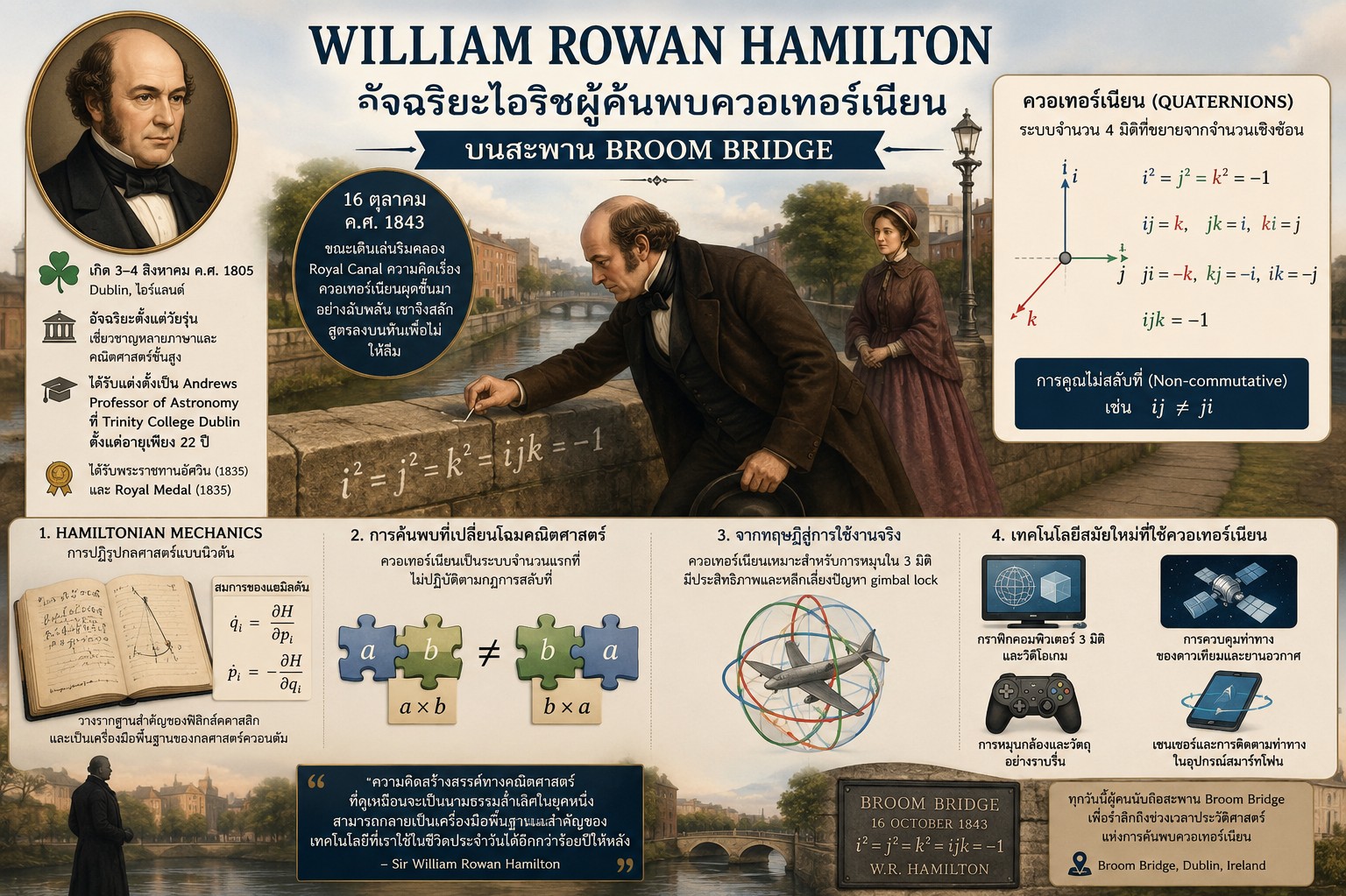
Sir William Rowan Hamilton was a legendary Irish mathematician who invented quaternions, a number system extended from complex numbers, now widely used in three-dimensional computer graphics, video games, and spacecraft motion control. He also made significant contributions to Hamiltonian mechanics, which later became a foundational work in quantum mechanics.
A genius who was praised since his teenage years.
William Rowan Hamilton was born at midnight between August 3 and 4, 1805, in Dublin, Ireland, as the fourth of nine children to Archibald Hamilton, a lawyer, and Sarah Hutton. He demonstrated remarkable intellectual talent from early childhood, being able to read multiple languages at a young age and mastering advanced mathematics as a teenager. His genius was such that the renowned astronomer Bishop John Brinkley once remarked of the 18-year-old Hamilton, "This young man, I do not say will be, but is, the first mathematician of his age."
He entered Trinity College Dublin and demonstrated outstanding ability from a young age, publishing important articles in optics and dynamics. This led to his appointment as Andrews Professor of Astronomy at Trinity College in 1827, even before he had completed his undergraduate studies—a remarkably unusual event in academic circles.
Hamiltonian Mechanics: Reformation of Newtonian Mechanics
Hamilton's first major contribution that brought him fame was the development of Hamiltonian mechanics, a refinement of Newtonian mechanics into a more elegant and simpler form. He used the concept of characteristic functions, which he had first developed in optics, and applied it to dynamics, resulting in Hamilton's equations of motion, which describe the relationship between momentum and position of a mechanical system.
This work not only changed the way physicists viewed classical mechanics, but also became a fundamental basis for classical field theories such as electromagnetic theory, and, more importantly, became an indispensable tool in the development of 20th-century quantum mechanics, which uses the Hamiltonian operator as central to describing the energy of quantum systems.
A historic moment at Broom Bridge.
The most famous event in Hamilton's life occurred on October 16, 1843, while he was strolling along the Royal Canal with his wife to attend a meeting at the Royal Irish Academy. Suddenly, the idea of quaternions popped into his head, after years of unsuccessful attempts to expand two-dimensional complex numbers into a three-dimensional number system.
In his excitement, he did not hesitate to carve the fundamental formula of quaternions, i² = j² = k² = ijk = -1, onto the stone of Broom Bridge immediately, so as not to forget this crucial idea. Quaternions are a number system that extends complex numbers into four dimensions, featuring the unique property that multiplication is non-commutative. This means multiplying a by b yields a different result than multiplying b by a. It was a discovery that completely revolutionized the field of algebra at the time, as it was the first time a number system was introduced that did not follow the commutative law, which had previously been viewed as a fundamental axiom of mathematics.
From pure theory to modern technology.
Although quaternions were not very popular for practical use during Hamilton's lifetime, due to the greater ease of use of later-developed vector systems in many contexts, they have become indispensable tools in various technological fields today, particularly in the rotation of objects in three-dimensional space. This is because quaternions can efficiently represent rotations while avoiding the gimbal lock problem often encountered with other methods.
Quaternions are widely used today in 3D computer graphics and video games for smooth calculations of object and camera rotations, as well as in the attitude control systems of spacecraft and satellites, which require high precision in calculating rotational direction in three-dimensional space.
A living legacy in modern technology.
William Rowan Hamilton died on September 2, 1865, in Dublin, at the age of 60. Throughout his life, he received numerous honors, including a knighthood in 1835 and the Royal Medal in the same year. He is widely regarded as one of the most influential Irish physicists, comparable to Nobel laureate Ernest Walton.
Today, mathematicians and engineers around the world still visit the Broom Bridge to commemorate the historic moment of the discovery of the quaternion, a testament to how seemingly abstract mathematical ingenuity could become a fundamental tool of the technologies we use in our daily lives for centuries to come.