Gábor Szegő: From the Trenches of World War I to a Master of Orthogonal Polynomials
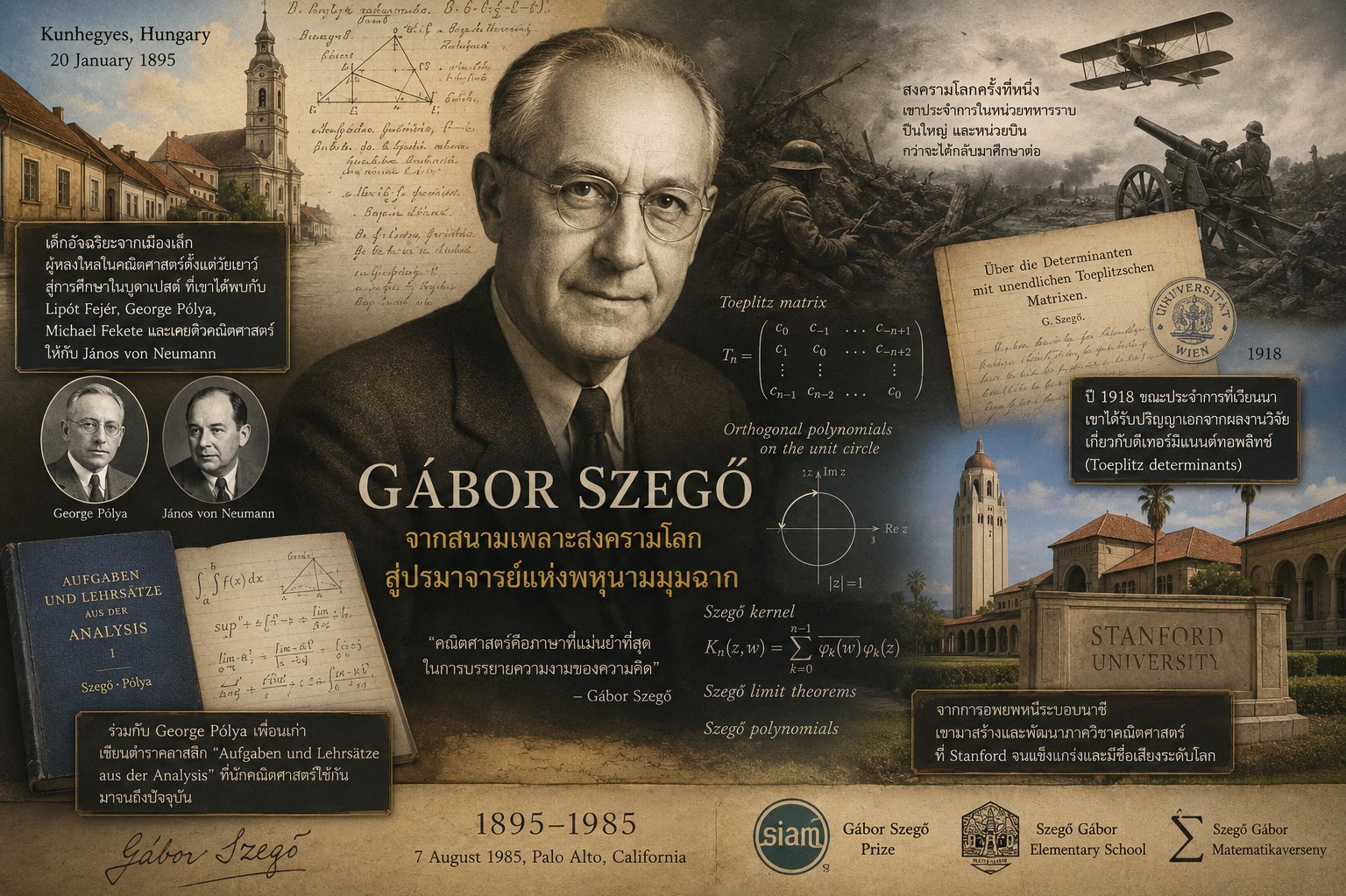
Before becoming one of the most important mathematical analysts of the 20th century, Gábor Szegő had served on the battlefields of World War I in the infantry, artillery, and aviation units. He later returned to pursue his passion for mathematics, which he had demonstrated since his school years, eventually becoming a pioneer in the theory of orthogonal polynomials and Toeplitz matrices, which remain fundamental to mathematical analysis to this day. Szegő died on August 7, 1985, in Palo Alto, California, at the age of 90.
A Child Prodigy from a Small Town in Hungary
Szegő was born on January 20, 1895, in Kunhegyes, a small town in Hungary with a population of around 9,000, into a Jewish family. His parents were Adolf Szegő and Hermina Neuman. He attended the local school in Kunhegyes before moving to Szolnok for secondary education, where he demonstrated exceptional talent in mathematics. He graduated in 1912 and went on to study mathematical physics at the University of Budapest. There, he met professors and fellow students who would later become important figures in his academic life, including Lipót Fejér and his friends George Pólya and Michael Fekete. He also tutored János von Neumann in mathematics, who would later become one of the greatest mathematicians of the 20th century.
His studies were interrupted in 1915 when World War I broke out. Szegő was drafted into the infantry, artillery, and aviation units before he was able to resume his education. In 1918, while stationed in Vienna, he received his Ph.D. from the University of Vienna for his research on Toeplitz determinants, which marked the beginning of a research career that would later bring him great recognition.
A Pioneer of Orthogonal Polynomials and Toeplitz Matrices
Throughout his career, Szegő devoted himself to the study of functional analysis, particularly the theories of Toeplitz matrices and orthogonal polynomials. His research in these fields was profound and had a wide-ranging influence, leading to the naming of several concepts after him, including the Szegő kernel, Szegő limit theorems, and Szegő polynomials. These have become important tools in the study of functions on the unit circle and extremal problems. He published more than 130 research papers throughout his lifetime and was one of the leading analysts of his era.
The work for which Szegő is most remembered is his collaboration with George Pólya, his longtime friend since their student days in Budapest. Together, they wrote the classic textbook “Aufgaben und Lehrsätze aus der Analysis” (Problems and Theorems in Analysis), which became an important reference book used by generations of mathematicians to develop problem-solving skills up to the present day.
The Escape from the Nazis to the Founding of a Department at Stanford
After completing his studies, Szegő was appointed as a Privat-Dozent at the University of Berlin in 1921 before becoming the successor to Konrad Knopp at the University of Königsberg in 1926. However, the increasingly harsh working conditions under the Nazi regime forced him to emigrate from Germany. He took a temporary position at Washington University in St. Louis in 1936 before moving to Stanford University in 1938, where he served as the head of the Mathematics Department. He devoted himself to building the department into a strong institution and remained in the position until his retirement in 1966.
His Final Years in Palo Alto
Gábor Szegő died on August 7, 1985, in Palo Alto, near Stanford University, where he had devoted half of his life to building and developing the institution. In his honor, the Gábor Szegő Prize of the Society for Industrial and Applied Mathematics (SIAM), the Szegő Gábor Primary School, and the Szegő Gábor Mathematics Competition at his former school in Hungary were all named after him to commemorate his life journey, which began as a child from a small town and led him to become a master of mathematical analysis recognized worldwide.