Roger Penrose: From Impossible Shapes to the Nobel Prize in Physics
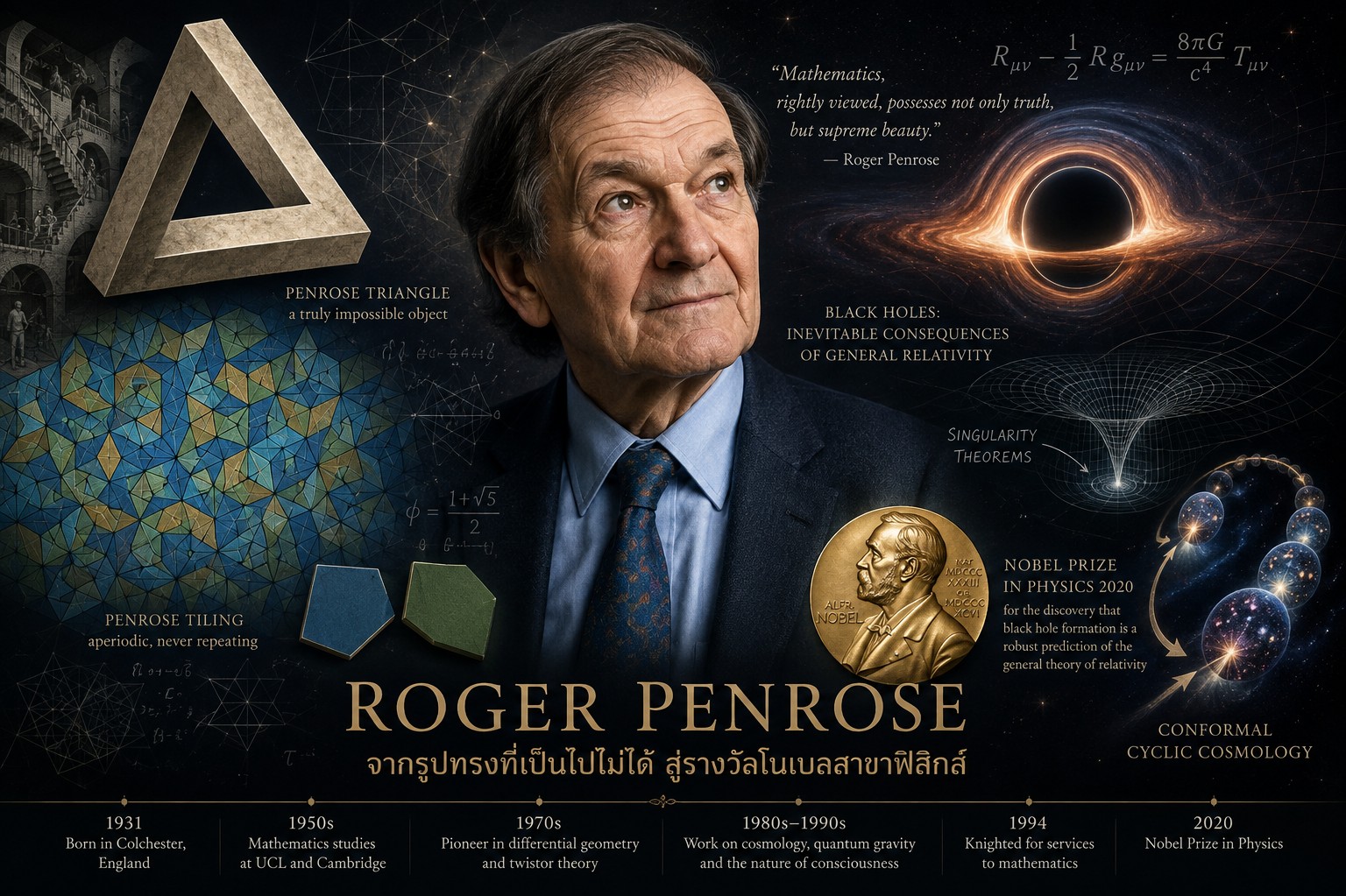
There are few mathematicians whose work is as famous in the art world as it is in the field of science. Roger Penrose, a British mathematician and physicist, is one of them. He was born on August 8, 1931, in Colchester, England, into an academic family with a strong interest in mathematics and science, before growing up to become a pioneer in both advanced geometry and theoretical physics related to black holes, ultimately receiving the Nobel Prize in Physics in 2020.
Impossible shapes and unique tiling
Before becoming known in the field of physics, Penrose made a name for himself in the field of pure mathematics with works that were unusual and beautiful in terms of geometry. One of them is the Penrose triangle, a three-dimensional shape that appears to be physically constructible when viewed from certain angles, but it is actually an 'impossible shape' in three-dimensional geometry. This later became an important inspiration for the artist M. C. Escher in creating his famous optical illusions.
Another work that made Penrose widely known is Penrose tiling, a system of tiling with only a few shapes that can cover an area infinitely without creating a repeating pattern (aperiodic tiling). This discovery challenged the previous understanding of symmetry in geometry and was later found to have a surprisingly close connection with the structure of materials called quasicrystals in nature.
From Geometry to the Theory of Relativity and Black Holes
Penrose studied mathematics at University College London and pursued a doctorate at the University of Cambridge before turning to the field of theoretical physics. In 1965, he proved an important theorem showing that black holes are an inevitable mathematical consequence of Einstein's general theory of relativity when massive stars collapse under their own gravity. This research, later developed together with Stephen Hawking, became a key foundation of the singularity theorems and was the work that led him to receive the 2020 Nobel Prize in Physics along with Reinhard Genzel and Andrea Ghez, who discovered the supermassive black hole at the center of the Milky Way galaxy.
A thinker who challenges the framework of understanding
In addition to his work in geometry and black hole physics, Penrose is also known for his widely debated and challenging ideas, such as the proposal of a connection between quantum mechanics and human consciousness in the book "The Emperor’s New Mind," as well as the concept of Conformal Cyclic Cosmology, which suggests that the universe may go through repeated cycles of rebirth. Although these ideas have not yet been widely accepted in the field, they reflect his unique willingness to think outside the box throughout his career.
Throughout his career, Penrose held the position of Rouse Ball Professor of Mathematics at the University of Oxford and was knighted in 1994 for his outstanding work in mathematics and physics. His story shows that geometric creativity, which may appear to be merely visual puzzles, can actually be deeply connected to the most fundamental structures of the universe.