Pierre Fatou: An astronomer who discovered fractal lands through his hobby
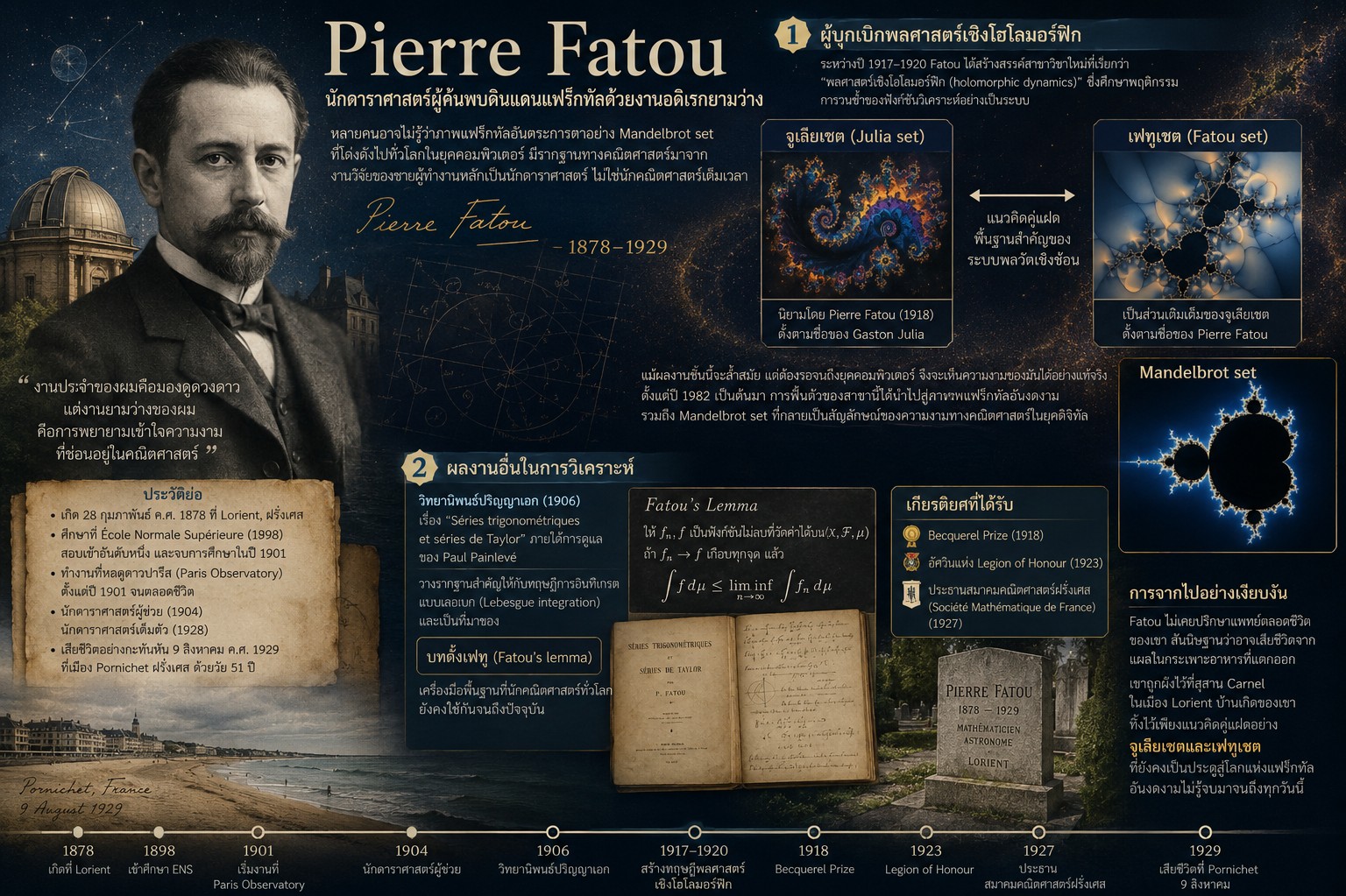
Many people may not know that the spectacular fractal image, the Mandelbrot set, famous worldwide in the computer era, has its mathematical roots in the research of a man whose main work was as an astronomer, not a full-time mathematician — Pierre Fatou, a French mathematician and astronomer, who died suddenly while vacationing in the town of Pornichet on the French coast on August 9, 1929, at the age of 51.
An astronomer who spends their free time studying mathematics
Fatou was born on February 28, 1878, in the city of Lorient, France, into a family of naval officers. He entered the École Normale Supérieure in 1898 with the top entrance exam score and graduated in 1901. After that, Fatou began working at the Paris Observatory as an observer before being promoted to assistant astronomer in 1904 and full astronomer in 1928, spending his entire career at this observatory. Although the everyday work of astronomical observation was not something he was particularly passionate about, Fatou devoted a significant portion of his time seriously to mathematical research alongside it.
Pioneer of holomorphic dynamics
Between 1917-1920, Fatou created a new branch of mathematics called holomorphic dynamics, which systematically studies the iterative behavior of analytic functions. He was the first to define and study the set now known as the Julia set, named after Gaston Julia, another mathematician who independently discovered similar fundamental results around the same time in 1918. The set that is the complement of the Julia set is now called the Fatou set, in his honor. Both of these sets have become paired concepts that are the most fundamental foundations of complex dynamics theory.
Although this work is profound and avant-garde, it had to wait until the era when computers played a role to be able to create images showing the complexity of these sets. Since 1982, mathematicians such as Dennis Sullivan, Adrian Douady, and John Hubbard have sparked a major revival in the field of holomorphic dynamics. The beautiful computer images of these sets, including the famous Mandelbrot set, have sparked widespread interest among both mathematicians and the general public, becoming a symbol of mathematical beauty in the digital age.
Other works in analysis
Beyond complex dynamics, Fatou also had several important works in the field of analysis. His doctoral thesis in 1906, titled 'Séries trigonométriques et séries de Taylor,' under the supervision of Paul Painlevé, laid a fundamental foundation for Lebesgue integration theory and was the source of Fatou’s lemma, which remains a basic tool used by mathematicians worldwide in measure theory to this day. From these works, Fatou received the Becquerel Prize in 1918, was appointed a Knight of the Legion of Honour in 1923, and served as president of the French Mathematical Society (Société Mathématique de France) in 1927.
A quiet departure
Fatou never consulted a doctor throughout his life. In the summer of 1929, he traveled to vacation in Pornichet, a seaside town to the west of Nantes, and died suddenly in his room on the evening of Friday, August 9, 1929. Although the death certificate did not specify the cause of death, historians of mathematics speculate that it may have been caused by a ruptured stomach ulcer. He was buried at Carnel Cemetery in Lorient, his hometown, leaving behind only twin ideas, the Julia set and the Fatou set, which remain gateways to the endlessly beautiful world of fractals to this day.