Gilles de Roberval: The man who almost discovered calculus before Newton and Leibniz
In the era when calculus had not yet officially come into existence, there was a group of mathematicians working on the borderline between traditional geometry and new ideas that would later revolutionize the field of mathematics. Gilles Personne de Roberval, a French mathematician, was one of the key pioneers of that era. He was born on August 10, 1602, in the village of Roberval near the city of Beauvais, France, into an ordinary peasant family.
From the name Personne to 'de Roberval'
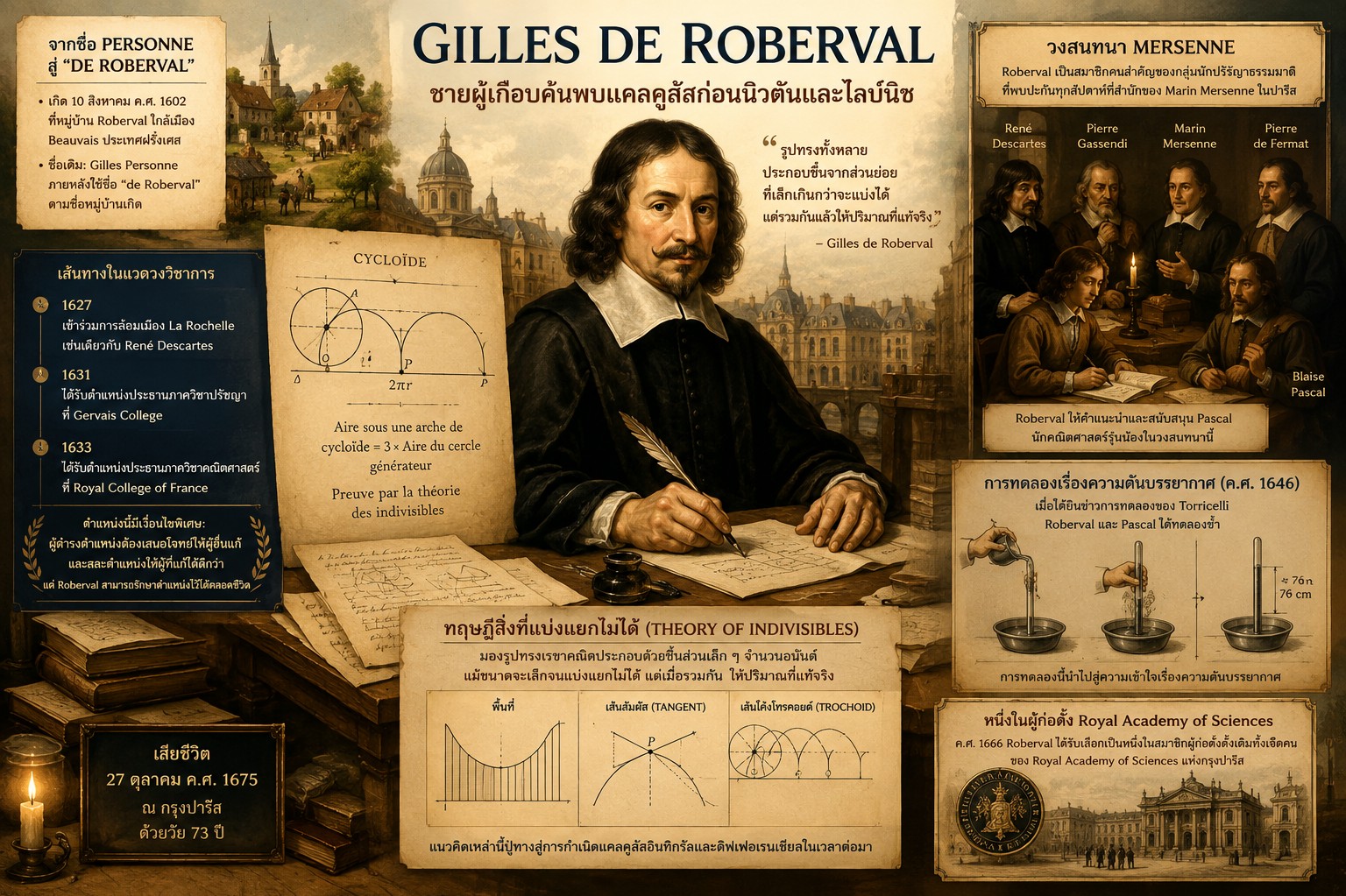
Roberval's original name was Gilles Personne. The surname 'de Roberval' that he used later came from the name of his native village. He participated in the Siege of La Rochelle in 1627, just like René Descartes, before traveling to Paris in the same year. There, he was appointed chair of the philosophy department at Gervais College in 1631, and two years later, he was appointed chair of the mathematics department at the Royal College of France, which had an interesting special condition: the holder of the position had to propose mathematical problems for others to solve and had to give up the position to anyone who could solve the problems better than him. However, Roberval was able to maintain this position until his death.
Pioneer of the method for finding the area under a cycloid curve
Roberval's most outstanding work was calculating the area under the cycloid curve — a curve formed by tracing a point on a wheel as the wheel rolls along a flat surface. This was a problem that greatly challenged mathematicians of that era. Roberval was able to prove that the area under one arch of the cycloid is equal to three times the area of the circle that generates the curve. This achievement was made possible by his method called the theory of indivisibles, which considers geometric shapes as being composed of infinitely many small parts. This idea was a significant step that paved the way for the formal invention of integral calculus by Isaac Newton and Gottfried Leibniz several decades later.
In addition, Roberval also devised a general method for drawing tangents to various curves by considering the curves as generated by moving points, where the movement consists of a combination of several simpler movements. This dynamic way of thinking was very advanced for that era, and he also coined the term 'trochoid,' which is the general name for curves in the cycloid family.
The versatile scientist of the Mersenne discussion circle
Roberval was a key member of the group of natural philosophers who met weekly at the monastery of Marin Mersenne in Paris, alongside leading thinkers of the era such as René Descartes, Pierre Gassendi, and Pierre de Fermat, and played an important role in advising and supporting Blaise Pascal, a younger mathematician who had just joined these discussions. In 1646, when Pascal and Roberval heard about the experiment on atmospheric pressure by the Italian scientist Evangelista Torricelli, the two conducted a repeat experiment by pouring mercury into a glass tube and inverting it into a mercury basin, which was an important experiment that later led to the understanding of atmospheric pressure.
In 1666, Roberval was also elected as one of the original seven founding members of the Royal Academy of Sciences of Paris. France's leading scientific institute that continues to play an important role to this day.
Gilles de Roberval died on October 27, 1675, in Paris at the age of 73. Although his name was not as widely known as that of his contemporaries such as Descartes or Fermat, his work in laying the foundations of the concept of 'indivisibles' was an important part in preparing the intellectual ground for the calculus revolution in the subsequent era.