Wei-Liang Chow: From a Chinese noble family to a pioneer of modern algebraic geometry
The life path of Wei-Liang Chow (周煒良), a Chinese-American mathematician, was full of the uncertainties of 20th-century history — from a noble family in Shanghai, through universities in Nazi-era Germany, to the war in China, before returning to establish himself in the United States and creating work that became a fundamental basis for modern algebraic geometry. He passed away on August 10, 1995, at his home in Parkville, Maryland, after suffering multiple strokes, at the age of 83.
A boy from a noble family who has never attended school in China
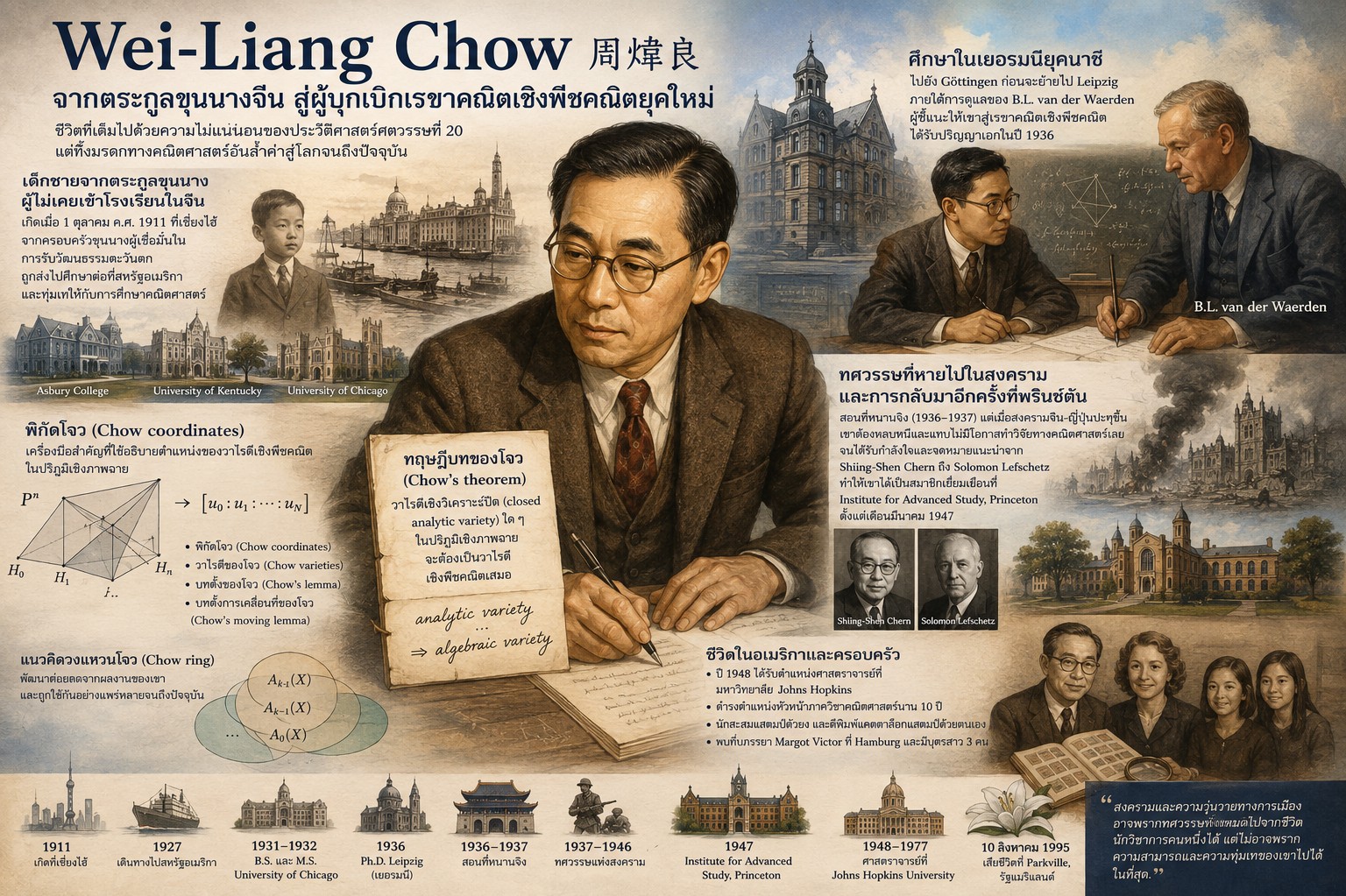
Chow was born on October 1, 1911, in Shanghai into a high-ranking noble Chinese family that strongly believed that China's success would come from adopting Western culture. With this belief, Chow never attended Chinese schools but was sent to study in the United States at the age of 16, even though he had received private tutoring in Chinese language and Chinese history at home before departing. He studied at Asbury College in Kentucky, then transferred to the University of Kentucky before continuing his studies at the University of Chicago, where he received a bachelor's degree in 1931 and a master's degree the following year. It was at Chicago that Chow decided to devote himself seriously to the study of mathematics.
When he decided to pursue further studies in mathematics, Chow traveled to Göttingen, Germany, which at the time was one of the most important centers of mathematics in the world. However, due to the increasingly worsening political atmosphere under the Nazi regime, he decided to move to study in Leipzig instead, under the supervision of Bartel Leendert van der Waerden, a mathematician who introduced him to the field of algebraic geometry, guiding him to study the works of Severi, Bertini, and Enriques. He received his doctorate in 1936.
Zhou Coordinates: A Key Tool of Algebraic Geometry
While working with van der Waerden in Leipzig, the two published several joint research papers on intersection theory in the series of articles "Zur algebraische Geometrie," which appeared in the journal Mathematische Annalen in 1937. They introduced the concept now known as Chow coordinates, an essential tool used to describe the position of algebraic varieties in projective space. This work laid an important foundation for the concept that later developed into Chow varieties, which elegantly describe the moduli space of algebraic varieties in projective space, as well as Chow’s lemma and Chow’s moving lemma, which became standard tools in this field.
An equally famous work is Chow’s theorem, which states that any closed analytic variety in projective space must always be an algebraic variety. This result beautifully connects the world of complex analytic geometry with algebraic geometry and remains a fundamental tool used by mathematicians in this field to this day. The concept of the Chow ring, developed as a continuation of his work, also has numerous advantages and is widely used.
The decade lost in war, and the return again at Princeton
After graduating, Chow returned to China to teach at National Central University in Nanjing between 1936-1937. But when the Second Sino-Japanese War broke out, he had to flee from Nanjing to his hometown of Shanghai amid fierce fighting. Throughout the decade of war that followed, Chow had almost no opportunity to conduct mathematical research, leading many to doubt whether he would be able to return to academic work. However, with the help and encouragement of Shiing-Shen Chern, an influential mathematician friend who wrote a recommendation letter to Solomon Lefschetz, Chow received the opportunity to become a visiting member at the Institute for Advanced Study in Princeton starting in March 1947, marking the beginning of his full return to the field of mathematics.
In 1948, Chow was appointed professor at Johns Hopkins University and served as the head of the mathematics department for 10 years before retiring in 1977. In addition to his research in mathematics, he was also an avid stamp collector who published his own stamp catalog, and lived a warm family life with his wife, Margot Victor, whom he met during a vacation in Hamburg, with whom he had three daughters.
Wei-Liang Chow passed away on August 10, 1995, at his home in Parkville, Maryland, leaving behind an intellectual legacy that remains a fundamental tool of modern algebraic geometry. It is a testament that even though war and political turmoil can take entire decades from a scholar's life, they cannot ultimately take away his ability and dedication.