Alonzo Church: The father of the languages that drive modern computers, who never touched a real computer
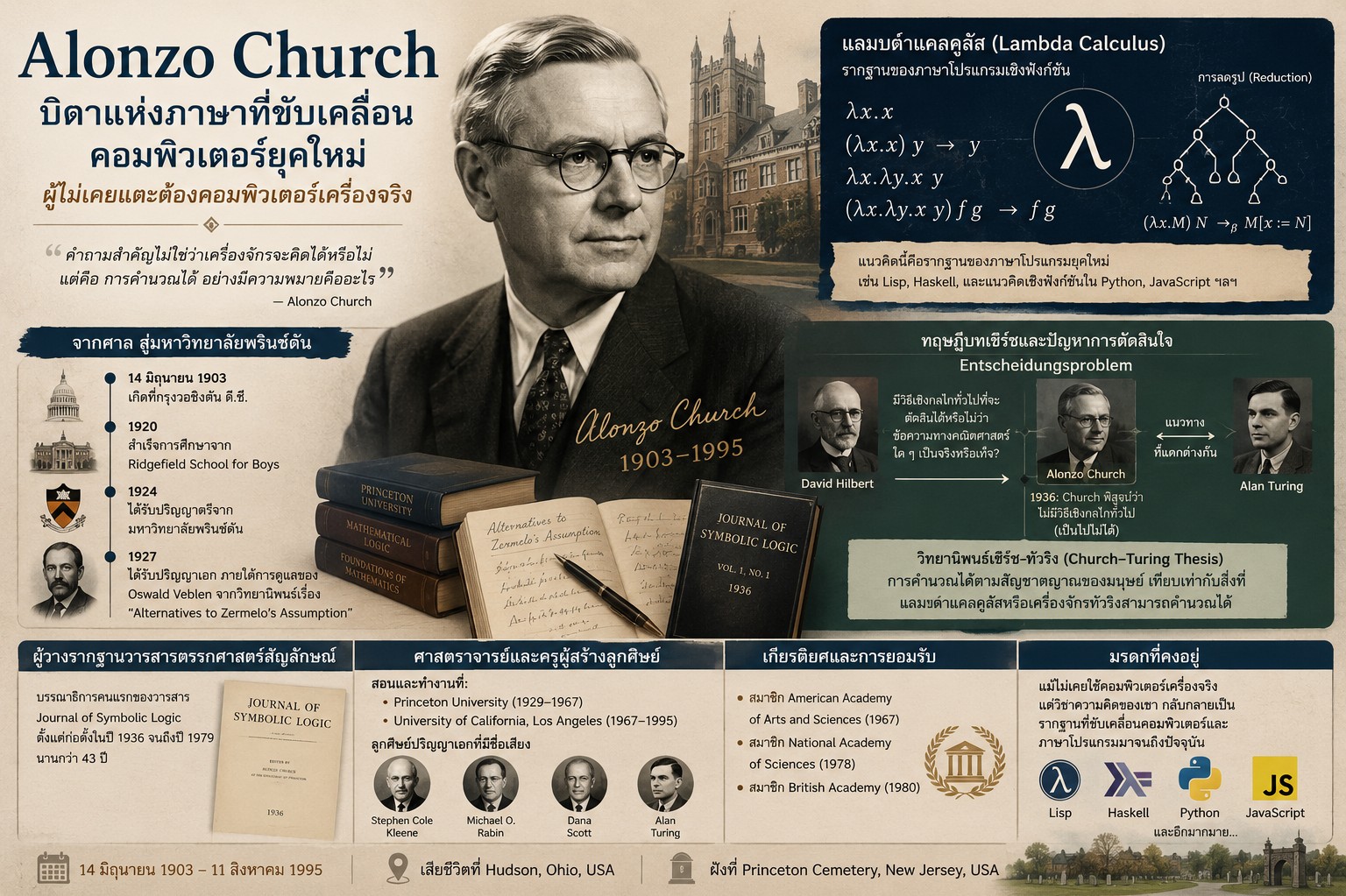
Several decades before the first computer was born, a logician invented a mathematical language that would become the foundation of functional programming languages decades later. Alonzo Church, an American logician and mathematician, passed away on August 11, 1995, in Hudson, Ohio, at the age of 92, leaving behind an intellectual legacy that became a pillar of modern computer science.
From the Court to Princeton University
Church was born on June 14, 1903, in Washington, D.C. His father, Samuel Robbins Church, was a municipal court judge in the District of Columbia but had to resign due to vision problems, which led the family to move to Virginia. With the help of his uncle, Alonzo Church, he had the opportunity to attend Ridgefield School for Boys in Connecticut and graduated in 1920 before continuing his studies at Princeton University, where he received his bachelor's degree in 1924 and his doctorate in 1927 from the thesis “Alternatives to Zermelo’s Assumption” under the supervision of Oswald Veblen, a mathematician who later co-founded the Institute for Advanced Study.
Lambda Calculus: The Foundation of Functional Programming Languages
In the early 1930s, Church developed lambda calculus, a formal system used to describe computation through the definition of functions and function application, without the need to rely on the concepts of variables or memory as used by Turing machines. Although lambda calculus was initially developed purely for logical and mathematical foundational purposes, it later became the most important foundation of functional programming. Many modern programming languages, including Lisp, Haskell, and even the functional concepts in mainstream programming languages like Python and JavaScript, all trace their ideas back to Church's lambda calculus.
Church's theorem and the decision problem
Another important work of Church was solving the Entscheidungsproblem (decision problem) previously posed by David Hilbert. Church proved in 1936 that there is no general mechanical method to determine whether any mathematical statement is always true or false. This result is known as Church’s theorem, which emerged around the same time as similar work by Alan Turing, a British mathematician who solved the same problem using a different approach through the concept of the Turing machine. The consistency of the results from both approaches led to the proposal known as the Church–Turing thesis, which states that the intuitive human notion of 'computability' is equivalent to what can be computed by lambda calculus or a Turing machine. This thesis has become one of the most important theoretical foundations of theoretical computer science to this day. Interestingly, Turing himself later became a doctoral student of Church at Princeton University.
The founder of the Journal of Symbolic Logic
Church joined the faculty at Princeton University in 1929 and worked there for as long as 38 years before moving to teach in the Philosophy Department at UCLA in 1967 until 1995. In addition to his research work, he played a significant role in elevating the credibility of the field of mathematical logic through serving as the first editor of the Journal of Symbolic Logic from its founding in 1936 until 1979, a period of over four decades. Throughout his career, he had many successful doctoral students, including Stephen Cole Kleene, Michael O. Rabin, Dana Scott, and Alan Turing. He was elected a member of the American Academy of Arts and Sciences in 1967, a member of the National Academy of Sciences in 1978, and a member of the British Academy in 1980.
Alonzo Church passed away on August 11, 1995, in Hudson, Ohio, and was buried at Princeton Cemetery. Although he himself never touched or worked with an actual computer in the modern sense, the mathematical languages he developed to explore the nature of computation turned out to be the foundation that drives programming languages and computer science theory up to the current digital age.