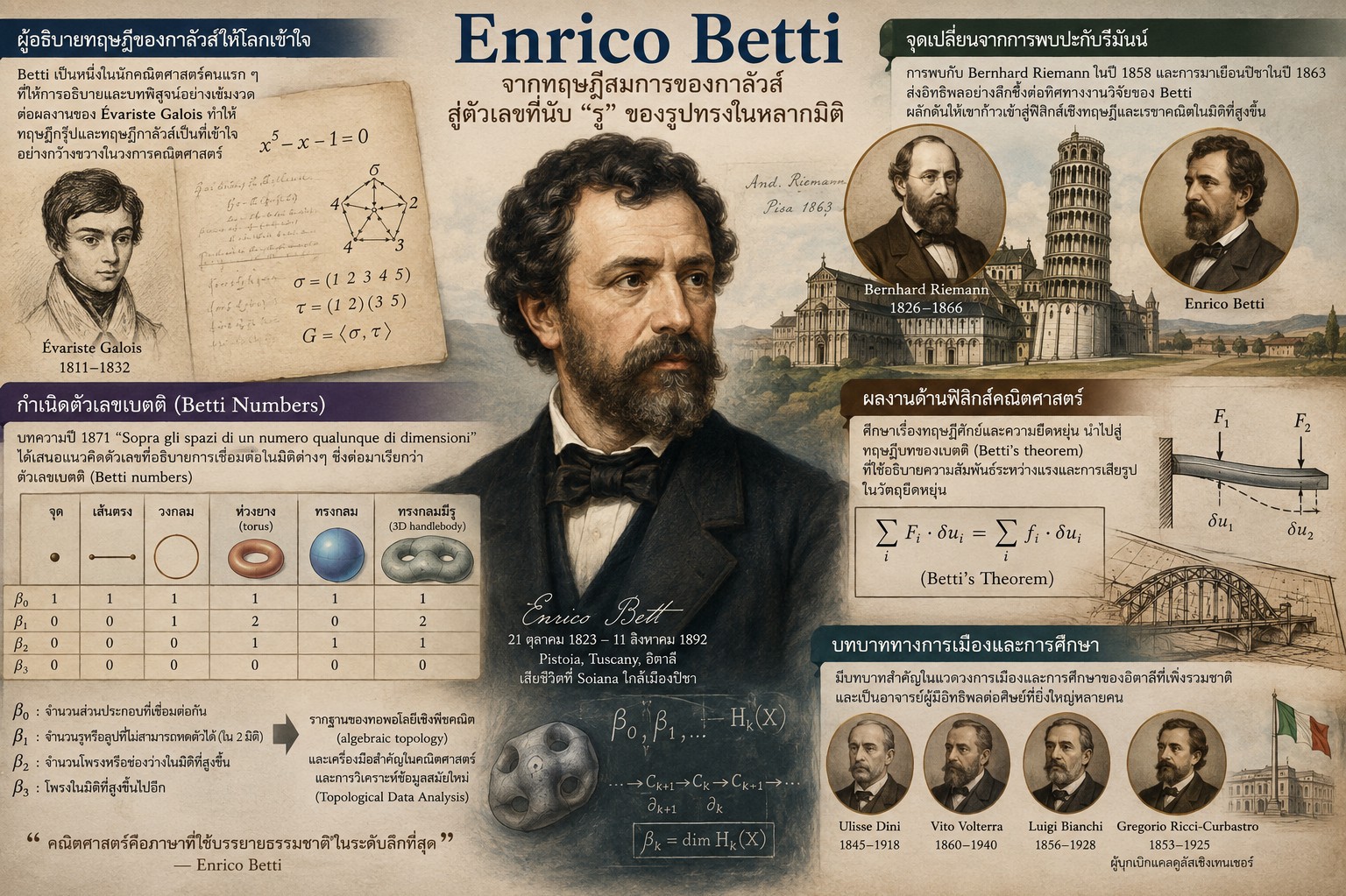
Enrico Betti: From Galois' equation theory to the numbers that count the 'holes' of shapes in multiple dimensions
The intellectual journey of Enrico Betti, an Italian mathematician, took him through many seemingly unrelated fields — from the theory of algebraic equations to the theory of elasticity of objects, and ultimately to pioneering a new field now known as algebraic topology. Betti passed away on August 11, 1892, in the village of Soiana near the city of Pisa, Italy, at the age of 68, leaving behind ideas that remain fundamental tools in modern mathematics to this day.
The person who explained Galois's theory to the world
Betti was born on October 21, 1823, in the city of Pistoia, Tuscany. He studied at the University of Pisa and graduated in 1846 under the supervision of Giuseppe Doveri, and also studied with leading scientists such as Ottaviano-Fabrizio Mossotti and Carlo Matteucci. Betti's early career work focused on algebraic equation theory, and he was one of the first mathematicians to provide a rigorous explanation of the work of Évariste Galois, the brilliant French mathematician who died in a duel at the age of only 21, before he could fully explain his own work. Betti expanded upon and provided complete proofs for Galois's concepts, helping to make group theory and Galois theory more widely understood in the mathematics community of that time.
Turning point from meeting with Riemann
A turning point in Betti's research journey occurred in 1858 when he traveled across Europe with Francesco Brioschi and Felice Casorati and met Bernhard Riemann, the great German mathematician. This encounter deeply influenced the direction of Betti's research in later years, and when Riemann visited Pisa in 1863, the academic relationship between the two further decisively impacted Betti's work, driving him to enter the fields of theoretical physics and higher-dimensional geometry.
The origin of Betti numbers
The work that made Betti's name most memorable is the article published in 1871 titled “Sopra gli spazi di un numero qualunque di dimensioni” (On the spaces of any number of dimensions), which was a pioneering study in topology. In this article, Betti proposed the concept of numbers used to describe the connectivity properties of spaces in multiple dimensions, which was later named in his honor as Betti numbers. These numbers count the "holes" or voids in different dimensions of geometric shapes. For example, the zeroth Betti number indicates the number of connected components, the first Betti number indicates the number of holes or loops that cannot be contracted in two dimensions, and higher Betti numbers describe the characteristics of cavities in higher dimensions. This concept became a fundamental foundation of the field of algebraic topology, which mathematicians like Henri Poincaré later developed further, and it remains a standard tool widely used in modern mathematics and computer science, including the emerging field of topological data analysis.
Works in mathematical physics and politics
In addition to his work in topology, Betti also made significant contributions to theoretical physics, particularly potential theory and elasticity theory, which led to the discovery of Betti's theorem, an important result used to describe the relationship between forces and deformations in elastic objects, which remains a key tool in structural engineering today. Beyond his academic work, he also played an important role in the political and educational spheres of newly unified Italy at the time, and had several famous doctoral students, including Ulisse Dini, Vito Volterra, Luigi Bianchi, and Gregorio Ricci-Curbastro, the pioneer of tensor calculus who later influenced Einstein's theory of relativity.
Enrico Betti died on August 11, 1892, in the village of Soiana near Pisa, leaving an intellectual legacy that connected multiple branches of mathematics, from algebra and theoretical physics to topology, which still remains an important foundation used by mathematicians around the world today.