In Memory of Friedrich Schottky: Pioneer of the Theory of Complex Variable Functions
On August 12, 1935, in Berlin, the world of mathematics lost an important thinker who dedicated his life to the study of analytic functions. Friedrich Hermann Schottky passed away at the age of 84, leaving behind work that remains a cornerstone of the theory of complex variable functions to this day.
From Breslau to the leading circles of mathematics in Europe
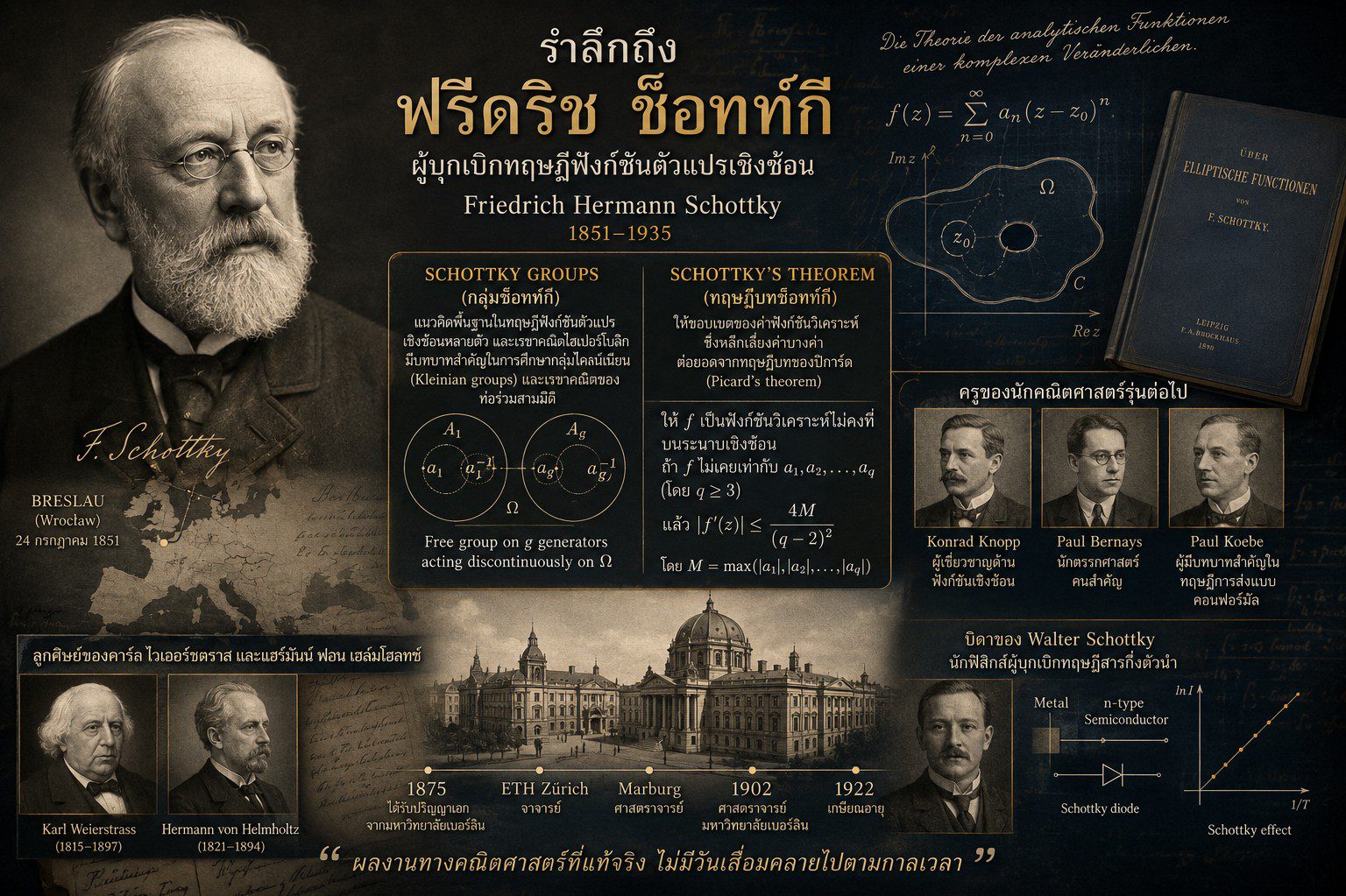
From Breslau to the circle of leading mathematicians, Schottky was born on July 24, 1851, in the city of Breslau (now Wrocław, Poland). He began his studies at the University of Breslau in 1870 before moving on to study in Berlin, where he became a student of legendary mathematicians and physicists such as Karl Weierstrass and Hermann von Helmholtz. He received his doctorate in 1875 and gradually advanced in academic positions, from a lecturer at ETH Zurich and the University of Marburg, until he became a professor at the University of Berlin in 1902, a position he held until his retirement in 1922.
A living mathematical legacy
Schottky's main work was on elliptic functions, Abelian functions, and theta functions, but what has kept his name in mathematics textbooks to this day are two concepts that bear his own name.
Schottky groups are an important basic concept in the theory of several complex variables and hyperbolic geometry, which later played an important role in the study of Kleinian groups and the geometry of three-dimensional manifolds.
Schottky’s theorem is an important result in complex analysis that provides bounds for the values of an analytic function that avoids certain values. This theorem builds upon the concept of Picard’s theorem and has become an essential tool in modern complex analysis.
The teacher of the next generation mathematician
Although it is acknowledged that his most outstanding research occurred before 1902 and there are records that his teaching skills were not particularly remarkable, Schottky still nurtured young mathematicians who later made their own names known. His students included Konrad Knopp, an expert in complex functions; Paul Bernays, a prominent logician; and Paul Koebe, who played a significant role in conformal mapping theory.
Apart from his academic legacy, Schottky was also the father of Walter Schottky, a renowned physicist who pioneered semiconductor theory and is the source of terms such as 'Schottky diode' and 'Schottky effect,' which are widely used in the electronics field to this day. It can be said that the Schottky family has left significant contributions both in the world of pure mathematics and in the world of applied physics.
Ninety years after the passing of Friedrich Schottky, his name is still mentioned in complex analysis classrooms around the world, through the groups and theorems he created. It is a testament that true mathematical work never fades with time.