Jules Richard: The mathematician who created a paradox that shook the foundations of mathematics
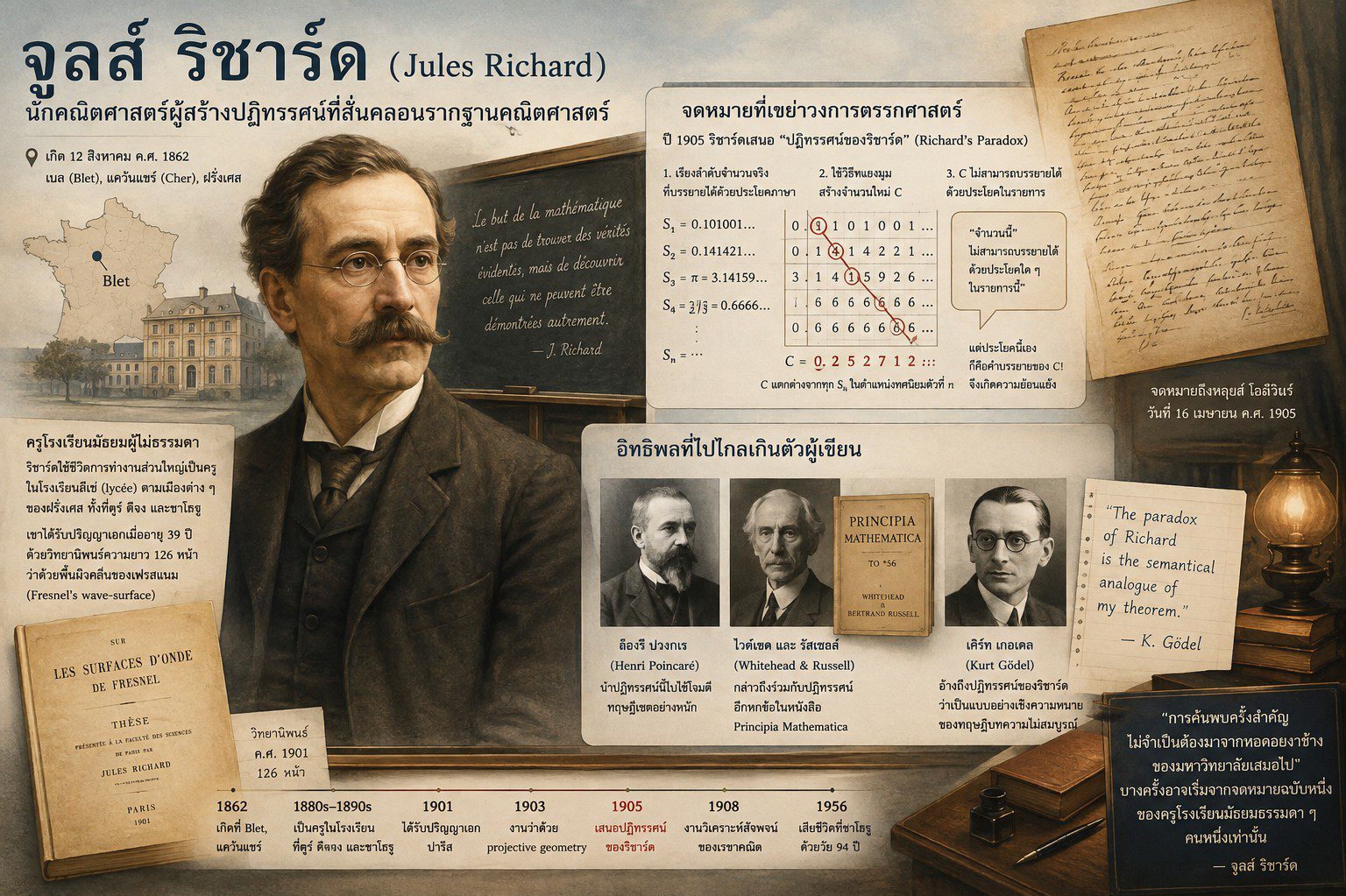
Among the great mathematicians who are famous worldwide, there are often the names of small thinkers who are hardly known but have left an important mark in the history of human thought. Jules Richard is one of them. He was born on August 12, 1862, in the village of Blet, Cher, France, and never became a leading mathematician with a position at a major university throughout his life. However, with a letter he wrote to the editor of an academic journal in 1905, his name was forever inscribed in the history of mathematical logic.
An extraordinary high school teacher
Richard spent most of his working life as a teacher in lycées in various cities in France, including Tours, Dijon, and Châteauroux. He did not rush to pursue academic positions. It was not until the age of 39 that he received his doctorate from the Faculty of Sciences in Paris, with a 126-page dissertation on Fresnel’s wave-surface. His life path was thus different from that of famous mathematicians of the same era, who often moved within leading universities.
The letter that shook the field of logic
In 1905, Richard wrote a letter to Louis Olivier, the director of the journal Revue générale des sciences pures et appliquées, to propose a paradox that later became known as “Richard’s Paradox.” The idea originated from the fact that real numbers are infinitely numerous in an “uncountable” way, whereas the sentences in the language used to describe those numbers, such as “one-third” or “the ratio of a circle's circumference to its diameter,” are only countable.
Richard then tried to list all real numbers that can be described by a language sentence, and used Cantor’s diagonal argument to create a new number that "cannot be described" by any sentence in that list. But the problem is that the process of creating this number is itself another descriptive sentence, which means that the number that was supposed to be "undescribable" ends up being described by itself. This is the core of the paradox that made this thought experiment famous.
Influence that goes beyond the author's control
Although Richard was not a mathematician at a top-tier institution, his paradox was widely used in high-level academic debates. Henri Poincaré applied this paradox to strongly attack set theory, so much so that supporters of set theory had to find ways to respond and strengthen the foundations of the theory. This paradox is also mentioned along with six other paradoxes in a book. Principia Mathematica Of Alfred North Whitehead and Bertrand Russell, and more importantly, Kurt Gödel also directly referred to Richard's paradox as a semantical analogue of his own famous incompleteness theorem.
It can be said that Richard's worldview played an important role in pushing the field of mathematics to recognize the necessity of strictly distinguishing between 'mathematics' and 'metamathematics,' and it also served as a significant inspiration for the later development of predicative mathematics.
A simple life until the very end
After the period of fame in 1905, Richard continued to write works on the philosophy of mathematics, such as the work on projective geometry in 1903 and the work on the analysis of geometric axioms in 1908. He lived quietly as a teacher until his later years and died in Châteauroux in 1956 at the age of 94.
After a period of fame in 1905, Richard continued to write works on the philosophy of mathematics, such as work on projective geometry in 1903 and analytical work on the foundations of geometry in 1908. He lived quietly as a teacher until the end of his life and died in Châteauroux in 1956 at the age of 94. The story of Jules Richard serves as a reminder that major discoveries in the history of human thought do not always have to come from the ivory towers of leading universities. Sometimes, they may start with a single letter from an ordinary high school teacher.