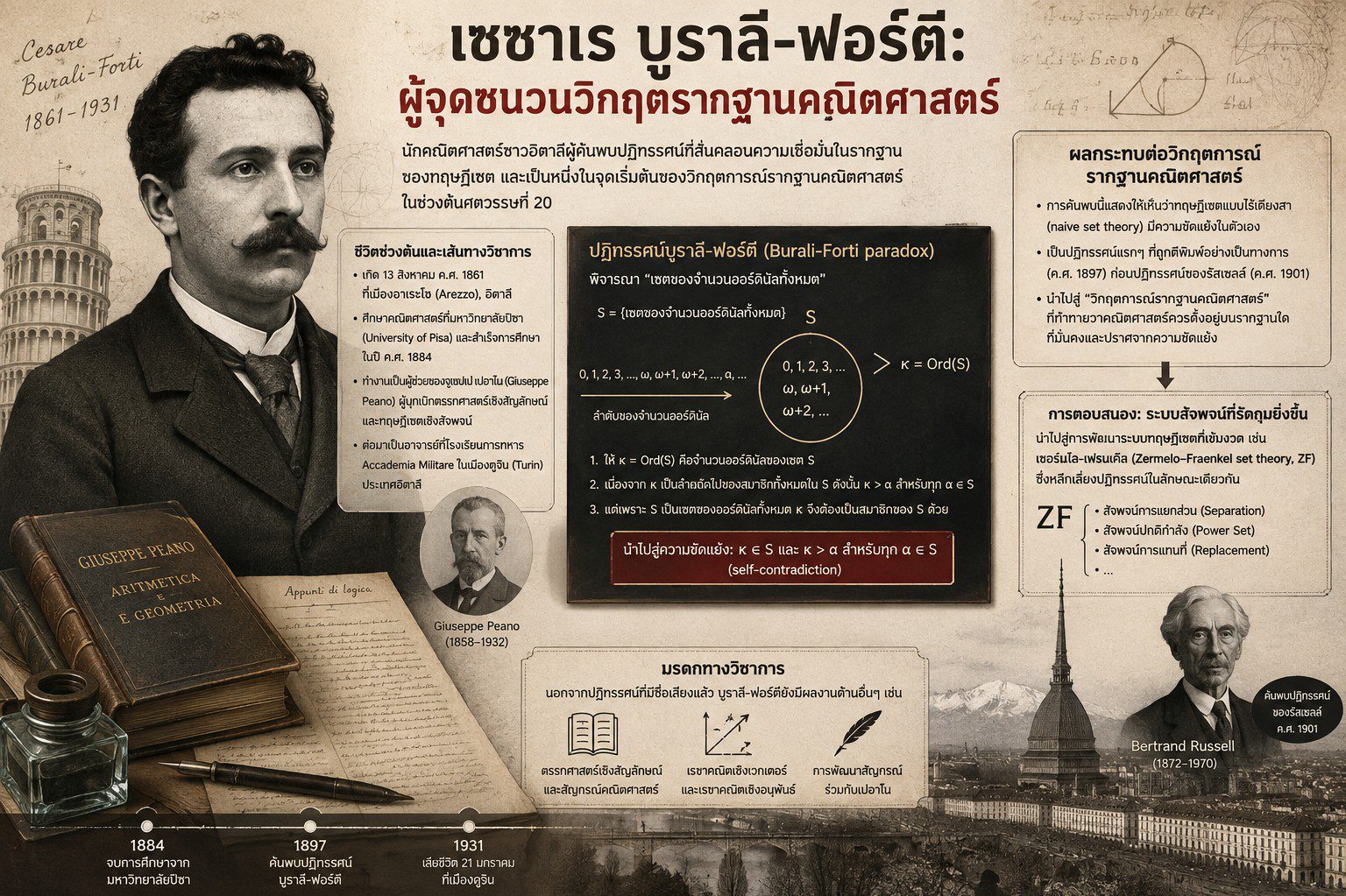
Cesare Burali-Forti: The Provoker of the Foundations of Mathematics Crisis
The late 19th century was a period when the field of mathematics was trying to establish a rigorous foundation for set theory, and one of the significant events that shook the confidence in that foundation came from an Italian mathematician. That was Cesare Burali-Forti, who was born on August 13, 1861, in the city of Arezzo, Italy.
Early life and academic path
Burali-Forti studied mathematics at the University of Pisa and graduated in 1884. After that, he worked as an assistant to Giuseppe Peano, a mathematician pioneering symbolic logic and renowned worldwide for predicate set theory. Working with Peano allowed Burali-Forti to engage deeply with foundational problems in set theory.
Later, Burali-Forti became a teacher at the Military Academy in the city of Turin and spent most of his career there.
Burali-Forti Paradox
The work that made Burali-Forti's name most remembered is the discovery of the Burali-Forti paradox in 1897. This paradox arose from considering 'the set of all ordinal numbers'.
In set theory, ordinal numbers are used to describe the ordering of sets, and the set of all ordinal numbers arranged in order must itself have an ordinal number. However, this ordinal number must be greater than all the ordinal numbers in that set, which means it would also have to be a member of that set. This leads to a self-contradiction because the set of all ordinal numbers cannot have an ordinal number greater than itself.
This discovery is considered one of the first paradoxes to be officially published in the history of set theory, and it occurred before the more famous paradox, Russell’s paradox, which Bertrand Russell discovered in 1901.
Impact on the foundational crisis in mathematics
The discovery by Burali-Forti caused a great shock to the field of mathematics at that time, because it showed that the set theory commonly used (which later came to be called 'naive set theory') contained inherent contradictions. This paradigm became one of the key starting points of the 'foundational crisis of mathematics' in the early 20th century, which challenged mathematicians to reconsider what kind of logical foundation mathematics should be based on that is stable and free from contradictions.
This crisis led to the development of a more rigorous axiomatic set theory system, such as the Zermelo–Fraenkel set theory (ZF) widely used today, which was specifically designed to avoid paradoxes of the type discovered by Burali-Forti.
Academic heritage
Although Burali-Forti is best known for that paradox, he also had many other works, particularly his collaboration with Peano in developing mathematical notation and symbolic logic, as well as work in vector geometry and differential geometry. Burali-Forti passed away on January 21, 1931, in Turin, leaving behind a name that is still mentioned every time the history of set theory and mathematical logic is taught.