Peter Shor: The man who wrote the algorithm that could shake the digital world
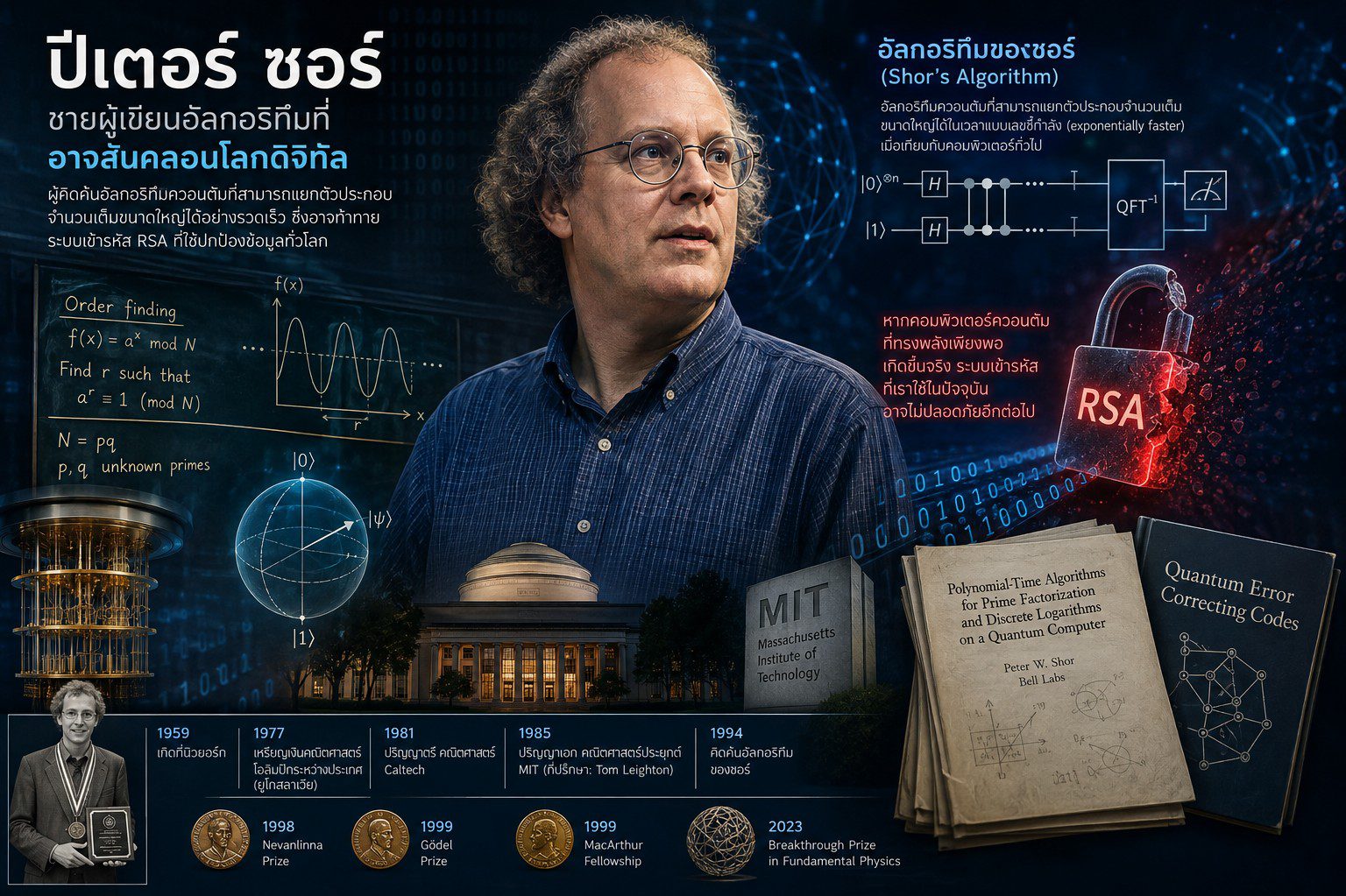
Peter Williston Shor was born on August 14, 1959, in New York City, and grew up in Washington, D.C., and Mill Valley, California. He currently serves as a professor of applied mathematics at the Massachusetts Institute of Technology (MIT) and is known worldwide as the inventor of an algorithm that could transform cybersecurity across the globe.
A mathematical genius from a young age
Shor demonstrated a talent for mathematics from his school days. While studying at Tamalpais High School, he placed third in the 1977 United States of America Mathematical Olympiad, and that same year he won a silver medal at the International Mathematical Olympiad in Yugoslavia. He earned a bachelor's degree in mathematics from the California Institute of Technology (Caltech) in 1981 and a PhD in applied mathematics from MIT in 1985 under the supervision of Tom Leighton, before beginning his career at Bell Labs.
The algorithm that shook the world of cryptography
In 1994, while working at Bell Labs, Shor invented “Shor’s algorithm,” a quantum algorithm that can factor large integers exponentially faster than the best-known algorithms running on conventional computers. This discovery sent shockwaves throughout the fields of computer science and cryptography because the RSA encryption system, which underpins the security of online transactions worldwide today, relies on the difficulty of factoring large integers as its protective barrier. If a sufficiently powerful quantum computer capable of actually running Shor’s algorithm were to exist, the encryption systems used today could potentially be broken.
This discovery was not only a major turning point in the field of cryptography, but also sparked enormous interest and investment in quantum computing worldwide, as it provided the first proof that quantum computers could solve practically important problems significantly faster than conventional computers.
The honor that follows
Shor's work has been widely recognized with numerous awards. He received the Nevanlinna Prize in 1998, the Gödel Prize in 1999, the MacArthur Fellowship in the same year, and most recently the Breakthrough Prize in Fundamental Physics in 2023. In addition, he has made significant contributions to combinatorial analysis and the development of quantum error-correcting codes, which are a crucial foundation for building practical quantum computers in the future.
From a young boy who loved competing in mathematical Olympiads to a scientist whose single piece of work could challenge the foundations of security across the entire digital world, the story of Peter Shor is proof that pure mathematics, which may seem far removed from everyday life, can in fact have a profound impact on everyone’s daily lives.