Guido Castelnuovo: Father of Italian algebraic geometry
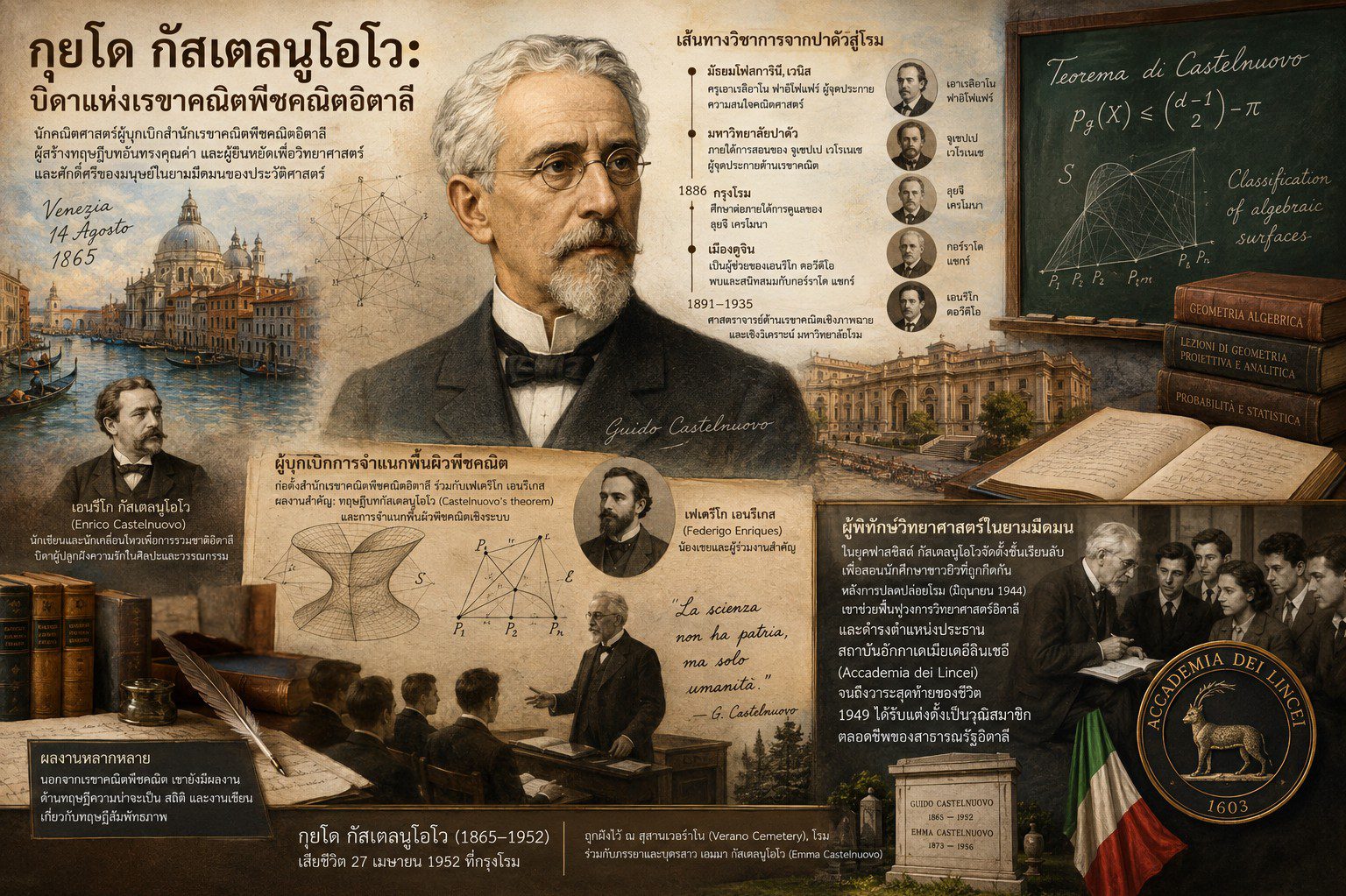
On August 14, 1865, in the city of Venice, Guido Castelnuovo was born into a family filled with a love of art and literature. His father, Enrico Castelnuovo, was a renowned novelist and an activist for Italian unification, but Guido's life path instead led him toward the world of numbers and shapes, until he eventually became one of the most important pioneers of the Italian school of algebraic geometry.
Academic journey from Padua to Rome
Castelnuovo attended the Foscarini secondary school in Venice, where his mathematics teacher, Aurelio Faifofer, played an important role in awakening his interest in mathematics. After completing secondary school, he went on to study at the University of Padua under Giuseppe Veronese, who sparked his interest in geometry, which became the field to which he devoted his life. After graduating in 1886, he continued his studies in Rome under Luigi Cremona before moving to Turin to become an assistant to Enrico D'Ovidio, where he met and became close to Corrado Segre, who had a major influence on the direction of his research. From 1891 to 1935, he taught projective and analytical geometry at the University of Rome.
Pioneer in the classification of algebraic surfaces
Castelnuovo was one of the founders of the Italian school of algebraic geometry, together with his brother-in-law, Federigo Enriques. His most important work was Castelnuovo’s theorem, which concerns the classification of algebraic surfaces. The joint research of Castelnuovo and Enriques on the systematic classification of algebraic surfaces is considered one of the greatest achievements of algebraic geometry in the late 19th and early 20th centuries. He also made important contributions to probability theory and statistics, as well as writing on the theory of relativity.
Guardian of science in dark times
The most impressive period in Castelnuovo's life may not have been his mathematical research, but rather his courage during the period when Mussolini's fascist regime enacted laws excluding Jews from state universities. Castelnuovo, who was himself of Jewish descent, established secret classes to teach Jewish students who had been excluded from the formal education system. After Rome was liberated in June 1944, he was tasked with helping to restore the Italian scientific community, which had been damaged by the fascist era, and served as president of the Accademia dei Lincei, Italy's prestigious scientific academy, until the end of his life. In 1949, he was also appointed a senator for life of the Italian Republic.
Guido Castelnuovo died on April 27, 1952, in Rome, at the age of 86. He was buried alongside his wife and daughter, Emma Castelnuovo, who carried on his legacy as a renowned mathematician and educator in her own right. Castelnuovo's legacy continues to live on in algebraic geometry textbooks around the world, a testament to the power of the Italian school of thought that he helped establish.