Charles de la Vallée Poussin: The Conqueror of the Mystery of Prime Numbers
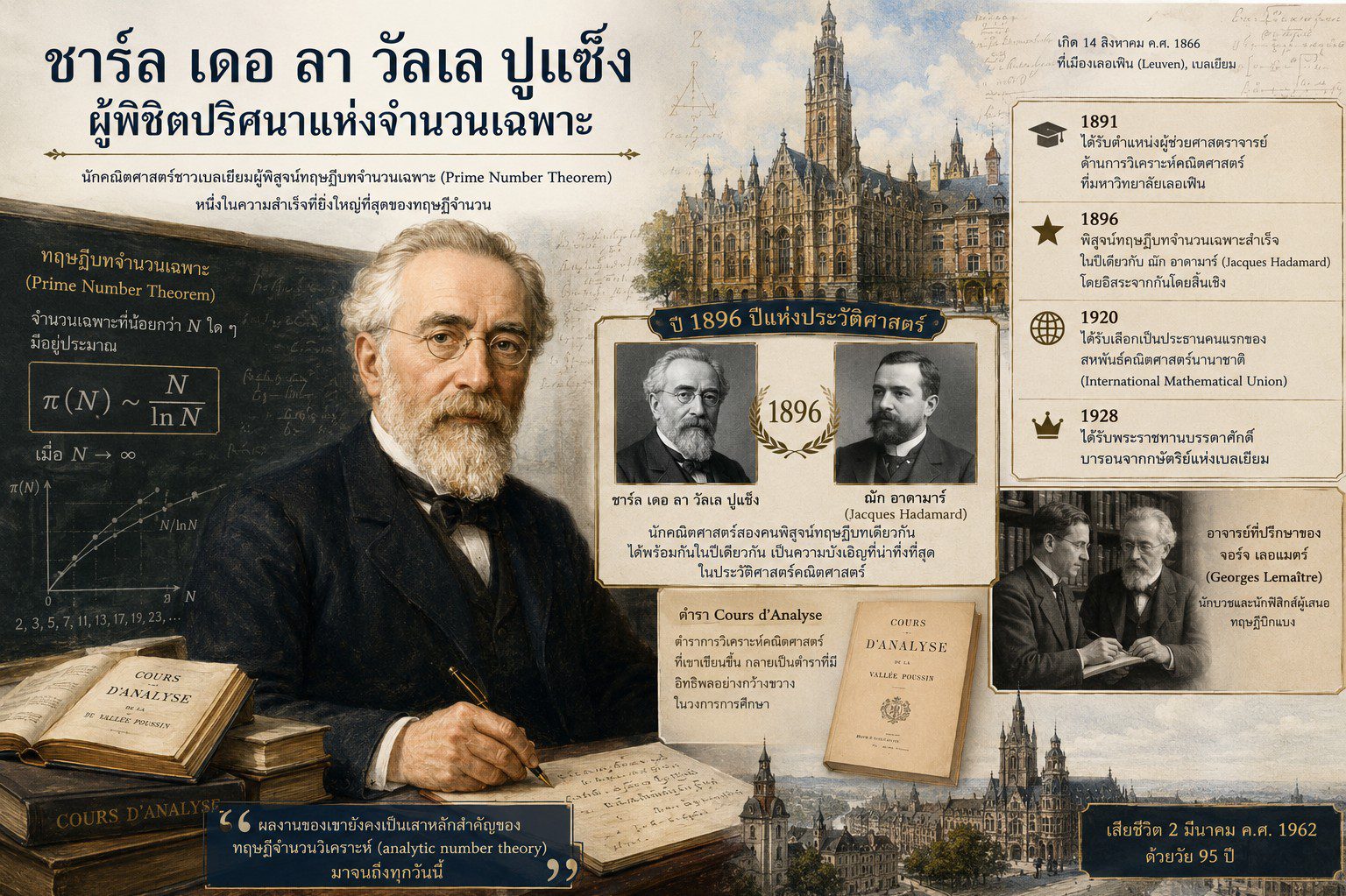
In the world of mathematics, there are some problems that have awaited answers for centuries, and one of them is the question, “How are prime numbers distributed among the natural numbers” Charles-Jean de la Vallée Poussin, a Belgian mathematician born on August 14, 1866, in the city of Leuven, was one of two people who first solved this mystery in history.
The path from engineering to pure mathematics
Vallee Poussin was born into an academic family. His father was a professor of mineralogy and geology at the University of Leuven for nearly 40 years. Although in his youth he had considered becoming a Jesuit priest, he eventually turned to engineering before being persuaded by his uncle, Louis-Philippe Gilbert, a mathematician who taught at the University of Leuven, to pursue advanced studies in mathematics seriously. In 1891, at just 25 years old, he became an assistant professor of mathematical analysis at the same institution, and when his uncle died, he succeeded him as a professor.
1896, a historic year
The work that made Charles-Jean de la Vallée Poussin's name forever memorable was his successful proof of the Prime Number Theorem in 1896. This theorem explains that there are approximately N/ln(N) prime numbers less than any given number N, providing an accurate approximate answer to an age-old question that mathematicians had been trying to solve for more than a hundred years. Even more remarkably, in that very same year, the French mathematician Jacques Hadamard also independently succeeded in proving the same theorem. The event in which two mathematicians solved the same puzzle simultaneously in the same year is considered one of the most remarkable coincidences in the history of mathematics, and the results of both men continue to be regarded as one of the most important achievements in number theory to this day.
A life filled with honor
Vallee Poussin devoted his life to the University of Leuven for many years. He served as a professor there for as long as 50 years, and the textbook he wrote on mathematical analysis (Cours d’Analyse) became a widely influential textbook in academic circles. During the First World War, when the city of Leuven was destroyed by the German army, he was invited to teach temporarily at Harvard University in the United States, before returning to Europe to teach in Paris and settling back in Belgium once the war ended.
He was elected as the first president of the International Mathematical Union in 1920 and was granted the title of baron by the King of Belgium in 1928. He was also an academic advisor to Georges Lemaître, the priest and physicist who proposed the Big Bang theory, who had completed his master's thesis under his supervision.
Charles de la Vallée Poussin died on March 2, 1962, at the age of 95, leaving behind work that remains a cornerstone of analytic number theory to this day.