Remembering Edward Waring: Cambridge's Enigmatic Lucasian Professor
On August 15, 1798, in the village of Plealey near Pontesbury, Shropshire, England, Edward Waring passed away at around 62 years of age. He left behind a body of mathematical work decades ahead of its time, yet remained largely unrecognized during his lifetime due to his obscure writing style and his isolated nature from contemporary mathematicians.
From Farmer’s Son to Lucasian Professor
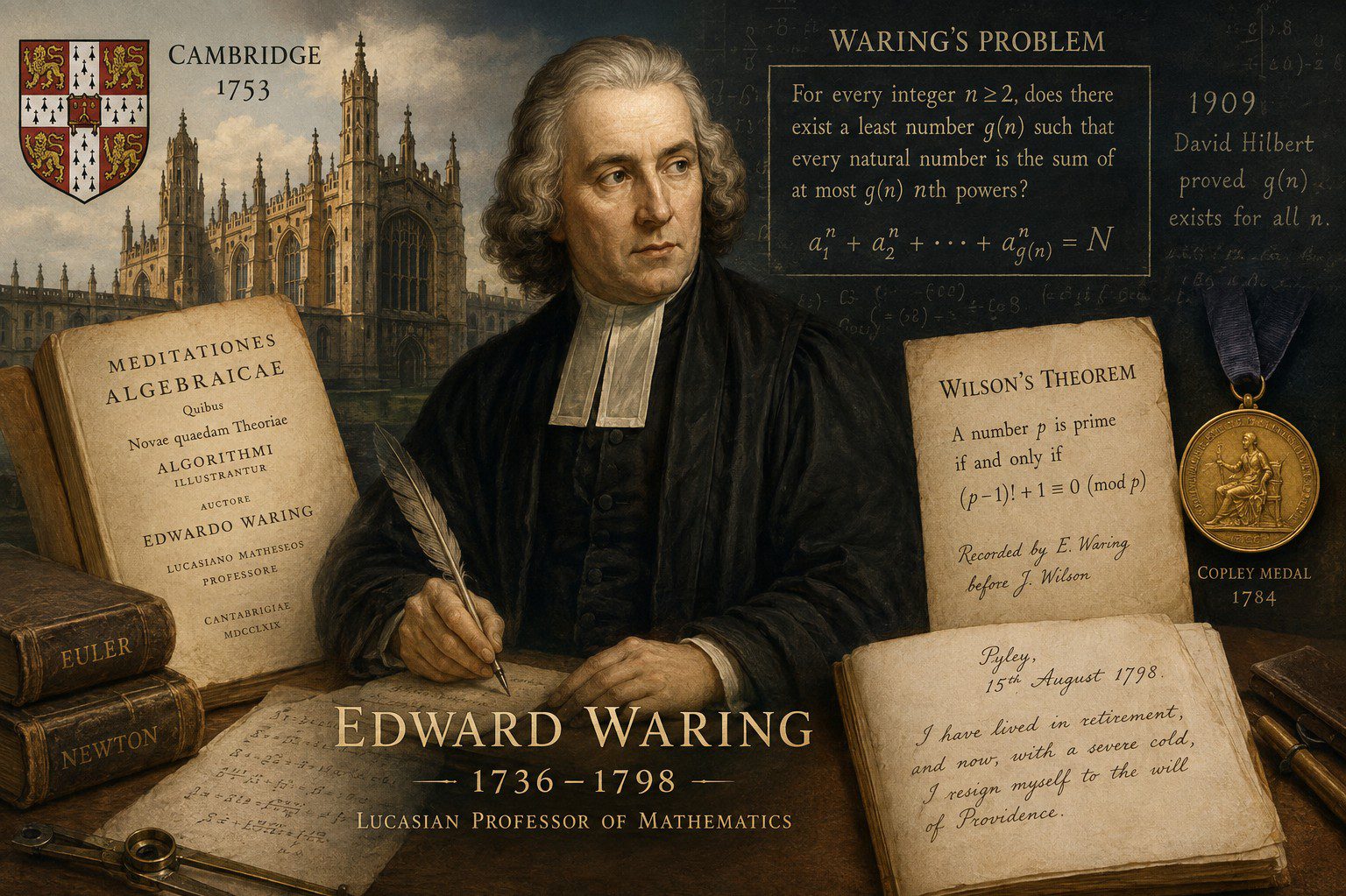
Waring was born into a prosperous farming family in Old Heath, near Shrewsbury. He attended Shrewsbury School before entering Magdalene College, Cambridge, in 1753 as a 'sizar'—a student who received reduced tuition in exchange for performing domestic duties for the college. His exceptional mathematical talents were evident from his earliest years, and in 1757, he graduated as Senior Wrangler, securing the highest score in Cambridge's renowned Mathematical Tripos examination.
Just three years later, in 1760, Waring was appointed Lucasian Professor of Mathematics—the prestigious chair once held by Sir Isaac Newton—a position he would occupy until his death. Although he earned a Doctor of Medicine degree from Cambridge in 1770, it is believed he practiced medicine only briefly. In 1784, his contributions were recognized with the distinguished Copley Medal from the Royal Society of London.
A Problem Awaiting Answers for Over a Century
Waring’s most celebrated achievement is Waring’s Problem, which he posed without proof in his treatise Meditationes Algebraicae. The core question asks whether, for any given integer $n$, there exists a minimum integer $g(n)$ such that every natural number can be expressed as a sum of at most $g(n)$ $n$-th powers. This challenge remained unanswered for over a century until 1909, when the German mathematician David Hilbert successfully proved the existence of $g(n)$ for all values of $n$. Today, Waring’s Problem continues to be a vibrant area of research in analytic number theory.
In addition, Waring was the first to record Wilson’s Theorem in writing, although it was named after his pupil, John Wilson, who initially discovered it. The theorem states that an integer $p > 1$ is a prime number if and only if $(p-1)! + 1$ is divisible by $p$—a fundamental result that has become an essential tool in modern number theory.
The Genius No One Understood
Waring’s academic life was full of paradoxes. Despite holding the Lucasian Chair, records suggest he rarely gave lectures, and his writings were notoriously obscure and difficult to comprehend. A biographer once described him as one of the most profound mathematicians of the 18th century, yet noted that the inelegance and obscurity of his works prevented him from receiving the acclaim he rightly deserved.
In his later years, Waring faced severe financial difficulties, forcing him to resign from the Royal Society in 1795 because he could no longer afford the annual subscription fee. He spent his final years in seclusion on his estate in Plealey before succumbing to a severe cold on August 15, 1798. Although his fame was modest during his lifetime, the problems and theorems he bequeathed remain fundamental topics in number theory textbooks around the world to this day.