Remembering Jacob Bernoulli: The pioneer of probability theory of the Bernoulli family.
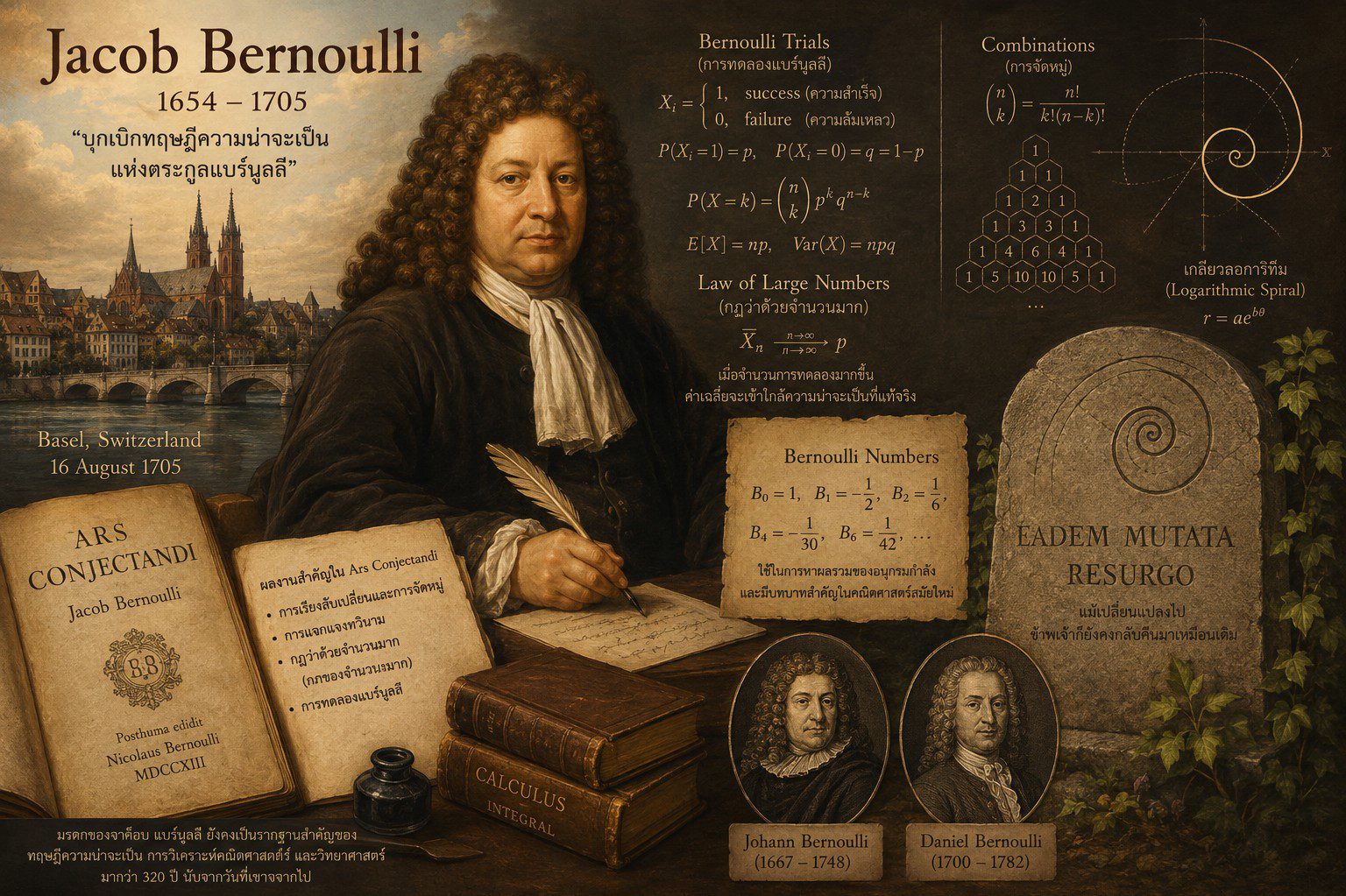
On August 16, 1705, in Basel, Switzerland, Jacob Bernoulli, better known as James or Jacques Bernoulli, died at the age of 50. He was the first member of the Bernoulli family, one of the most famous and distinguished Swiss mathematical families in the history of mathematics, which had produced many brilliant mathematicians over several generations.
From theologian to mathematician.
Jacob Bernoulli was born in Basel into a family of spice merchants. Initially, he studied theology according to his father's wishes, but driven by a passion for mathematics, astronomy, and physics, he secretly pursued these disciplines in tandem. After graduating in theology, he spent about six to seven years traveling throughout Europe to study under various scholars before returning to Basel, where he was appointed professor of mathematics at the University of Basel in 1687, a position he held until the end of his life.
Bernoulli was a key supporter of Gottfried Wilhelm Leibniz's calculus ideas during the priority dispute between Leibniz and Isaac Newton, and together with his younger brother Johann Bernoulli, he pioneered the crucial field of the calculus of variations in mathematical analysis. However, their sibling relationship was filled with severe conflict; starting from early cooperation, their feud escalated until they stopped speaking entirely in their later years.
Ars Conjectandi: The Foundations of Probability Theory
Bernoulli's greatest work is the book Ars Conjectandi (The Art of Conjecturing), which was published in 1713, eight years after his death, by his nephew Nicholas Bernoulli. This book is considered one of the earliest texts to lay the vital foundation for modern probability theory. It covers the theories of permutations and combinations, the binomial distribution, and most importantly, the first law of large numbers for independent trials, which are now known as "Bernoulli trials" and have become a cornerstone of modern sampling theory.
Additionally, Bernoulli also discovered the Bernoulli numbers, a sequence of numbers that plays an important role in finding the sums of power series and remains a widely used tool in modern mathematics, including number theory, numerical analysis, and exponential series expansion. He was also the first person to use the term "integral" in a mathematical sense, and he made significant contributions to the study of various curves, such as the catenary, which is the shape of a freely hanging rope.
The legacy left on the grave.
Bernoulli was so fascinated by the properties of the logarithmic spiral that he requested it be carved onto his tombstone along with the Latin inscription "Eadem mutata resurgo," which translates to "Though changed, I return to my original form," reflecting the unique characteristic of this spiral that retains its original shape even when expanded or rotated.
Jacob Bernoulli was just the beginning of the Bernoulli family, which went on to produce many other famous mathematicians and scientists, including his younger brother Johann and his nephew Daniel Bernoulli, a pioneer in fluid dynamics. Jacob's work remains a cornerstone of probability theory and mathematical analysis, studied by mathematicians worldwide even today, more than 320 years after his death.