Arthur Cayley: Father of Modern Matrix Algebra
Arthur Cayley was born on August 16, 1821, in Richmond, Surrey, England, during a temporary visit of his parents back to England from Saint Petersburg, Russia, where his family conducted their business. Throughout his career, Cayley became one of the leading figures of the English pure mathematics school in the 19th century and was a person with an enormous number of published works, almost unmatched in his era.
A lawyer who never abandoned mathematics
Although he exhibited mathematical talent from a young age at King's College School in London, and later at Trinity College, University of Cambridge, where he graduated as Senior Wrangler in 1842, Cayley did not immediately pursue an academic career. Since the college scholarship was limited in duration, he chose to practice as a solicitor specializing in conveyancing for 14 years, between 1846 and 1863. Remarkably, throughout his time as a lawyer, he continued to produce around 200-300 mathematical research works, considered the best and most innovative of his life. It was during this period that he met and became close with James Joseph Sylvester, another mathematician who also worked as a lawyer. Together, they developed the algebraic theory of invariants and were recognized as co-founders of this field. In 1863, when the Sadleirian Professorship at Cambridge was re-established, Cayley was selected to hold this position and devoted himself to academic work.
The pioneer of matrix algebra
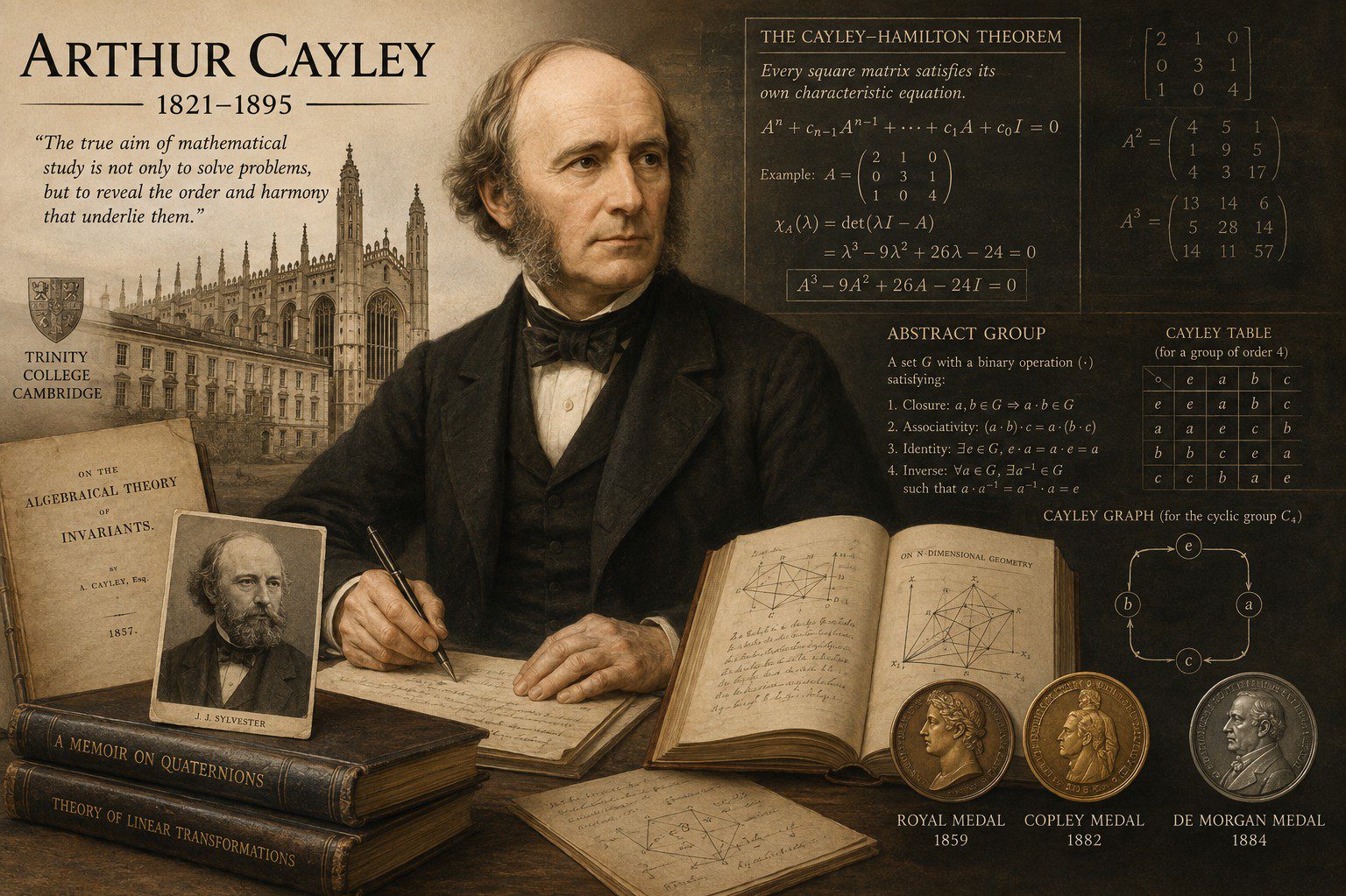
Cayley's most important work was the development of matrix algebra into a systematic discipline. He pioneered the concept of performing algebraic operations on entire matrices, not just individual numbers, which laid the essential foundation for modern linear algebra used in nearly every field of science and engineering today. His most famous contribution in this area is the Cayley-Hamilton theorem, which states that every square matrix satisfies its own characteristic equation. This theorem remains a fundamental and widely used tool in linear algebra, physics, and engineering to this day.
In addition, Cayley was the first person to define the concept of an abstract group in the modern sense, which is different from the permutation group concept of Évariste Galois that existed earlier. This work led to other important concepts bearing his name, such as Cayley tables and Cayley graphs, which remain essential tools in group theory to this day.
One of the most prolific mathematicians in history
Throughout his career, Cayley published more than 900 works, covering almost every branch of mathematics that existed in his era, from algebraic geometry, group theory, non-Euclidean geometry, to n-dimensional geometry. The breadth and quantity of his work earned him recognition as one of the most prolific mathematicians in history, second only to Euler and Cauchy. He received numerous honors, including the Royal Medal in 1859, the Copley Medal in 1882, and the De Morgan Medal in 1884.
Arthur Cayley passed away on January 26, 1895, in Cambridge at the age of 73, leaving behind the fundamental foundations of linear algebra and group theory that mathematicians, engineers, and scientists around the world still use every day to this day.