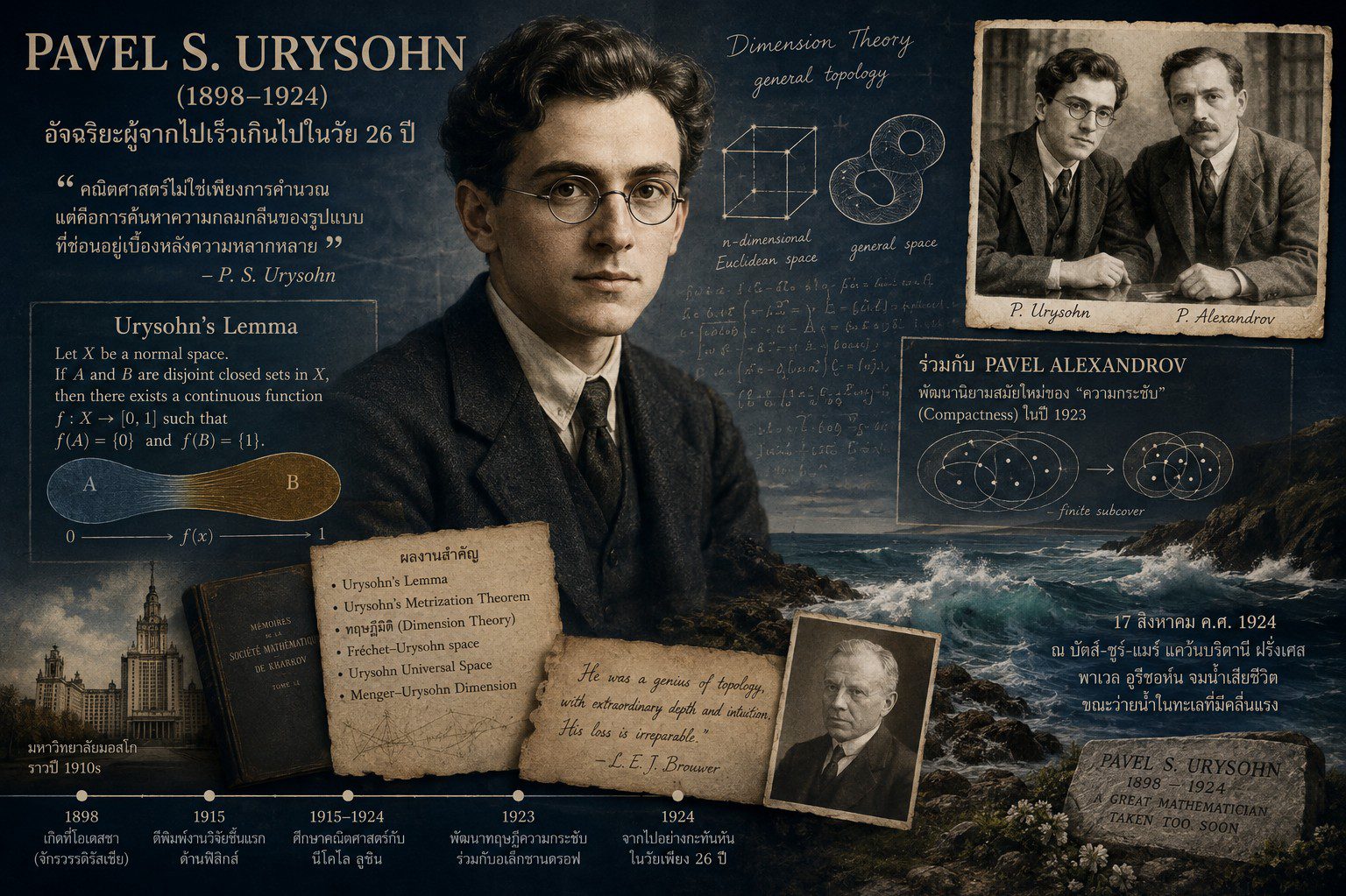
Pavel Urizohn: A Genius Who Left Too Soon at the Age of 26
On August 17, 1924, in the village of Batz-sur-Mer on the coast of Brittany, France, Pavel Samuilovich Urysohn drowned while swimming in the sea with strong waves during a vacation after touring important mathematical centers across Europe. He passed away at the age of only 26, leaving behind topological work far greater than his short life could suggest.
A brilliant mathematician from Odessa
Urysohn was born in the city of Odessa, Ukraine (then part of the Russian Empire) into a well-off Jewish family. His father was a financier. He began studying at Moscow University in 1915, initially interested in physics, and published his first research in physics in the same year. However, after attending lectures by Nikolai Luzin and Dmitri Egorov, his interest fully shifted to mathematics, with Luzin as his advisor.
Pioneer of topological dimension theory
Urysohn's most important work was laying the foundation for dimension theory in general topology. He developed the idea of what the “dimension” of a topological space is in an abstract sense, which is a basic question that seems simple but becomes very complex when you try to extend it from familiar Euclidean spaces to general topological spaces.
His most famous work is Urysohn’s lemma, which is one of the most fundamental results in general topology. This lemma specifies the conditions under which it is possible to construct a continuous function that separates two closed sets in a normal space. Urysohn’s lemma is a basic tool that mathematicians use to prove many other important theorems, including Urysohn’s metrization theorem, which provides conditions under which a topological space can be given a metric. In addition, he, together with his close friend and colleague Pavel Alexandrov, developed the modern definition of 'compactness' in 1923.
Close academic relationship
Urysohn and Aleksandrov worked closely together as academic collaborators. They traveled together to visit leading mathematicians in Europe, including David Hilbert, Felix Hausdorff, and Luitzen Egbertus Jan Brouwer, who was particularly impressed with Urysohn, to the point of having a bond similar to that of an adoptive father. After their last visit to Brouwer in the summer of 1924, the two went on to vacation in the region of Brittany, which is where the tragedy occurred.
On the day of the incident, Urisohn was swept away by strong currents while swimming in the sea with high waves. Alexandrov, who was on the shore, tried to help but was too late. Urisohn’s sudden passing caused profound sorrow for Alexandrov, who later described it as the loss of his closest friend and greatest intellectual partner in life. The news of Urisohn's death spread quickly among European mathematicians, and letters of condolence poured in from many leading mathematicians.
A legacy that remains even if life is short
Although he lived only 26 years, Urysohn's work has had a profound influence on the field of topology up to the present day. His name has been used for several key concepts, such as Urysohn universal space, Fréchet–Urysohn space, and Menger–Urysohn dimension. The story of Pavel Urysohn remains a sad reminder of the limitless potential that may be cut short prematurely, but it also serves as proof that profound ideas can exert influence across time, even after their creator has passed away.