Brook Taylor: The creator of the most powerful function approximation tool
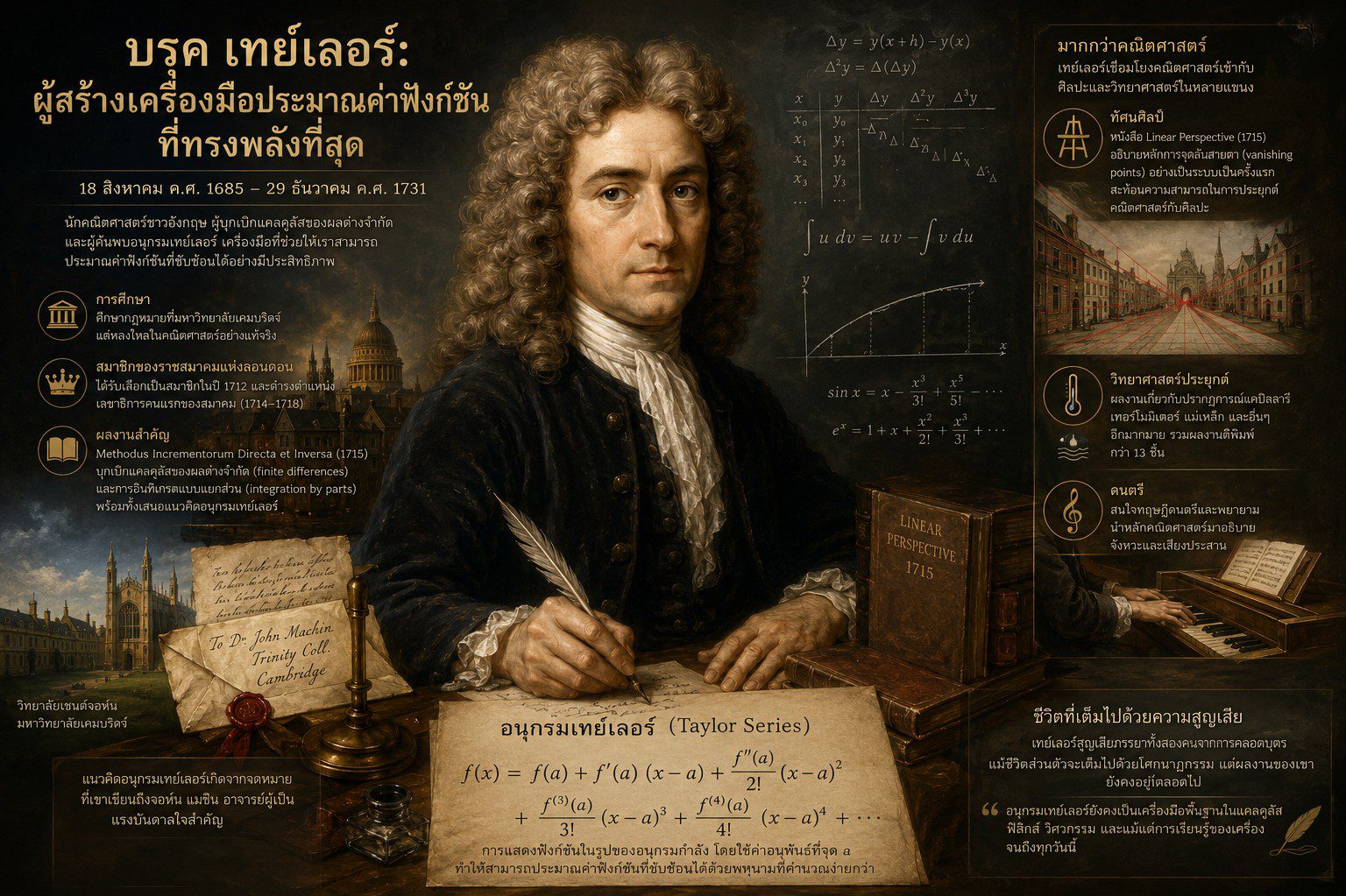
Brook Taylor He was born on August 18, 1685, in Edmonton, Middlesex, England, into a well-off family and within high society. His father was strict but cultured, with interests in both painting and music, and these two interests later influenced Taylor when he applied mathematical principles to both music and visual arts.
A lawyer who is passionate about mathematics
Taylor entered St John's College, University of Cambridge in 1701 to study law, receiving a Bachelor's degree in law in 1709 and a Doctorate in 1714. However, there is almost no evidence that he ever seriously practiced as a lawyer, because his true interest was always in mathematics. He was trained by John Machin and John Keill and became one of the most enthusiastic supporters of Newtonian mechanics of his time. In 1712, he was elected a Fellow of the Royal Society of London and served as the Society's first Secretary from 1714 to 1718.
A work that transformed the face of applied mathematics
In 1715, Taylor published an important work Methodus Incrementorum Directa et Inversa He pioneered a new field called the 'calculus of finite differences' and was the initiator of the 'integration by parts' technique. But what made his name most memorable was the formula that appears in this book, which later became known as Taylor series
The Taylor series is a method for representing a function in the form of an infinite power series by using the derivatives of the function at a particular point. This principle allows the approximation of complex functions with polynomials that are easier to calculate and has become one of the fundamental tools of calculus and applied mathematics up to the present day. From engineering calculations, computational physics, to optimization techniques used in modern machine learning, all rely on Taylor approximation principles as a crucial foundation.
Interestingly, the concept of the Taylor series originated from a letter he wrote to John Machin, his teacher, which explained the origin of this idea. And even though there was a delay in publishing the work, which led to a dispute over who had discovered it first with Johann Bernoulli, the Swiss mathematician, Taylor's name has still stuck with this formula to this day.
Works in visual arts and music
In addition to his work in pure mathematics, Taylor also published books Linear Perspective In the same year, 1715, which was his first work to systematically describe the principle of “vanishing points,” this piece reflected Taylor's ability to connect mathematics with art in a profound way. In addition, he published thirteen other works on a variety of topics, ranging from capillary action and thermometers to magnets.
A personal life full of loss
Taylor's personal life was filled with tragedy. He first married in 1721, but his wife died during childbirth. He later remarried in 1725, and four years later he inherited his father's land in Kent. However, his second wife also died the following year from childbirth. Although his daughter survived this time, these repeated losses greatly affected Taylor's health and mind in his later years.
Brook Taylor died on December 29, 1731, in London at the age of 46. Although during his lifetime he was not recognized to the same extent as contemporary mathematicians like Isaac Newton or Gottfried Leibniz, today there is hardly any calculus textbook in the world that does not mention Taylor series, which remains an essential tool used by scientists, engineers, and artificial intelligence developers around the world every day to this day.