Alan Baker: The Man Who Revolutionized the Theory of Transcendental Numbers with Logarithms
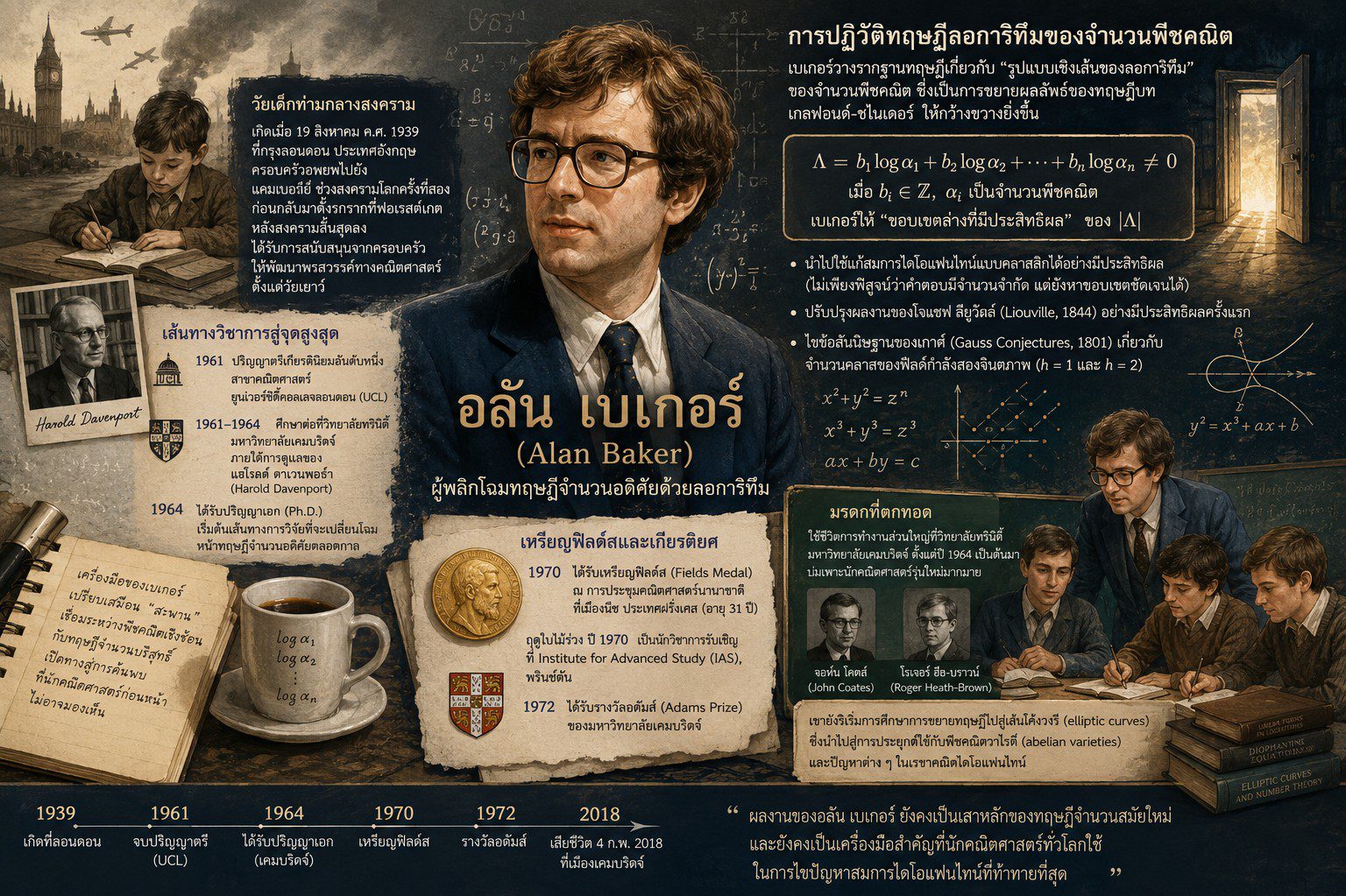
Alan Baker was born on August 19, 1939, into a Jewish family in London, England. His childhood was filled with memories of World War II, during which his family had to evacuate to Camberley in Surrey before moving back to settle in the Forest Gate area in East London after the war ended. Although his father had mathematical talents comparable to anyone, he never had the opportunity to develop these abilities and instead pursued a career as a tailor. Baker himself received support from his family to develop his mathematical talents, which were evident from an early age.
The academic path to the highest point
Baker studied at University College London and graduated with a first-class honors degree in mathematics in 1961 before moving on to study at Trinity College, University of Cambridge under the supervision of Harold Davenport, a leading number theorist. He received his PhD in 1964 and began a research path that would forever change the landscape of transcendental number theory.
The revolution of logarithm theory in algebra
Baker's greatest work was laying the theoretical foundation for linear forms in logarithms of algebraic numbers, which significantly extended the results of the Gelfond-Schneider theorem, or Hilbert’s seventh problem. This work opened the door to the discovery of many new transcendental numbers that had never been found before, and became the essential foundation of what is now called Baker’s theorem.
More importantly, Baker also developed quantitative versions of this theory and applied it to effectively solve classical Diophantine equations, which means that not only can it be proven that the number of solutions is finite, but the precise bounds of these solutions can also be identified. This represents the first effective improvement on Joseph Liouville's 1844 work on Diophantine approximations. In addition, Baker was able to resolve Gauss's 1801 conjectures regarding the class numbers of imaginary quadratic fields, successfully covering both the cases h=1 and h=2.
The Fields Medal and Inherited Legacy
In 1970, at the International Congress of Mathematicians in Nice, France, Baker was awarded the Fields Medal at the age of only 31 for his outstanding work in transcendental number theory and its applications. That same autumn, he became a visiting scholar at the Institute for Advanced Study in Princeton, and in 1972 he also received the prestigious Adams Prize from Cambridge.
Baker spent most of his working life at Trinity College, University of Cambridge, as a fellow since 1964, and he nurtured many young mathematicians who later made names for themselves in their own fields, such as John Coates and Roger Heath-Brown. In addition, he initiated the study of extending his theories to elliptic curves, which paved the way for applications to abelian varieties and various old and new problems in Diophantine geometry.
Alan Baker passed away on February 4, 2018, in Cambridge after facing a severe stroke. His work remains a cornerstone of modern number theory and continues to be a tool that mathematicians around the world use to solve the most challenging Diophantine equations to this day.