Remembering William Burnside: Pioneer of Group Representation Theory
On August 21, 1927, in West Wickham, Kent, England, William Burnside, an English mathematician, passed away at the age of 75. He left behind work that laid important foundations for finite group theory, a field that became a key pillar of modern abstract algebra.
The orphan who discovered a talent in mathematics
Burnside was born on July 2, 1852, in the Paddington district of London. He was the eldest son of a Scottish merchant, but fate played a cruel trick on him when both his father and mother passed away before he was six years old, making Burnside an orphan from a young age. He was educated at Christ's Hospital School, a school that accepted children from families who could not afford boarding school tuition, and he excelled in both linguistics and mathematics.
In 1871, Burnside received a scholarship to study at St John's College, University of Cambridge, before transferring to Pembroke College in 1873 and graduating in 1875 with the position of Second Wrangler in the famous Mathematical Tripos examination. He was awarded a fellowship at Pembroke College and taught hydrodynamics there until 1886, before being appointed as a professor of mathematics at the Royal Naval College in Greenwich, a position he held throughout his working life until his death. Although this position was far from the main centers of mathematical research in England, Burnside remained an active researcher and published more than 150 works throughout his career.
The turning point to group theory
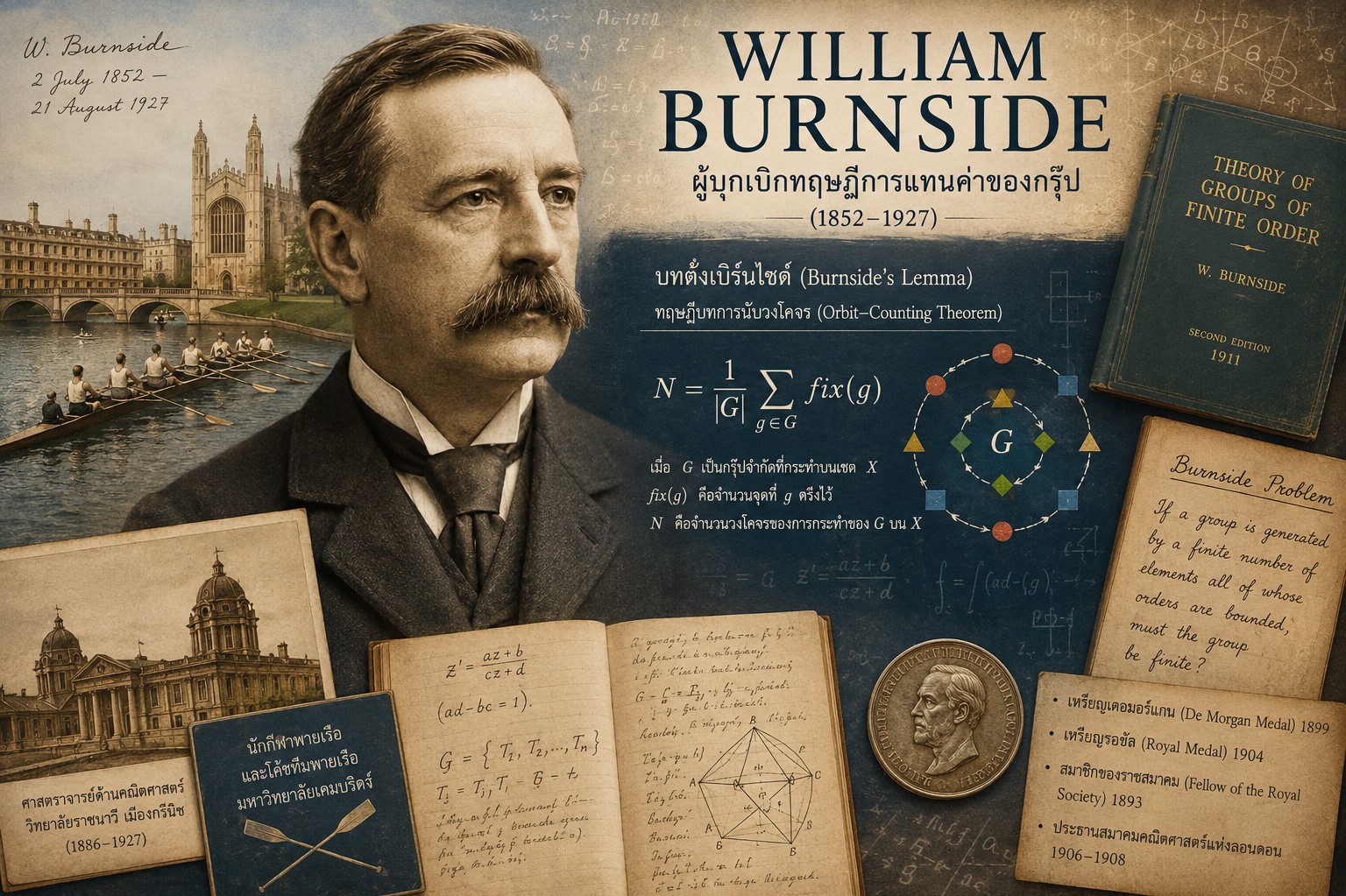
Although he began his career in applied mathematics research, in the early 1890s Burnside's interest fully shifted to group theory, starting with research on groups of linear fractional transformations of complex variables in 1891-1892, and by 1894 finite group theory had become the central focus of his research. In 1897, he published a book Theory of Groups of Finite Order Which is considered the first textbook in English to systematically explain group theory, and has become a standard textbook used widely for more than 40 years, especially the second edition published in 1911, which included the group representation theory of Ferdinand Georg Frobenius.
A chapter named after him even though he was not the first to discover it
The work of Burnside that is best known today is Burnside’s lemma, also known as the “orbit-counting theorem,” which is a formula that connects the number of orbits of a permutation group acting on a set with the average number of fixed points of the elements in that group. This lemma has become an important tool in combinatorics, particularly for counting objects that have symmetry. Interestingly, although this lemma is named after Burnside, it was actually discovered earlier independently by Frobenius and Augustin-Louis Cauchy. This is a classic example of the phenomenon known as the “Stigler’s law of eponymy” in the history of mathematics.
Furthermore, Burnside also proposed the Burnside problem, which questions whether a group generated by a finite number of elements, where each element has a finite order bounded by a limit, must always be a finite group. This question became a major inspiration for research in group theory throughout the 20th century, and many significant discoveries were made in attempts to solve it, including research that led to two Fields Medal awards.
An athlete who is also a mathematician
Apart from his academic work, Burnside was also known as a famous rower. During his time as a lecturer at Cambridge, he also served as a coach for the university's rowing team. So much so that his obituary in The Times newspaper emphasized his athletic career more than his mathematical work, calling him 'one of the most famous athletes at Cambridge in his time.'
Burnside received numerous academic honors, including the De Morgan Medal in 1899 and the Royal Medal in 1904 from the Royal Society of London. He was elected a Fellow of the Royal Society in 1893 and served as president of the London Mathematical Society from 1906 to 1908. Even in his final presidential address in 1908, he continued to express concern that English mathematicians paid too little attention to group theory.
The academic legacy of William Burnside continues to live on in combinatorics and group theory textbooks worldwide to this day. It is a testament that researchers working far from major academic centers can still produce work that profoundly changes the field of mathematics.