Augustin-Louis Cauchy: The Father of Rigor in Modern Mathematics
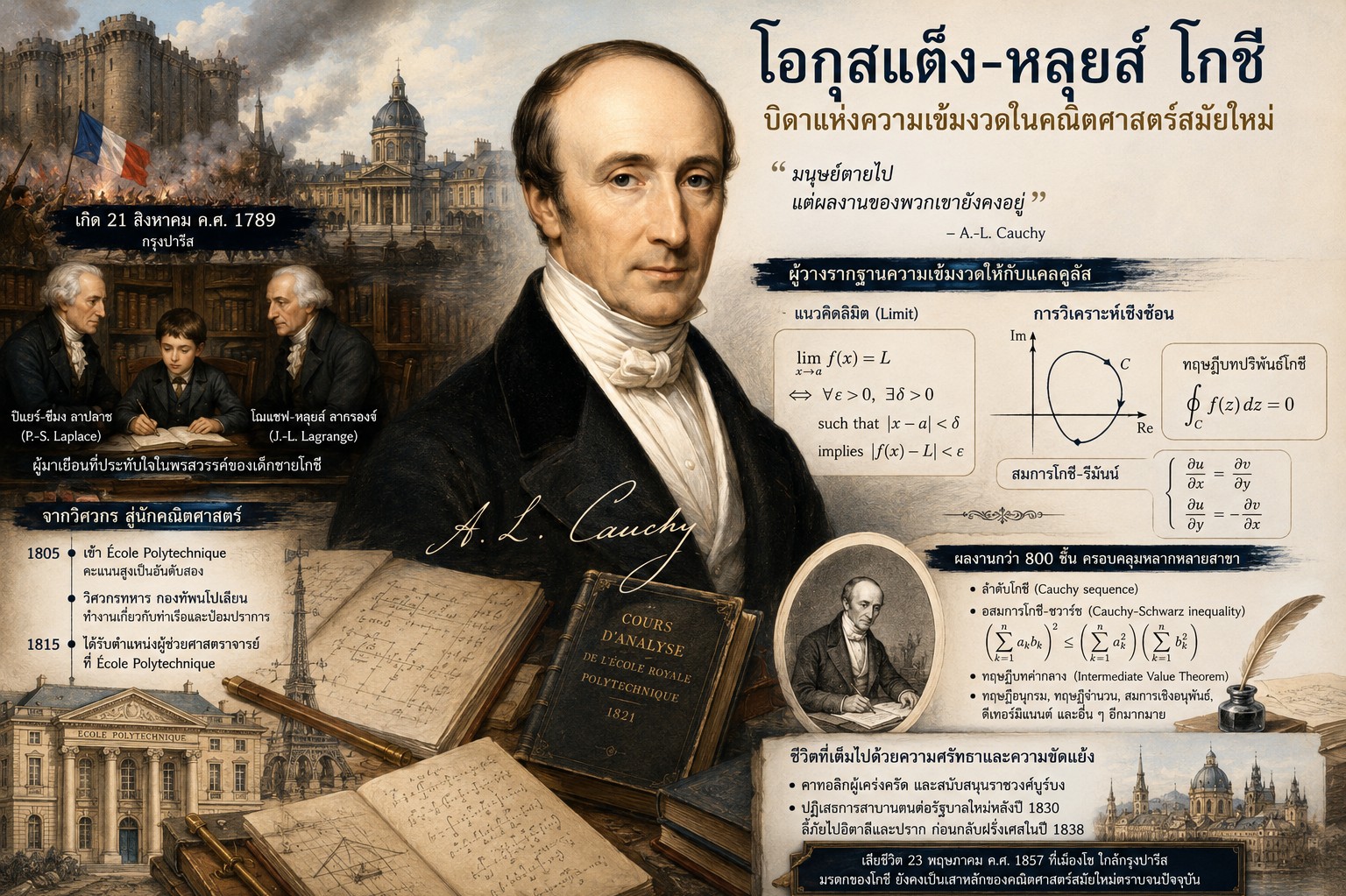
Auguste-Louis Cauchy was born on August 21, 1789, in Paris, just 38 days after the storming of the Bastille, which marked the beginning of the French Revolution. His father, a lawyer and a police officer loyal to the monarchy, recognized the impending danger and hurriedly took the family to flee to the village of Argeville. There, the Cauchy family had to live in hardship amid the famine during the Reign of Terror. Yet, amid these difficulties, Cauchy received basic education from his knowledgeable father and displayed a mathematical talent that impressed Pierre-Simon Laplace and Joseph-Louis Lagrange, who regularly visited the Cauchy household.
From engineer to great mathematician
Although he clearly had mathematical talent, Gauch chose to study engineering at first. He entered the Central School of Ponts before continuing his studies at the École Polytechnique in 1805, ranking second in his class, and graduated in engineering from the École des Ponts et Chaussées. He began his career as a military engineer in Napoleon's army in Cherbourg, working on ports and fortifications. But amidst the heavy workload, he continued to produce significant mathematical work continuously, until in 1815 he received the position of assistant professor at the École Polytechnique, marking the beginning of an academic path filled with tremendous achievements.
The person who laid the foundations of rigor for calculus
Cauchy's greatest achievement was revolutionizing the way calculus is studied. He was among the first individuals to define and rigorously prove key theorems of calculus using the concept of "limit" instead of the intuitive approaches that earlier mathematicians employed. This was the origin of what is now called real analysis. In lectures at the École Polytechnique during the 1820s, Cauchy laid the essential foundations for modern rigorous calculus, which, although initially unpopular among students, was eventually recognized and became a central element of contemporary mathematical analysis.
In addition, Cauchy was almost single-handedly a pioneer in the field of complex analysis. His significant works in this field include the Cauchy-Riemann equations, which are the fundamental conditions that determine whether a complex variable function is differentiable, and the Cauchy integral theorem along with the Cauchy integral formula, which are the most essential foundations of all complex analysis. These concepts remain fundamental tools that mathematicians, engineers, and physicists around the world continue to use to this day.
One of the most prolific mathematicians in history
Throughout his career, Cauchy published nearly 800 works, covering almost every branch of mathematics of his time, including series theory, number theory and complex quantities, group theory and permutations, function theory, differential equations, and determinants. Hans Freudenthal, a mathematician and historian of mathematics, once said that there are more concepts and theorems named after Cauchy than any other mathematician in history. For example, the Cauchy sequence, which is a fundamental concept used to define the completeness of metric spaces; the Cauchy-Schwarz inequality; and the intermediate value theorem, which he was the first to prove rigorously.
A life full of faith and conflict
Gauche was known as a devout Catholic and a strong supporter of the Bourbon monarchy. His intense religious and political beliefs caused conflicts with colleagues numerous times throughout his career. After the revolution in 1830, he refused to swear allegiance to the new government and chose to take refuge with King Charles X, teaching in Turin and Prague before returning to France in 1838.
Augustin-Louis Cauchy died on May 23, 1857, in Soisy, near Paris. His last words, 'Men pass away, but their works remain,' clearly reflect the great legacy he left behind. To this day, almost no advanced mathematics textbook fails to mention Cauchy's name. His works remain a fundamental pillar that mathematicians around the world use every day, more than 165 years after his passing.