Hans Lewy: The discoverer of the unsolvable equation that shook the field of differential equations
On August 23, 1988, in Berkeley, California, Hans Lewy, a German-American mathematician, passed away from leukemia at the age of 83. He left behind work that is regarded as one of the unparalleled contributions in the field of partial differential equations and several-variable complex analysis of the 20th century.
From Breslau to Göttingen
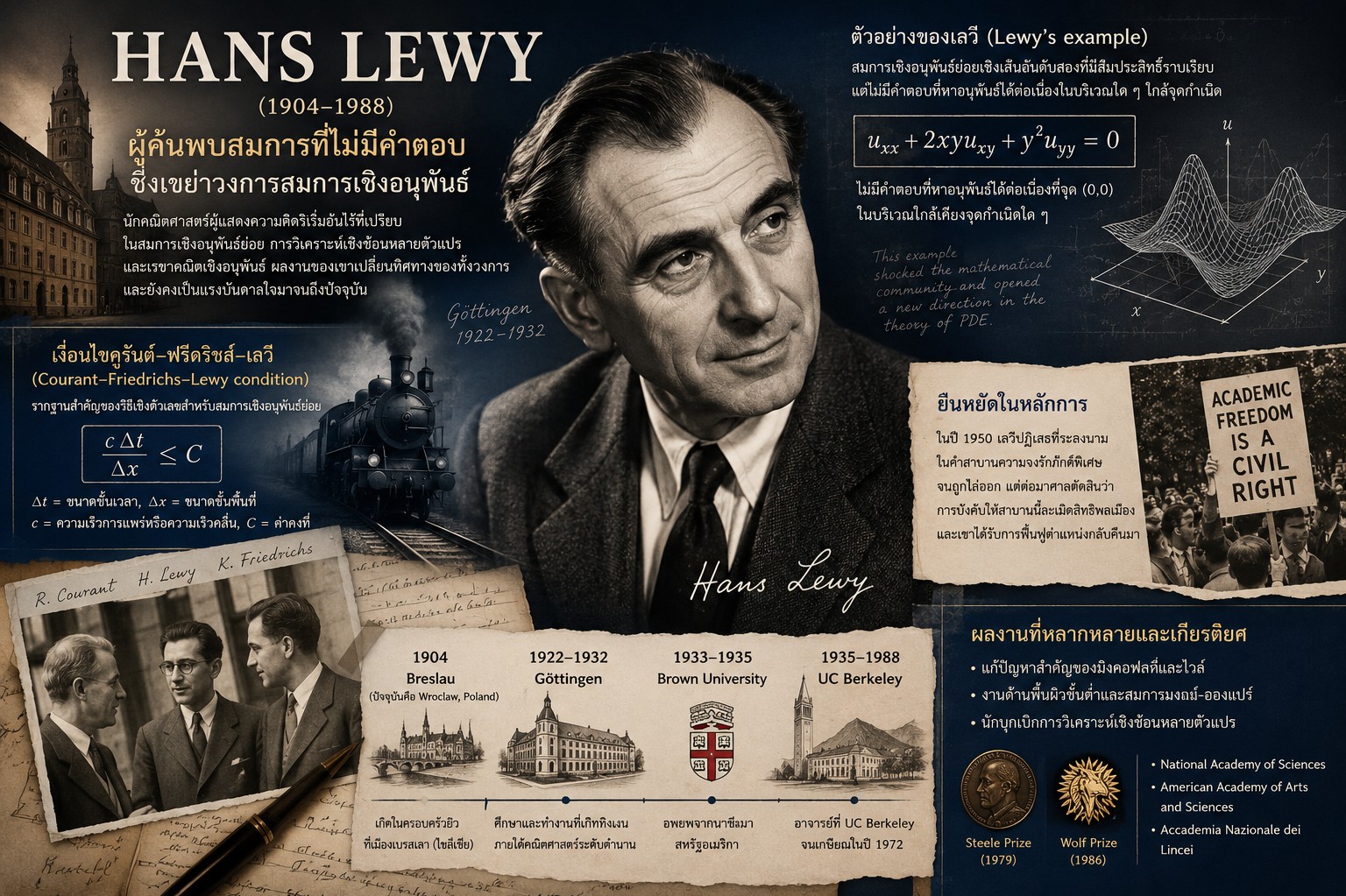
Levi was born on October 20, 1904, into a Jewish family in Breslau, Silesia. He began his studies at the University of Göttingen in 1922, following the advice of his high school teacher that the local University of Breslau was too outdated. While studying, he had to earn extra income by working on railway maintenance amid the severe inflation of the Weimar era. At Göttingen, which was one of the greatest centers of mathematics in the world at the time, Levi studied both mathematics and physics under many legendary professors, including Max Born, Richard Courant, James Franck, David Hilbert, and Edmund Landau. He received his doctorate in 1926 under Courant's supervision and held a teaching position at Göttingen for another six years. During this time, he was awarded a Rockefeller fellowship to continue his studies in Rome and Paris.
It was during this time that Lewy, together with Courant and Kurt Friedrichs, developed the Courant-Friedrichs-Lewy condition, or known as the CFL condition, in a 1928 paper, which became an essential foundation for the development of numerical methods for partial differential equations and played a very important role in the later development of high-speed computers.
Fleeing the Nazis to Berkeley
When Hitler came to power on January 30, 1933, Lewitt immediately realized that he could no longer stay in Germany and had to emigrate abroad. He traveled to the United States and held a position at Brown University between 1933-1935 before moving to become a professor at the University of California, Berkeley in 1935, where he was gradually promoted to full professor in 1945. During World War II, he also contributed to the war effort by working at the Aberdeen Proving Grounds.
In 1950, Levi demonstrated virtue and steadfast principles when he refused to sign the special loyalty oath required by the University of California Board of Regents, resulting in his dismissal along with several other faculty members. However, later on, the court ruled that forcing this oath violated civil rights, and he and his colleagues were reinstated.
An equation with no solution that changed the direction of the entire field
Levi's most famous work is what is now called Lewy’s example, which he presented in 1957. He constructed a second-order linear partial differential equation (PDE) with smooth coefficients, but it had no continuously differentiable solutions in any neighborhood of the origin. This discovery caused tremendous surprise in the mathematics community because it contradicted the basic belief that a differential equation with sufficiently smooth coefficients should always have a solution. This result revealed fundamental limitations in the classical hypotheses regarding the solvability of differential equations and pushed the entire field in a new direction.
Many leading mathematicians, including Louis Nirenberg and Lars Hörmander, have taken Lévy's examples and further developed them, leading to significant changes in the theory and structure of this field. Lévy received the Steele Prize from the American Mathematical Society in 1979 to honor this work.
A diverse body of work covering multiple fields
Aside from this famous example, Lewy also had many other significant works. Early in his career at Berkeley, he solved two important problems: Minkowski's problem (constructing a convex surface in three-dimensional space that corresponds to a given curvature in the direction of the normal lines) and Weyl's problem (embedding a two-dimensional Riemannian manifold with positive Gaussian curvature into three-dimensional space). He also made significant contributions to minimal surfaces and Monge-Ampère equations. In 1986, he received the Wolf Prize together with Kunihiko Kodaira.
Levi was a member of the United States National Academy of Sciences, the American Academy of Arts and Sciences, and the Accademia Nazionale dei Lincei in Rome. He was praised by his colleagues as a person of integrity and steadfast moral principles, as well as a mathematician who demonstrated unparalleled originality throughout his career. Even after retiring from Berkeley in 1972, Levi continued to conduct deep mathematical research until the end of his life. His academic legacy remains an important lesson that mathematicians around the world continue to study to this day.