Yousef Joane-Varonski: The philosopher who left an important determinant in the world of mathematics
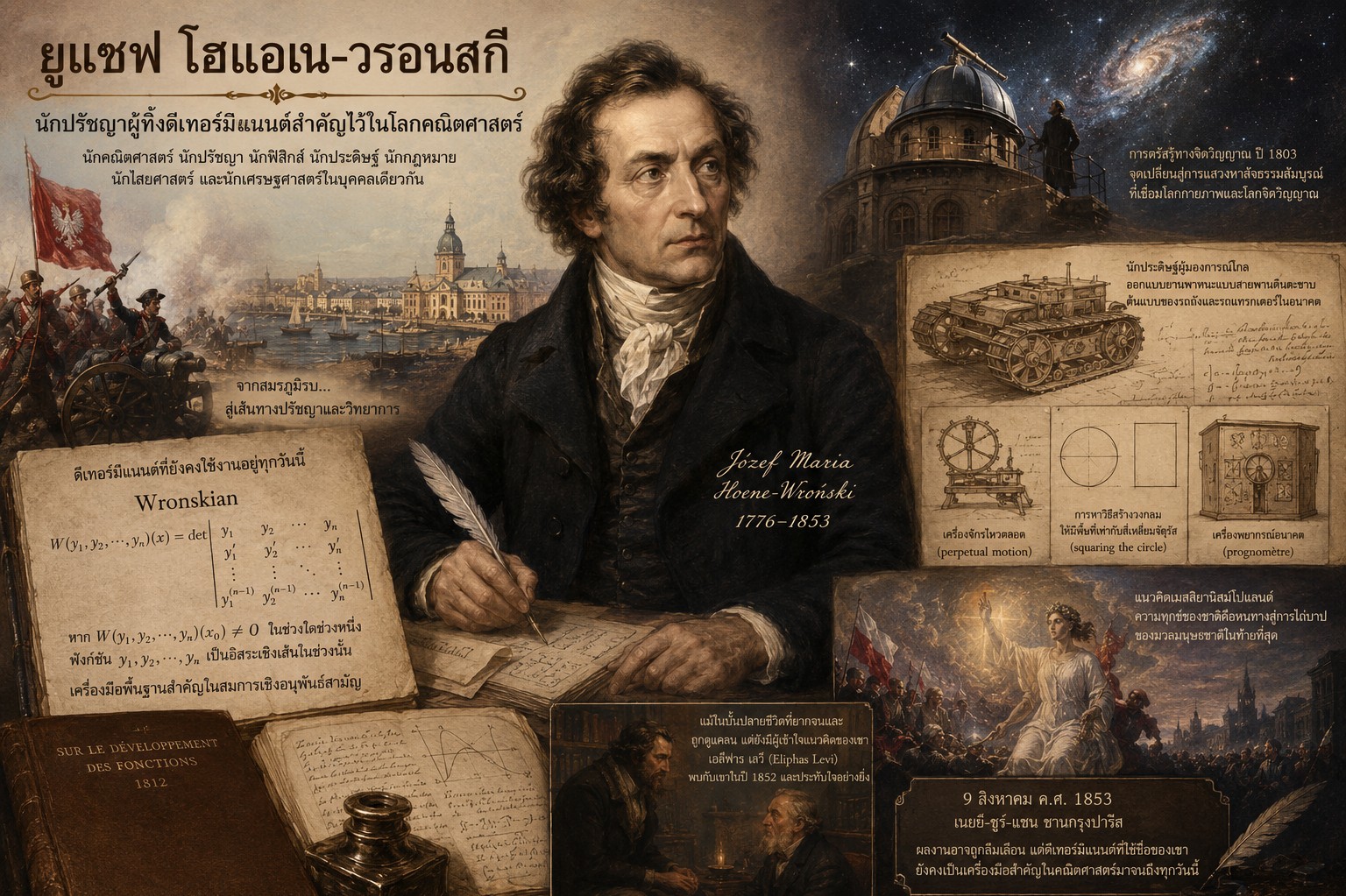
Józef Maria Hoene-Wroński was born on August 23, 1776, in the town of Wolsztyn, Poznań region, Poland, originally named Józef Hoene. His father was a city architect of Czech descent who settled in western Poland. Hoene-Wroński's life is one of the most peculiar stories in the history of mathematics because he was simultaneously a mathematician, philosopher, physicist, inventor, lawyer, occultist, and economist.
From the battlefield to German philosophy
In his youth, Hoane-Wronski joined the Kosciuszko Uprising in 1794 as a lieutenant of artillery, before being captured as a prisoner of war and having to serve in the Russian army until 1797. After resigning from the rank of lieutenant colonel, he traveled to study philosophy at various universities in the Holy Roman Empire, before joining the Polish troops in the city of Marseilles in 1800 and permanently settling in France from then on.
In 1803, while working at the Marseille Observatory, Hoane-Vronsky experienced what he called a "spiritual awakening," which he believed was a discovery of the absolute truth that connected the physical world with the spiritual world. This experience became a pivotal turning point that drove him to set a grand goal of reforming philosophy, mathematics, astronomy, and all technology into a single system under the "absolute" framework.
Determinants that are still in use today
Although most of Józef Hoene-Wroński's works were heavily criticized in his own era as being overly grandiose and obscure, one of his mathematical works turned out to be an essential tool still used today. This was his presentation of a new form of series expansion for functions, devised as a response to the use of infinite series by Joseph Louis Lagrange. The coefficients in Hoene-Wroński's new series are what gave rise to what is now called the Wronskian, a determinant which Thomas Muir later named in 1882.
The Wronskian is an important basic tool used to check whether a set of functions is linearly independent or not, especially in the context of ordinary differential equations. If the Wronskian of a set of functions is non-zero in a certain interval, it can be concluded that those functions are linearly independent in that interval. This tool remains a fundamental topic taught in differential equations courses around the world to this day.
Unlimited ambition
Apart from Voronskyan, Hoane-Voronsky also devoted himself to many grand projects, most of which were unsuccessful. In 1812, he published a work claiming that he could solve all equations of any degree using algebra, which contradicted what Paolo Ruffini had just proven earlier, and eventually it was proven that Ruffini was correct. He also designed a caterpillar vehicle, which was one of the early prototypes of the technology that later developed into modern tanks and tractors, even though in his time no one recognized the importance of this invention. He also tried to create a perpetual motion machine, find a way to square the circle, and even attempted to build a "future-predicting" machine which he called a prognomètre.
The Messianism Philosophy of Poland
Hoene-Wronski was also an important figure in the philosophical movement called 'Polish Messianism,' which viewed Poland's historical suffering from territorial partitions as having a providential meaning that would ultimately lead to the redemption of humanity. His complex philosophical ideas extended to politics, history, economics, law, psychology, music, and education, although the language he used was difficult to understand, and his boundless self-confidence made him alienated from most scientific circles.
In the later years of his life, even though he was living in poverty and looked down upon by the intellectual community, Hoane-Waronski still found listeners willing to hear his ideas in 1852, when the occultist Eliphas Levi met him and was greatly impressed by his work.
Joseph Maria Hoene-Wronski died on August 9, 1853, in Neuilly-sur-Seine, near Paris. Although most of his works have been forgotten over time, the determinant named after him remains an important tool in mathematics to this day. It is proof that even thinkers who were considered the most eccentric of their time could leave a lasting legacy for the scientific community.