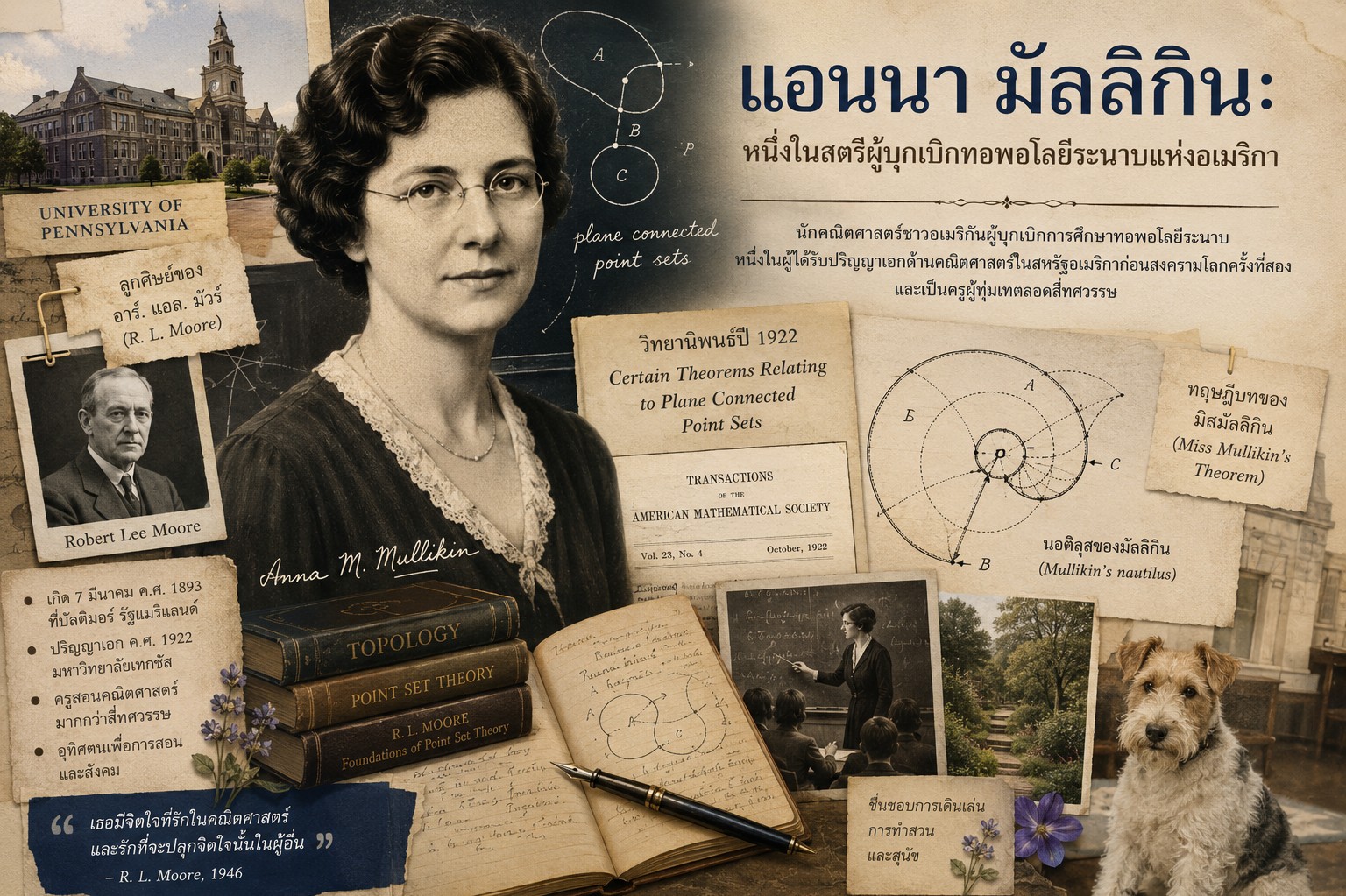
Anna Mullikin: One of the pioneering women in planar topology of America
On August 24, 1975, in Philadelphia, Pennsylvania, Anna Margaret Mullikin, an American mathematician, passed away at the age of 82. She was one of the very few women to earn a Ph.D. in mathematics in the United States before World War II and was one of the early researchers pioneering the study of point set theory, particularly plane topology.
From Baltimore to R.L. Moore's classroom
Mallikin was born on March 7, 1893, in Baltimore, Maryland. She was the youngest of four siblings in a family that ran a leather business. She graduated with a bachelor's degree from Goucher College in Towson, Maryland, in 1915, and demonstrated talent in mathematics from her final year of study by successfully solving a geometry problem published in the American Mathematical Monthly. After graduation, she taught at several private schools, including Science Hill School in Kentucky and Mary Baldwin Seminary in Virginia.
In 1918, Mallikin traveled to pursue graduate studies at the University of Pennsylvania in Philadelphia, where she attended the classes of Robert Lee Moore, a renowned topologist who developed the famous 'Moore Method' of teaching, which emphasized students discovering and proving theorems on their own rather than traditional lecturing. Mallikin became Moore's third student, and when Moore moved to teach at the University of Texas in 1920, Mallikin followed to continue her studies under his supervision.
A thesis that has received international attention
Mullikin received her Ph.D. in 1922 with a dissertation entitled “Certain Theorems Relating to Plane Connected Point Sets,” which was published in the journal Transactions of the American Mathematical Society in the same year. This work attracted significant attention in the mathematical community because it was connected to the research of Sigismund Janiszewski, a Polish mathematician who had previously published a similar work in Polish. Mullikin's dissertation also played an important role in bridging academic communication between Polish and American mathematicians in the early 20th century. Her work contains key theorems that later became known as “Miss Mullikin’s Theorem,” along with a well-known illustration referred to as the “Mullikin’s nautilus.”
A teacher who has dedicated himself for four decades
Despite her outstanding research potential, Mallikin chose the path of a high school teacher in Pennsylvania for over four decades. Although most of her students were unaware of her past research, and some didn't even know she had a Ph.D., they experienced firsthand learning from a sharp and serious mathematical mind. Mallikin had a special talent for identifying and nurturing students with remarkable mathematical abilities. She taught with careful and systematic attention, while also tailoring lessons to the capabilities of each student. One of her students was Mary-Elizabeth Hamstrom, who later became a renowned geometric topology mathematician.
In 1946, Moore still remembered Mallikin and sent his regards to her in a letter, reflecting that even after a long time, this great teacher still valued this student. During World War II, Mallikin also dedicated herself to Civilian Defense work, and in 1952, Goucher College awarded her the Outstanding Alumna Award to honor her achievements.
The later life and the legacy left behind
Mallikin never married and had no children. She lived a simple life, enjoying walks, gardening, and keeping dogs. Although her family had all passed away before her, and her own health was not very strong in her final years, she still maintained a positive attitude and always welcomed visitors with pleasure. In 1962, at the age of 69, she was diagnosed with arteriosclerosis, which limited her activities and caused her to spend the last 13 years of her life in a care facility, before passing away from a stroke.
The story of Anna Mullikin serves as a reminder of the value of mathematicians who dedicate their lives to teaching rather than academic fame. Although her name is not as widely known as other mathematicians of her time, her pioneering work in plane topology is still mentioned in the history of American mathematics and serves as proof of the important role of women in laying the foundations of modern mathematics, even in an era when opportunities for them were still limited.