

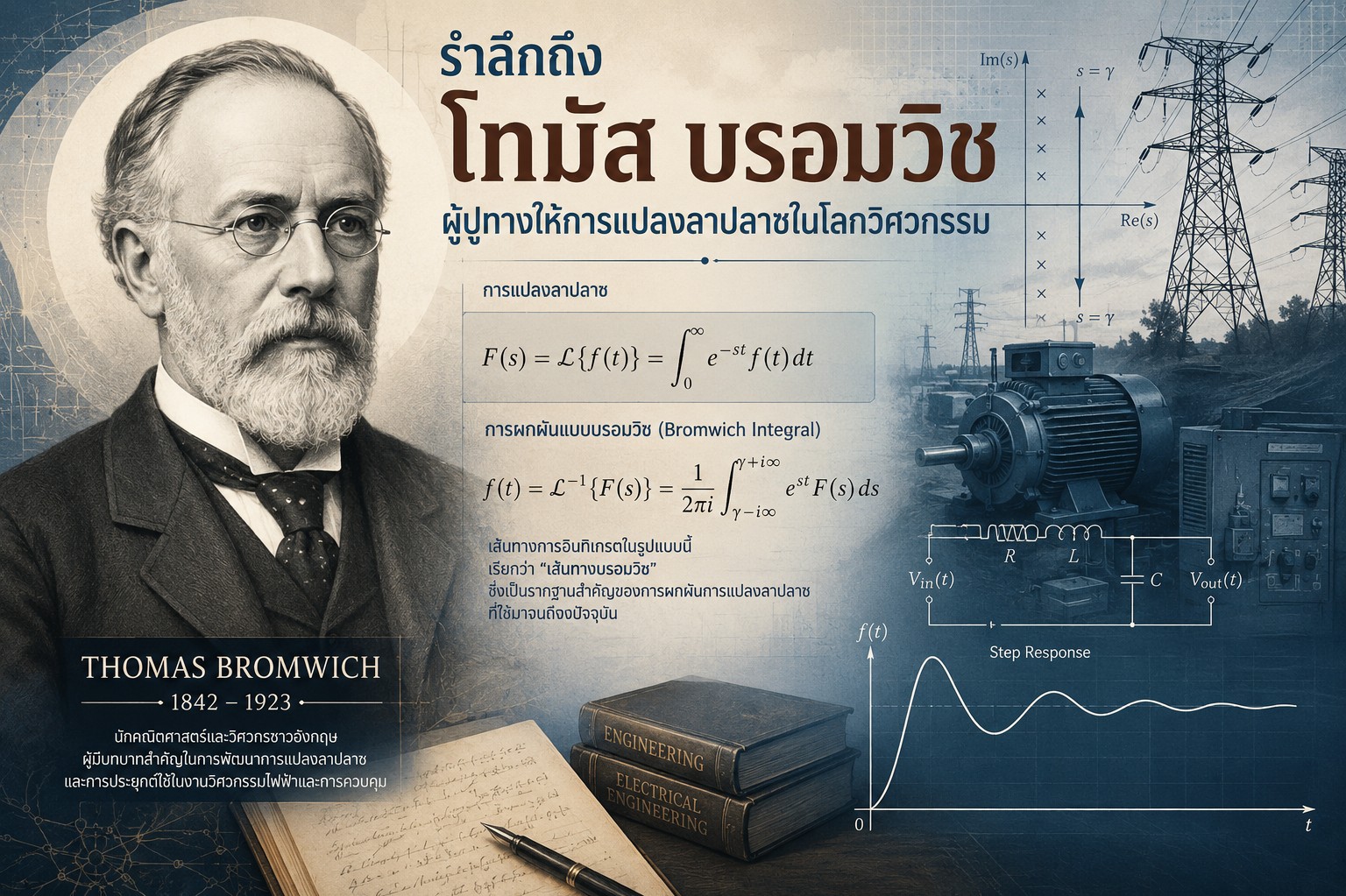
Remembering Thomas Bromwich: The Pioneer of Laplace Transform in the Engineering World
On August 24, 1929, in Northampton, England, Thomas John I’Anson Bromwich, an English mathematician, passed away at the age of 54 after struggling with mental illness believed to have resulted from years of overwork. He left behind work that laid important foundations for the theory of infinite series and transformation techniques that are still widely used in modern engineering.
From Wolverhampton to South Africa and back to Cambridge
Bromwich was born on February 8, 1875, in Wolverhampton, England. His father was a wool merchant. In his youth, his family emigrated to South Africa, where he completed his secondary education at a high school in Durban between 1888 and 1892 before returning to England to study at St John's College, University of Cambridge, in 1892, the same year that E. T. Whittaker, another famous mathematician, also began studying there. Although he did not receive a scholarship upon entry, Bromwich surprised everyone by graduating as a Senior Wrangler in 1895.
After receiving a fellowship at St. John's in 1897, Bromwich left Cambridge to hold a professorship in mathematics at Queen's College, Galway, Ireland in 1902, before returning to Cambridge again in 1907 to take up a fellowship and a permanent lecturer position at St. John's. He received a Doctor of Science degree in 1909 and was elected a Fellow of the Royal Society of London in 1906, as well as serving as Vice President of the Royal Society in 1919 and 1920.
Pioneer of the theory of infinite series
During his time working in Galway, Bromwich devoted himself seriously to research on infinite series. His most important work in this field is a book An Introduction to the Theory of Infinite Series Published in 1908, which developed from the lectures on analysis that he taught in Galway, G. H. Hardy, a great mathematician, described this book as undoubtedly an excellent book, with unique characteristics and distinction that immediately convey it was written by an extraordinary mathematician. This book was published in a second edition in 1926 and has continued to be republished up to the present.
Connect Heaviside calculus with rigorous mathematics
The work that made Bromwich's name most widely known today is his contribution to explaining Oliver Heaviside's "operator calculus," a technique that is very useful in practice but was heavily criticized by pure mathematicians for lacking mathematical rigor. Bromwich demonstrated that Heaviside's operators could be rigorously explained using contour integrals, which later became known as Bromwich integrals and became an essential tool for performing the inverse Laplace transform.
This technique was first used by Bromwich in 1899 and was independently discovered later by H. M. Macdonald. Bromwich formally presented this method in 1919 and also used the same technique as a fundamental basis for research on the scattering of plane electromagnetic waves when they strike a sphere. The Bromwich Laplace transform and integral became indispensable basic tools in electrical engineering, control systems, and modern circuit analysis up to the present day.
Work in algebra and electromagnetism
Apart from infinite series and operator calculus, Bromwich also had significant work in quadratic and bilinear forms, which was published in a book. Quadratic Forms and Their Classification by Means of Invariant Factors In 1906, he introduced Kronecker's concepts to English readers for the first time. Influenced by George Stokes, Bromwich also made significant contributions to the mathematics of electromagnetism and many other fields, including the interesting application of mathematical principles to lawn tennis.
A later life full of dedication
Bromwich produced the best work of his life before the age of 33, and Hardy once observed that it might have been due to the intense dedication he gave to teaching and administrative work later on, including teaching, grading exams, and private tutoring, which, although it made him one of the most famous mathematics teachers at Cambridge at the time, also had a severe impact on his mental health in his later years, ultimately leading to his death.
Although Thomas Bromwich's life ended tragically, his academic legacy, including his textbooks on infinite series and Bromwich integrals for inverse Laplace transforms, remains an essential tool used by mathematicians and engineers around the world every day to this day, nearly a century after his passing.