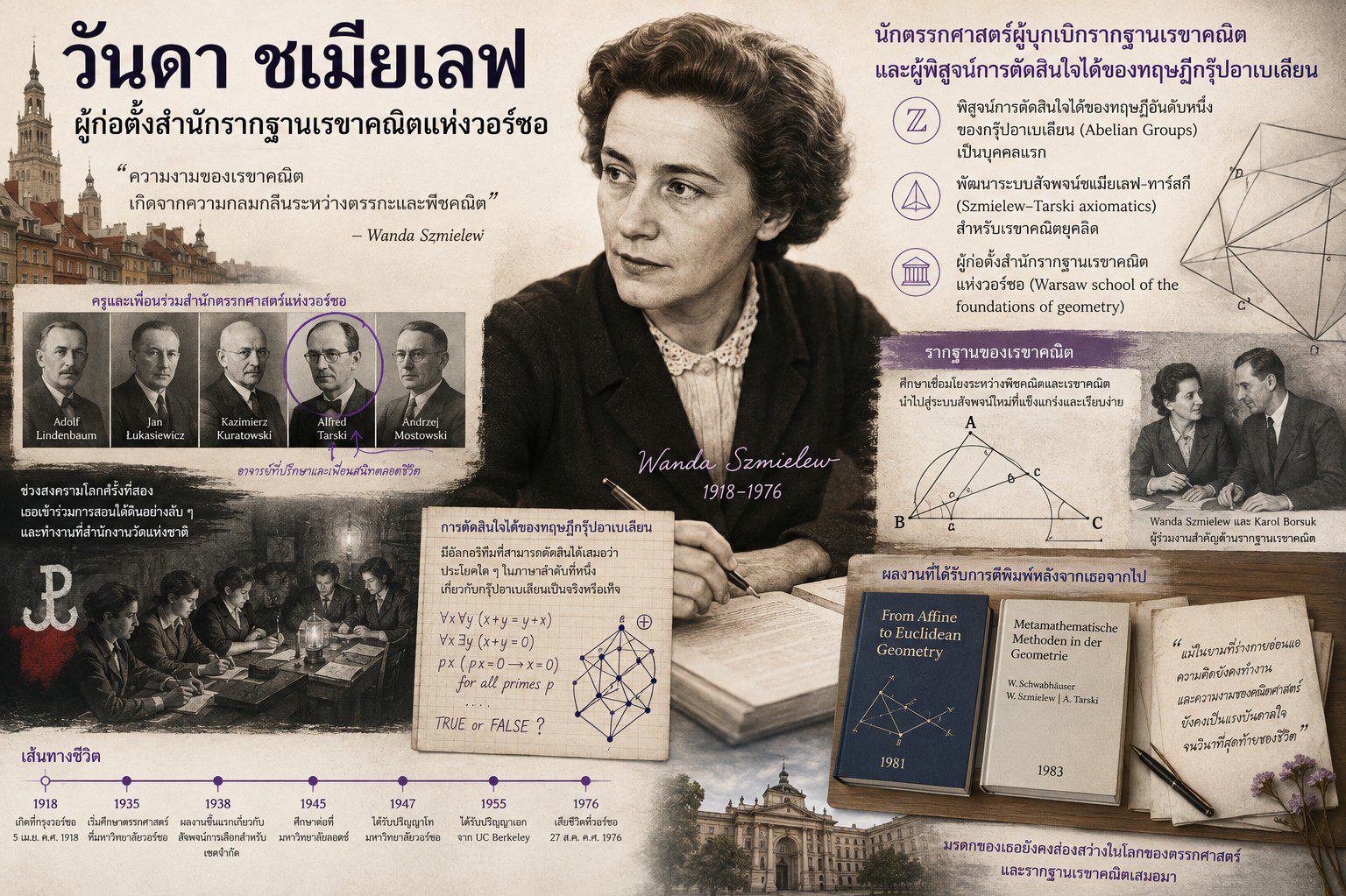
Wanda Szmielew: Founder of the Warsaw School of Geometry Foundations
On August 27, 1976, in Warsaw, Poland, Wanda Szmielew, a Polish mathematical logician, passed away from cancer at the age of 58. She left behind work that laid an important foundation for mathematical logic and algebraic geometry. She was one of the few women to have a prominent role in the Warsaw School of Logic.
From Montlac to Schmeilev
Shmielew was born on April 5, 1918, in Warsaw under the original name Wanda Montlak, the daughter of David Montlak and Bronisława, his wife. After completing her secondary education in 1935, she married Boris Shmielew and took her husband's surname. In the same year, she began studying at the University of Warsaw to study mathematical logic under the instruction of Adolf Lindenbaum, a student of Wacław Sierpiński, Jan Łukasiewicz, Kazimierz Kuratowski, and Alfred Tarski, who at that time was only an assistant to Łukasiewicz but later became both her advisor and lifelong close friend. Her classmates in mathematical logic at that time included Andrzej Mostowski, who later also became a leading logician in Poland.
Chmielew produced her first significant result in 1938 concerning the axiom of choice for finite sets, but her studies at the University of Warsaw were interrupted when World War II broke out. When Nazi Germany closed most educational institutions in Poland, Chmielew did not give up and secretly participated in underground teaching despite being aware of the potential dangers. She also worked as a metrology officer at the National Office of Weights and Measures during the war.
Decidability prover of Abelian group theory
After the war ended, Chmielew continued her studies at the University of Łódź in 1945 before returning to study at the University of Warsaw, where she received her master's degree in 1947 with a thesis entitled 'The Completeness of Abelian Group Theory with No Cyclic Members.' She then went on to pursue a PhD at the University of California, Berkeley, under the supervision of Tarski, who had by then moved to work in the United States. She received her doctorate in 1955 with a thesis on 'Elementary Properties of Abelian Groups.'
Shmielew's most famous work is being the first person to prove the decidability of the first-order theory of abelian groups. This work showed that there is an algorithm that can always decide whether any sentence about abelian groups written in first-order language is true or false. This result became an important work in model theory, and later the mathematicians Eklof and Fischer proved the same result again using more standard model theory techniques in 1972.
The pioneer of the foundations of Warsaw geometry
After returning to Warsaw as an assistant professor, Szmielew's interests shifted toward the foundations of geometry. In 1955, she co-published an important textbook in this field with Karol Borsuk, which was translated into English in 1960. Throughout 1970-1974, she published significant works on the foundations of Euclidean geometry, using the new Szmielew-Tarski axiomatic system. Her research sought to find connections between algebra and geometry, leading to stronger and simpler geometric-theoretical representations. She was recognized as the founder of the Warsaw school of the foundations of geometry.
The final work amidst the battle with a serious illness
In 1974, even while seriously ill with cancer, Schiemelef decided to write a book presenting her own approach to the foundations of geometry, which at that time had developed in a direction quite different from Tarski's perspective. Maria Mossinska, her colleague, recounted that although she could no longer perform university duties, Schiemelef continued to work intensely throughout the last two years of her life. This book grew beyond the initial framework, but by May 1976, it was clear that she did not have enough time or strength to complete this work.
Even though she was seriously ill, Tarsky still worried about her and took care of her closely, helping with buying a car and sending her money to go on a vacation to Italy. Her unfinished works were published after her death, including the book. From Affine to Euclidean Geometry in 1981 and Metamathematische Methoden in der Geometrie which was co-written with Wolfgang Schwabhauser and Alfred Tarski, published in 1983
Wanda Szmielew's academic legacy remains remembered in the fields of mathematical logic and the foundations of geometry, both as the prover of the decidability of Abelian group theory and as the founder of a new approach to studying the foundations of geometry that continues to influence later generations of mathematicians to this day. It is a testament to the steadfast dedication of a scholar who worked continuously even during the most difficult times of life.