John Kingman: The originator of the Coalescent theory, a fundamental foundation of population genetics
In the field of probability theory and statistics in England, there is a mathematician whose work transcended the boundaries of pure mathematics to become a fundamental tool of another discipline entirely. That is Sir John Frank Charles Kingman, born on August 28, 1939, in Beckenham, Kent, England.
Early life and academic path
Kingman grew up in a family that placed great importance on education. His paternal grandfather had been a coal miner in Somerset and intended for his descendants to receive a good education so that they would not have to continue working in the mines. As a result, Kingman's father pursued his studies and earned a PhD at the University of Bristol. Kingman attended Christ’s College School in Finchley before receiving a scholarship to study mathematics at Pembroke College, University of Cambridge, in 1956. After graduating in 1960, he began doctoral research under the supervision of Peter Whittle, studying queueing theory, Markov chains, and regenerative phenomena.
Kingman held several important academic positions at the University of Sussex, the University of Oxford (as Wallis Professor of Mathematics), and later served as Vice-Chancellor of the University of Bristol from 1985 to 2001 before returning to Cambridge as N. M. Rothschild and Sons Professor of Mathematical Sciences and Director of the Isaac Newton Institute from 2001 to 2006.
Coalescent Theory: From Probability Theory to Population Genetics
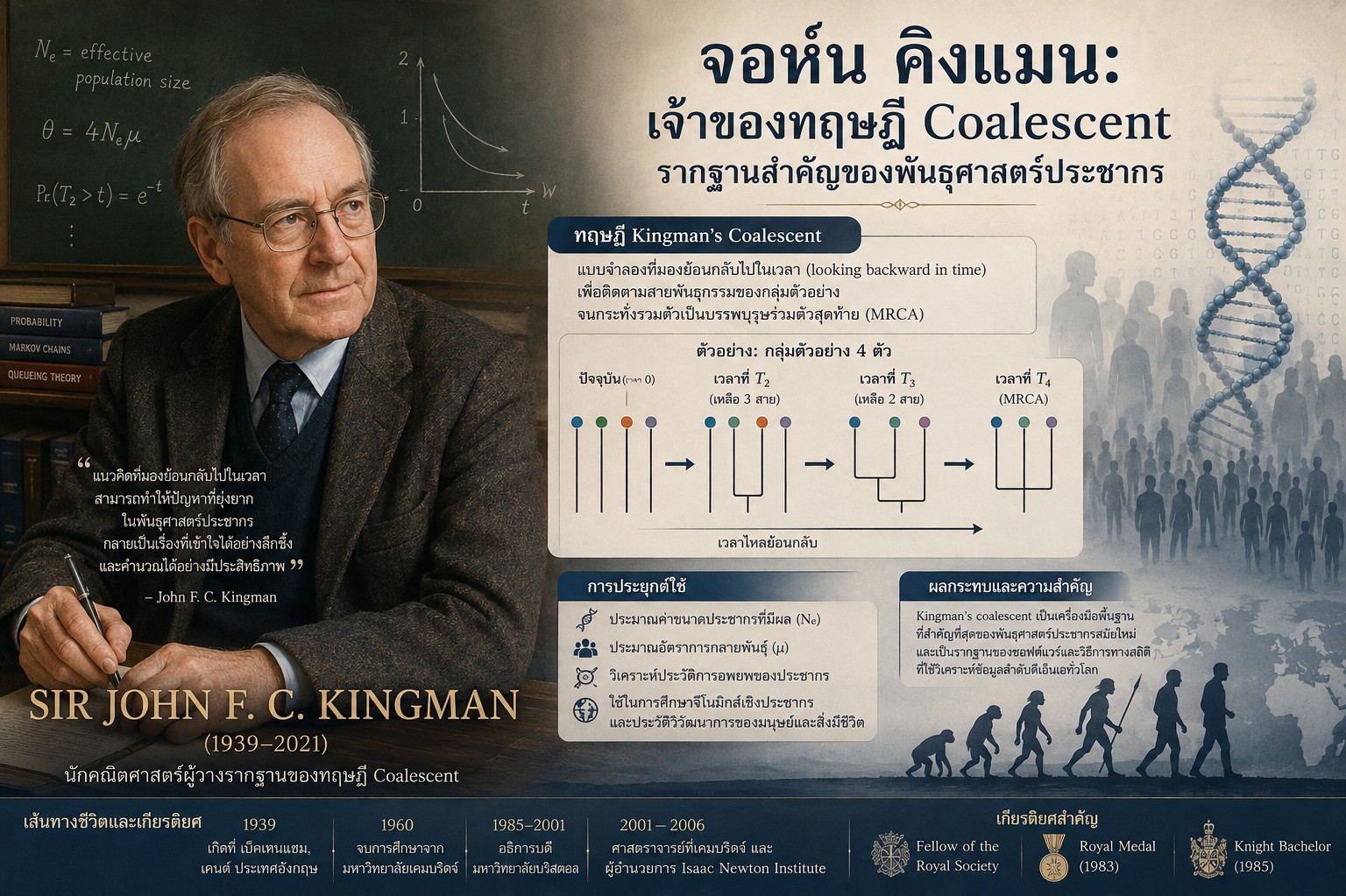
The work that made Kingman's name best known outside the field of mathematics is the Kingman’s coalescent theory, which he developed in the early 1980s while serving as Chairman of the Science and Engineering Research Council. This theory is a mathematical model that looks backward in time to explain how members of a population share common ancestry.
The main concept of coalescent theory is to trace the genetic lineages of a sample from the current population backward in time until all genetic lineages "coalesce" into the most recent common ancestor. This approach differs from traditional population genetics models, which usually look forward in time, and makes mathematical calculations related to genetic diversity much simpler and more efficient.
Importance to modern population genetics
Kingman’s coalescent theory has become one of the most fundamental tools in modern population genetics. Researchers use this model to analyze DNA sequence data in order to estimate evolutionary parameters such as effective population size, mutation rates, and historical population migration patterns. This theory is also a key foundation for software and statistical methods used in population genomics studies, including research on the evolutionary history of humans and other organisms, which is widely conducted today.
Other works and honors
Apart from the coalescent theory, Kingman also made significant contributions in probability theory and statistics, such as Kingman’s subadditive ergodic theorem and work in heavy traffic approximation. He received numerous academic honors, including being a Fellow of the Royal Society, receiving the Royal Medal in 1983, and being awarded the title of Knight Bachelor in 1985.
Kingman's work is a clear example of how pure mathematical theory can become an indispensable tool in other sciences, and his coalescent theory remains central to research in population genetics and evolution to this day.