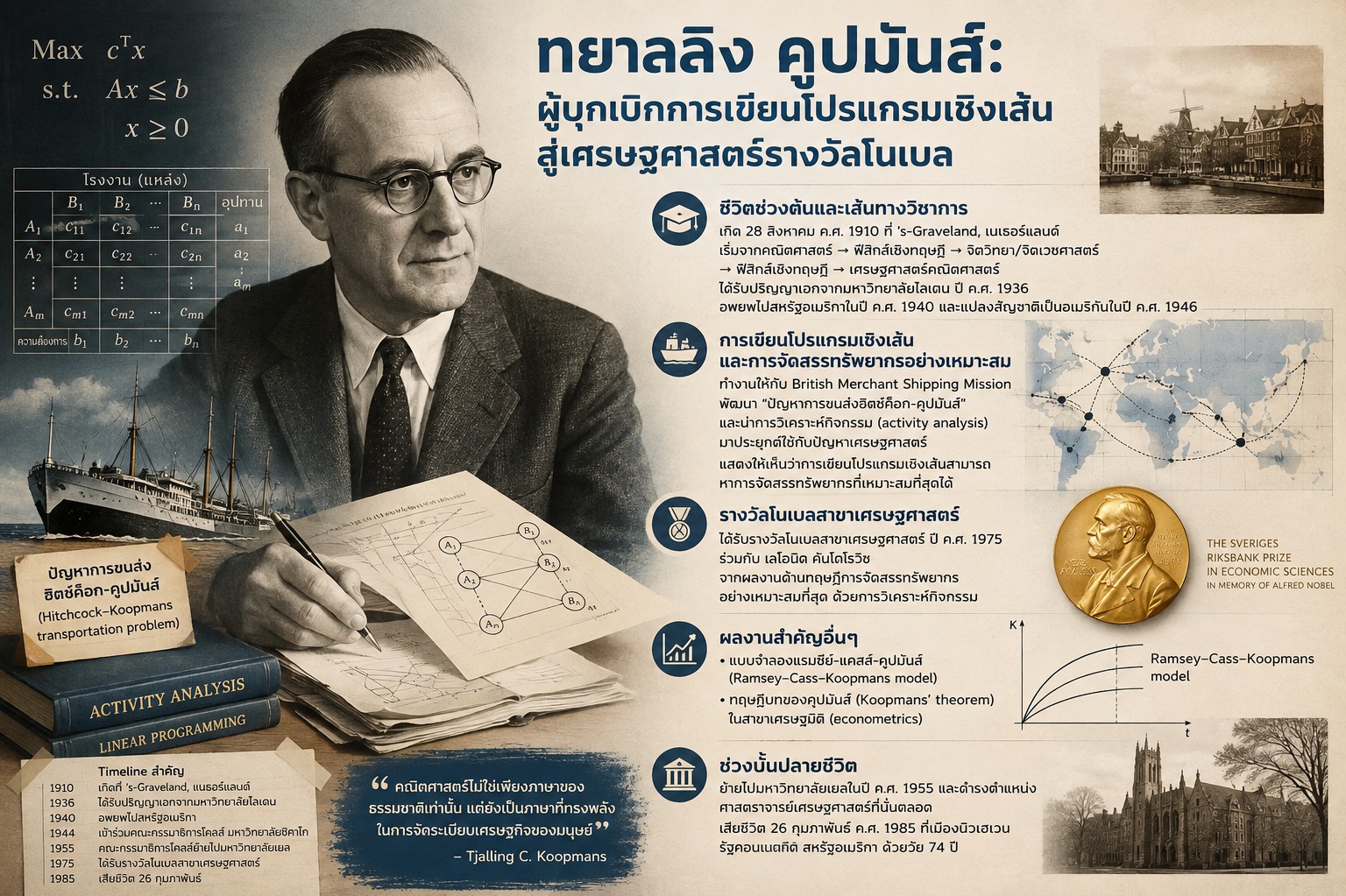
Tjalling Koopmans: Pioneer of Linear Programming to Nobel Prize Economics
Among the thinkers who deeply connected mathematics with economics, one name stands out particularly in the area of applying mathematical techniques to systematically solve resource allocation problems: Tjalling Charles Koopmans. He was born on August 28, 1910, in the village of 's-Graveland near the city of Hilversum, Netherlands.
Early life and diverse academic path
Coupmans began studying at Utrecht University at the age of only 17, starting in the field of mathematics before switching to theoretical physics three years later. His academic path is interesting in that he went through mathematics, psychology, psychiatry, and theoretical physics before eventually turning his interest to mathematical economics under the supervision of Jan Tinbergen, the Dutch economist who became the first Nobel laureate in Economics in 1969. Coupmans received his PhD from Leiden University in 1936 with a dissertation on the linear regression analysis of economic time series.
In 1940, when World War II broke out in Europe, Koopmans emigrated to the United States, and in 1946 he became an American citizen through naturalization.
Linear programming and proper resource allocation
During World War II, Koopmans worked for the British Merchant Shipping Mission, where he was responsible for planning shipping routes to minimize costs. This work led him to develop a concept later known as the 'Hitchcock–Koopmans transportation problem,' which is one of the key case studies in linear programming.
In 1944, Koopmans joined the Cowles Commission for Research in Economics at the University of Chicago and expanded a technique called 'activity analysis' to apply to a variety of economic problems. He showed that with certain efficiency criteria, economists can draw important conclusions about the optimal price system through linear programming, connecting mathematical tools developed for logistics problems with the systematic theory of economic resource allocation.
Nobel Prize in Economics
It was this work on the theory of optimum allocation of resources that earned Koopmans the Nobel Prize in Economics in 1975, along with Leonid Kantorovich, a Soviet mathematician who independently developed a similar concept. Both were recognized for their work showing how a rational method, called activity analysis, can be used to allocate resources to achieve predetermined economic objectives at the lowest possible cost.
In addition, Koopmans also has other significant works that still bear his name today, such as the Ramsey–Cass–Koopmans model, which is an important model of economic growth in macroeconomics, and Koopmans’ theorem in the field of econometrics.
the final stage of life
After the Coles Commission moved to Yale University in 1955, Koopmans also moved there and held the position of professor of economics throughout the remainder of his career. He passed away on February 26, 1985, in New Haven, Connecticut, USA, at the age of 74, leaving behind an academic legacy that deeply connected applied mathematics with economics, which remains a fundamental foundation of economic theory and operations research to this day.